

Rolex Cosmograph Daytona 116519
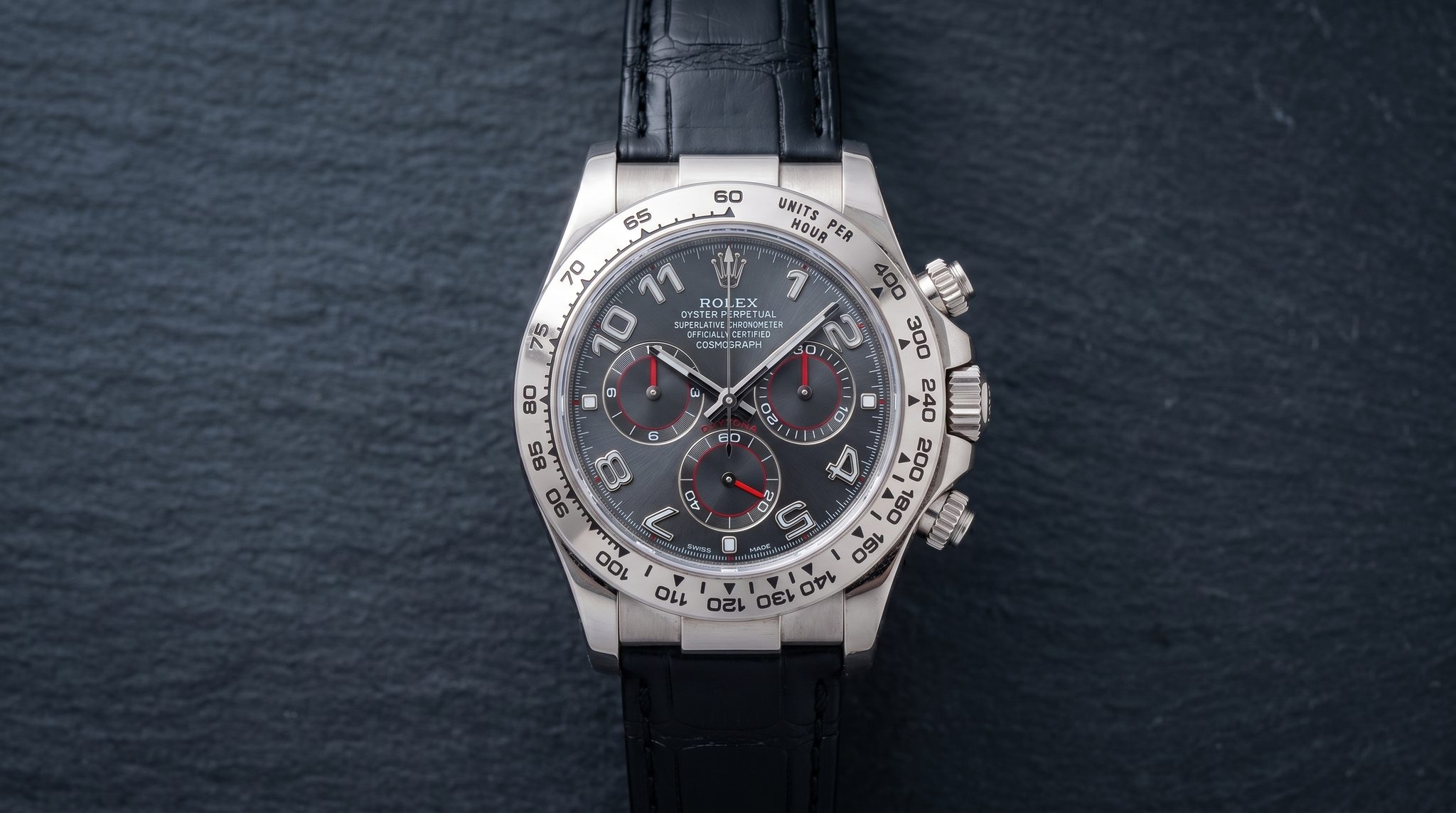
The Rolex Cosmograph Daytona 116519 is the white‑gold, strap‑wearing face of Rolex’s 2000-era in‑house chronograph shift, a reference defined as much by its stable metal‑bezel chassis as by the unusually wide spread of factory dial executions.
- Production
- c. 2000–mid‑2010s
- Case
- 18k white gold
- Diameter
- 40 mm (nominal)
- Thickness
- 12.3 mm
- Lug span
- 47.2 mm
- Lug width
- 20 mm
- Bezel
- White‑gold tachymeter
- Crystal
- Sapphire
- Water res.
- 100 m
- Movement
- Cal. 4130
- Power
- ~72h
- Chronometer
- Yes (COSC)
The Rolex Cosmograph Daytona 116519 was produced from about 2000 to the mid-2010s.
- Production years
- c. 2000–mid‑2010s
- Replaced
- 16519
- Replaced by
- 126519LN
- Movement
- Cal. 4130
The Rolex Cosmograph Daytona 116519 is a reference that proves how much variety Rolex could build without changing the fundamentals. In the early 2000s it could be ordered as a brightly colored “Beach” Daytona with Roman numerals, matching lizard strap, and hands filled with black lacquer instead of luminous material, yet it remained the same 18k white‑gold, metal‑bezel Daytona powered by the new in‑house caliber 4130.
That combination is the point of the 116519 in the Daytona lineage. It arrived alongside the steel ref. 116520 around 2000 as the white‑gold strap expression of the six‑digit, 4130 era, replacing the Zenith‑movement white‑gold strap ref. 16519. Rolex kept the construction conservative, a fixed engraved tachymeter bezel in white gold, 100 m water resistance, and a leather strap with a white‑gold deployant, while rotating dial executions from conventional luminous sports dials to exotic materials.
For wear, the numbers explain why it sits differently than its precious‑metal status suggests. Retailer listings call it 40 mm, but measured examples land closer to about 38.5 mm across, with a 12.3 mm thickness and 47.2 mm lug to lug. The result is a modern Daytona that reads compact on the wrist, with the weight and finishing of white gold and the flexibility of a strap, a format Rolex used as a platform for some of the reference’s most distinct factory dials.
“A stable white‑gold Daytona built around the 4130, with the dials doing the talking, from conventional sports layouts to the no‑lume “Beach” quartet.”
Rolex Cosmograph Daytona 116519 production years: c. 2000–mid‑2010s
Ref. 116519 belongs to the moment Rolex reset the Daytona’s mechanics. Around 2000, the six‑digit family arrives with caliber 4130, Rolex’s first fully in‑house automatic chronograph, and the 116519 takes on the role of white‑gold Daytona on a strap, replacing the Zenith‑based ref. 16519.
The movement matters here because it is the anchor for everything else. Technical breakdowns describe the 4130 as a 4 Hz chronograph with about 72 hours of power reserve, enabled in part by a simplified architecture with 201 parts, about 20 percent fewer than the preceding Zenith-based caliber 4030. It is also described with a column wheel and a free‑sprung balance under a full balance bridge, and it is COSC-certified.
Rolex then does something that is easy to miss if the watch is treated as a single configuration: it keeps the external construction broadly consistent for years, the white‑gold case, engraved metal tachymeter bezel, and leather strap format, while cycling dial executions. The clearest early marker is the “Beach” quartet introduced in the 2000 lineup, which deliberately abandons luminous material in favor of black lacquer on the hands and certain markers, paired with Roman numerals and matching lizard straps.
The zoomed‑out view is that the 116519 shows the six‑digit Daytona era being worked out in real time. The movement and case platform are modern and stable, but Rolex experiments at the edges of what a Daytona dial can be, from conventional luminous sports layouts to hardstone and mother‑of‑pearl, before the line’s late 2010s shift toward Cerachrom bezels and Oysterflex straps under the closely related 116519LN.
- c. 2000IntroducedMetal bezel, leather strap, 4130
- 2000Beach lineupBlack‑lacquer hands, lizard strap
- c. 2006Measured case12.3 mm thick, 47.2 mm L2L
- c. 2008Dated example116519 on strap, metal bezel
- 2000 – 2016Generation spanSix‑digit 4130 references
- 2018Role shiftBlack ceramic bezel, Oysterflex
- 2023Successor era1265xx family on Oysterflex
116519 against its neighbours
The 116519 makes the most sense when it is framed as a bridge between two Rolex chronograph eras. Ref. 16519 is the white‑gold strap Daytona of the Zenith period, while the later 126519LN represents the post‑2023 update in the same white‑gold, black‑bezel Oysterflex concept. Set against them, the 116519 reads as the long-running 4130 platform that carried Rolex from leather and metal bezels into the ceramic-and-Oysterflex language that followed.
16519 Predecessor c. 1990s–2000 | This reference 116519 Rolex · focal c. 2000–mid‑2010s | 126519LN Successor c. 2023–present | ||
|---|---|---|---|---|
| Production | c. 1990s–2000 | 2000–2016 | c. 2000–mid‑2010s | c. 2023–present |
| Case | 18k white gold | Stainless steel | 18k white gold | 18k white gold |
| Diameter | 40 mm | 40 mm (nominal) | 40 mm (nominal) | 40 mm (nominal) |
| Bezel | Metal tachymeter | Steel tachymeter | White‑gold tachymeter | Black Cerachrom |
| Water res. | 100 m | 100 m | 100 m | 100 m |
| Movement | Cal. 4030 | Cal. 4130 | Cal. 4130 | Cal. 4131 |
| Power | 52h | ~72h | ~72h | ~72h |
| Chronometer | COSC | COSC | Yes (COSC) | COSC |
Five dial generations across the run
The turquoise “Beach” is the easiest 116519 to spot from across a room because the dial is hardstone, not paint. Sources describe it as a turquoise hardstone dial paired with a matching turquoise lizard leather strap, and it carries the shared Beach architecture: applied white‑gold Roman numerals, rectangular markers at 3, 6, and 9 filled with black lacquer, and hands filled with black lacquer rather than luminous compound. In hand, the identifying tell is the absence of lume where a Daytona collector expects it, the hands and those black rectangles stay dark instead of charging under light.
What to check before buying a 116519
Buying a Rolex 116519 is less about catching a single “correct” configuration than confirming a coherent factory execution. The reference spans a long 4130-era window and was offered with many dials, so the same case and bezel can legitimately front very different watches, from luminous sports layouts to the early Beach dials that intentionally delete lume.
The most expensive mistakes are usually simple ones: a listing that collapses 116519 and 116519LN into one description, a watch missing its correct Rolex deployant and strap, or a dial that does not match any known factory execution for the reference. Condition also carries extra weight on a precious‑metal Daytona, since polishing can soften the white‑gold case geometry and dial damage is difficult to forgive on exotic materials.
In practice, the 116519 suits collectors who want the modern Daytona’s in‑house mechanics and water resistance, but prefer the flexibility and discretion of a strap over a full gold bracelet. The measured proportions, 12.3 mm thick and 47.2 mm lug to lug on a documented example, explain why it wears compact, while the dial range, especially the early 2000 Beach quartet, explains why two watches sharing the same reference number can feel like entirely different Daytonas.
Rolex Cosmograph Daytona 116519 price and value
A Rolex Cosmograph Daytona 116519 sells for about $35,000 at the median, typically $20,500 to $52,000 across 63 comparable sales.
Rolex Cosmograph Daytona 116519 for sale
Indicative figures from recent dealer, auction, and Grey Market sales (updated this week). Every watch is verified before it sells here.
Each point is a recent dealer or auction sale, banded to an indicative figure. The range shown is not a valuation.
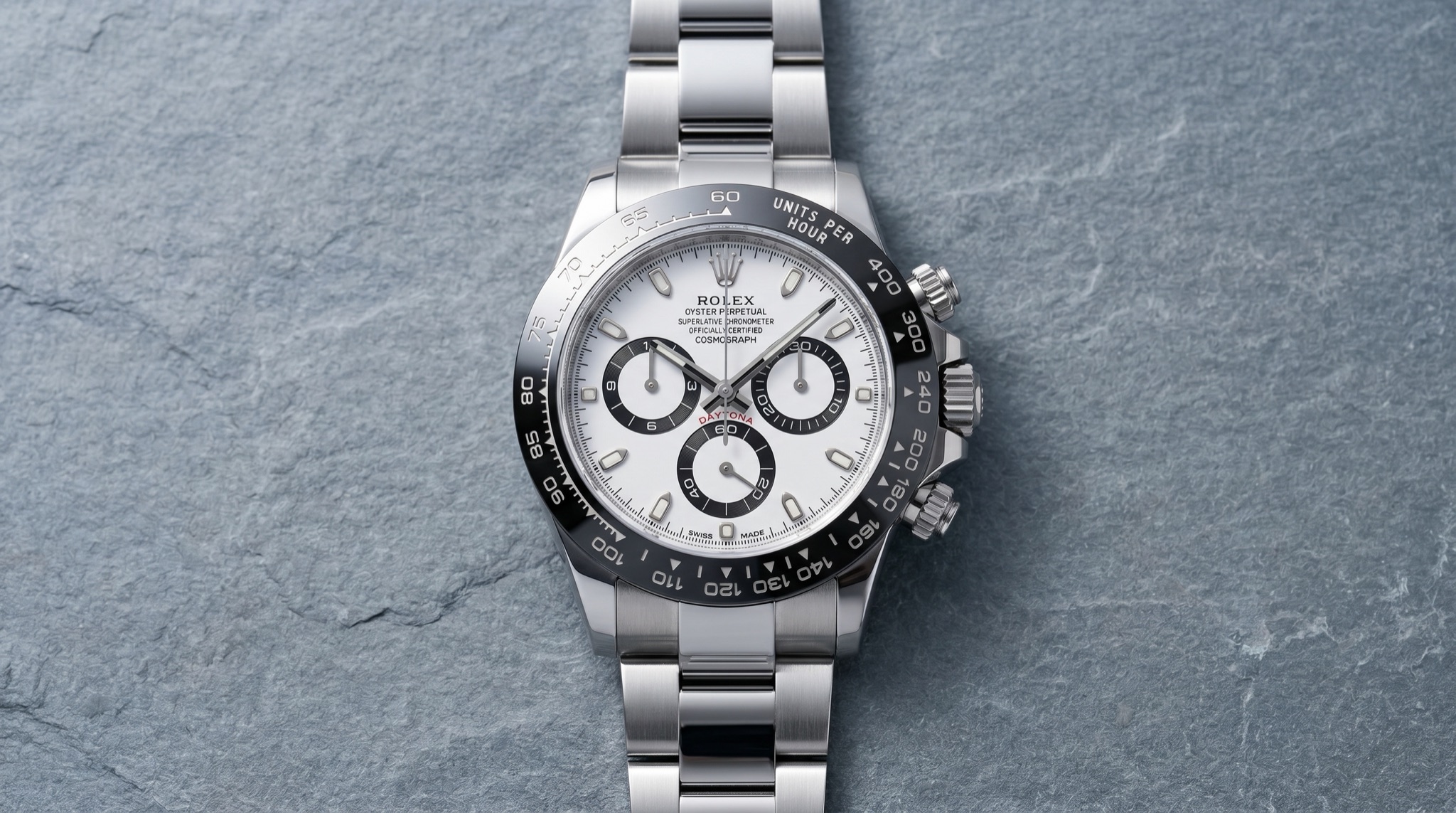
Adjacent in the Cosmograph Daytona family
Common questions about the 116519
Evidence-backed dated examples place the Rolex Cosmograph Daytona 116519 in production from at least 2000 through at least 2008, and it sits within the broader 2000–2016 six‑digit Daytona generation powered by caliber 4130. Rolex does not publish a single official discontinuation year for this specific reference, so the safest description is c. 2000 to sometime in the 2010s, prior to the late‑2010s 116519LN ceramic-and-Oysterflex configuration.
- Rolex | Reference 116519 Daytona | A white gold automatic… (Sotheby’s)sothebys.com
- Rolex Certified Pre-Owned Daytona 116519 (Tourneau)tourneau.com
- Pre-Owned Rolex Cosmograph Daytona 116519 (The 1916 Company, CPO)the1916company.com
Show 7 more
- Rolex Certified Pre-Owned Cosmograph Daytona in White Gold (Bucherer)bucherer.com
- Rolex Daytona 116519 White Gold (Tim Mosso / The 1916 Company video)youtube.com
- Rolex Cosmograph Daytona ref. 116519 (Wristcheck)wristcheck.com
- The complete history of the Rolex Daytona (41Watch)41watch.com
- A Complete History of the Rolex Daytona (Chrono Hunter)chronohunter.com
- Rolex "Beach" Daytona Ref. 116519 (Bucherer Curated Originals)bucherer.com
- Rolex product page: Cosmograph Daytona 126519LN (context for successor)rolex.com