

Rolex Datejust 116264

The Rolex Datejust 116264 is the last steel Turn-O-Graph, a 36 mm Datejust that hides its tool-watch intent in a white-gold, elapsed-time rotating bezel and loud red accents.
- Production
- c. 2004–2011
- Case
- Steel (Oyster)
- Diameter
- 36 mm
- Thickness
- 11.6–12.0 mm
- Lug width
- 20 mm
- Bezel
- Rotating, 18k WG
- Crystal
- Sapphire, Cyclops
- Water resist
- 100 m
- Movement
- Cal. 3135
- Power
- ~48h
- Chronometer
- Yes
- Lume
- Super-LumiNova
The Rolex Datejust 116264 is the Turn-O-Graph’s final act, a watch that takes the familiar 36 mm Datejust silhouette and gives it one last, very specific piece of purpose: an 18k white-gold bezel that actually rotates, with a 60-minute scale cut into its fluting. In a line better known for fixed bezels and quiet continuity, the 116264 is the Datejust that insists on being timed.
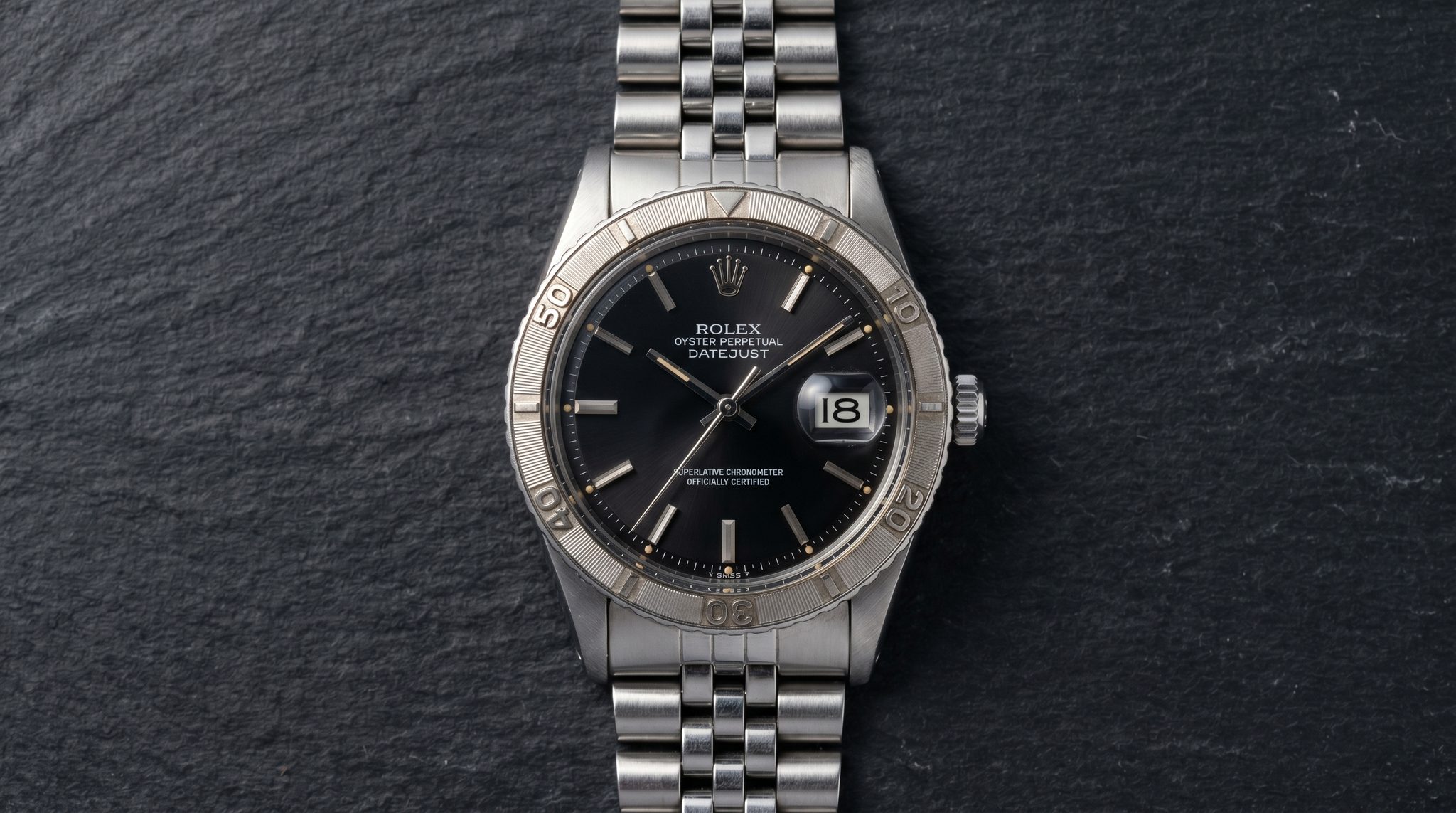
That insistence shows up in the details collectors repeat from memory: the seconds hand is red, the “TURN-O-GRAPH” signature is printed in red, and many examples pair them with a date wheel whose numerals are red as well. Those accents are not mere decoration. They are the visual cue that the fluted ring above the case is not the standard Datejust bezel, but a bidirectional timing bezel, a pilot-style feature that Rolex ultimately discontinued entirely when the Turn-O-Graph left the catalog around 2011.
Within the Datejust family, the reference sits in the last modern Turn-O-Graph generation introduced around 2004, built on an Oyster case with sapphire crystal and powered throughout by Rolex’s caliber 3135 (28,800 vph, 31 jewels, about 48 hours of power reserve). Its production window is best summarized as c. 2004–2011, with the caution that some listings date the latest examples to roughly 2009–2010 depending on how individual watches are interpreted. That short, late run is exactly why the 116264 reads today as a self-contained idea: a Datejust that briefly returned to timing-bezel utility, then vanished without a direct replacement.
“A Datejust that times things, and the last Turn-O-Graph Rolex ever built in steel.”
116264 across c. 2004–2011
The 116264 arrives late in the Turn-O-Graph story, and its defining feature is not a new movement or a size change, but a decision about what a Datejust bezel could be. On a standard Datejust, fluting is decorative and fixed. On the Turn-O-Graph 116264, the fluted ring is engraved with a 60-minute scale and designed to rotate bidirectionally, so the watch can time an interval in the simplest possible way: align the marker and read minutes off the bezel. The sources document the feature and its material clearly, an 18k white-gold rotating bezel on a steel case, but they do not document why Rolex chose to make this final generation look so close to a conventional fluted Datejust while keeping the functional scale.
Mechanically, the reference is unusually steady. Documented examples use Rolex caliber 3135 across the run, a high-beat 28,800 vph automatic with quickset date, 31 jewels, and about 48 hours of power reserve. That stability pushes the collector’s attention outward, onto what the watch communicates at a glance. The red seconds hand, red “TURN-O-GRAPH” script, and often the red date numerals are the 116264’s shorthand for the rotating-bezel idea, an aesthetic that makes the watch read sportier than most 36 mm Datejusts without leaving the Datejust’s comfort zone.
The one hard ending matters more than a dozen minor production tweaks: around 2011 Rolex dropped the Turn-O-Graph from the catalog and did not issue a direct successor reference. In retrospect the 116264 feels like a closed chapter within the Datejust line, a brief moment when Rolex offered a timing-bezel Datejust with modern construction, then returned the Datejust family to fixed-bezel simplicity.
- c. 2004Ref. debuts60-minute rotating fluted bezel
- c. 2004 – 2011Cal. 31353135 noted on service docs
- c. 2004 – 2011Red accentsRed “TURN-O-GRAPH” text
- c. 2004 – 2011Dial colorsBase dial color changes
- c. 2011Line endsNo later catalog examples
116264 against its neighbours
The 116264 makes the most sense when it is framed against the Turn-O-Graph it replaced and the two-tone siblings it launched alongside. The predecessor shows the same core concept, a Datejust with a rotating bezel, but in earlier case and bracelet architecture. The siblings show that Rolex treated the final Turn-O-Graph as a small family, with the steel 116264 as the most restrained expression of the idea.
16264 Predecessor c. 1988–c. 2000 | 116263 Closest sibling c. 2004–c. 2011 | 116261 Closest sibling c. 2004–c. 2011 | This reference 116264 Rolex · focal c. 2004–2011 | |
|---|---|---|---|---|
| Production | c. 1988–c. 2000 | c. 2004–c. 2011 | c. 2004–c. 2011 | c. 2004–2011 |
| Case | Steel | Steel + yellow gold | Steel + Everose gold | Steel (Oyster) |
| Diameter | 36 mm | 36 mm | 36 mm | 36 mm |
| Bezel | Rotating, WG | Rotating, YG | Rotating, RG | Rotating, 18k WG |
| Crystal | Sapphire | Sapphire, Cyclops | Sapphire, Cyclops | Sapphire, Cyclops |
| Water resist | 100 m | 100 m | 100 m | 100 m |
| Movement | Cal. 3135 | Cal. 3135 | Cal. 3135 | Cal. 3135 |
| Power | ~48h | ~48h | ~48h | ~48h |
| Chronometer | Yes | Yes | Yes | Yes |
| Lume | – | Super-LumiNova | Super-LumiNova | Super-LumiNova |
Six dial generations across the run
On the wrist, the white dial is the configuration that makes the 116264’s red accents feel most deliberate. The black minute track rings the outer edge, the applied baton markers catch light cleanly, and the red “TURN-O-GRAPH” line and seconds hand do the work of explaining the bezel. Many examples also pair the look with a date wheel whose numerals are red, turning the date into part of the watch’s identity rather than a separate window.
This dial appears throughout the reference’s documented life. Individual listings date white-dial watches to mid-2000s production, but no source ties the white dial to a specific sub-period or a documented “Mark” change. The differences collectors sometimes point to in fonts or spacing are visible in photos but are not anchored to dated documentation for this reference.
What to check before buying a 116264
Buying a Rolex Datejust 116264 is less about hunting an obscure movement or a fragile dial era than it is about protecting the one feature the watch was built around: the white-gold rotating bezel. Its fluting should look sharp, its 60-minute engraving should be clear, and the bezel should rotate properly. A 116264 with a non-rotating fluted bezel, or a bezel that has been polished until the facets go soft, has lost the very thing that separates it from an ordinary Datejust.
The second decision is honesty about configuration. Standard production dials are unified by the Turn-O-Graph signature in red, while the Japan limited variant is defined by green seconds hand and green date. Those visual tells matter more than a seller’s story, because the record for micro-variations like font spacing and rehaut engraving is not documented well enough to support confident “Mk” taxonomies.
The 116264’s appeal is that it wears like a familiar Datejust, 36 mm, sapphire crystal, 100 m water resistance, caliber 3135 reliability, yet it gives you one interactive tool feature that Rolex later removed from the lineup entirely. For the collector who wants a daily Rolex with a little friction against the rulebook, the last steel Turn-O-Graph is an easy watch to live with and a hard watch to mistake for anything else.
Rolex Datejust 116264 for sale
Indicative market value from recent dealer, auction, and Grey Market sales: median ≈ $6,800, with a typical $6,100–$7,500 range across 47 comparable sales (updated this week).
Each point is a recent dealer or auction sale, banded to an indicative figure. The range shown is not a valuation.
Adjacent in the Datejust family
Common questions about the 116264
The Datejust 116264 is best placed at c. 2004–2011. Some listings date the latest examples closer to 2009–2010 depending on how individual watches are interpreted, but the most defensible catalog-life window in the cited material is the mid-2000s through around 2011.
- The Rolex Datejust Turn-O-Graph 116264 | Gray & Sons Jewelersgrayandsons.com
- Rolex Datejust Turnograph Black Dial Red Hand Steel Mens Watch 116264swisswatchexpo.com
- Rolex Datejust Turnograph Blue Dial Oyster Bracelet Mens Watch 116264swisswatchexpo.com
Show 7 more
- Rolex Datejust Turnograph Blue Dial Jubilee Bracelet Steel Mens Watch 116264swisswatchexpo.com
- Rolex Turn-O-Graph Ultimate Guideswisswatchexpo.com
- Rolex Turn-O-Graph Certified Pre-Owned – Prices by Referencerlxcpo.com
- Rolex Oyster Perpetual Datejust Turn-O-Graph 116264 – Certified Pre-Ownedrlxcpo.com
- Rolex 116264 market overviewwatchcharts.com
- Rolex Datejust Turn-O-Graph 116264 on Chrono24 (reference results)chrono24.com
- Discontinued Rolex Watches: Models, References, and Morebobswatches.com