

Rolex Datejust 1625
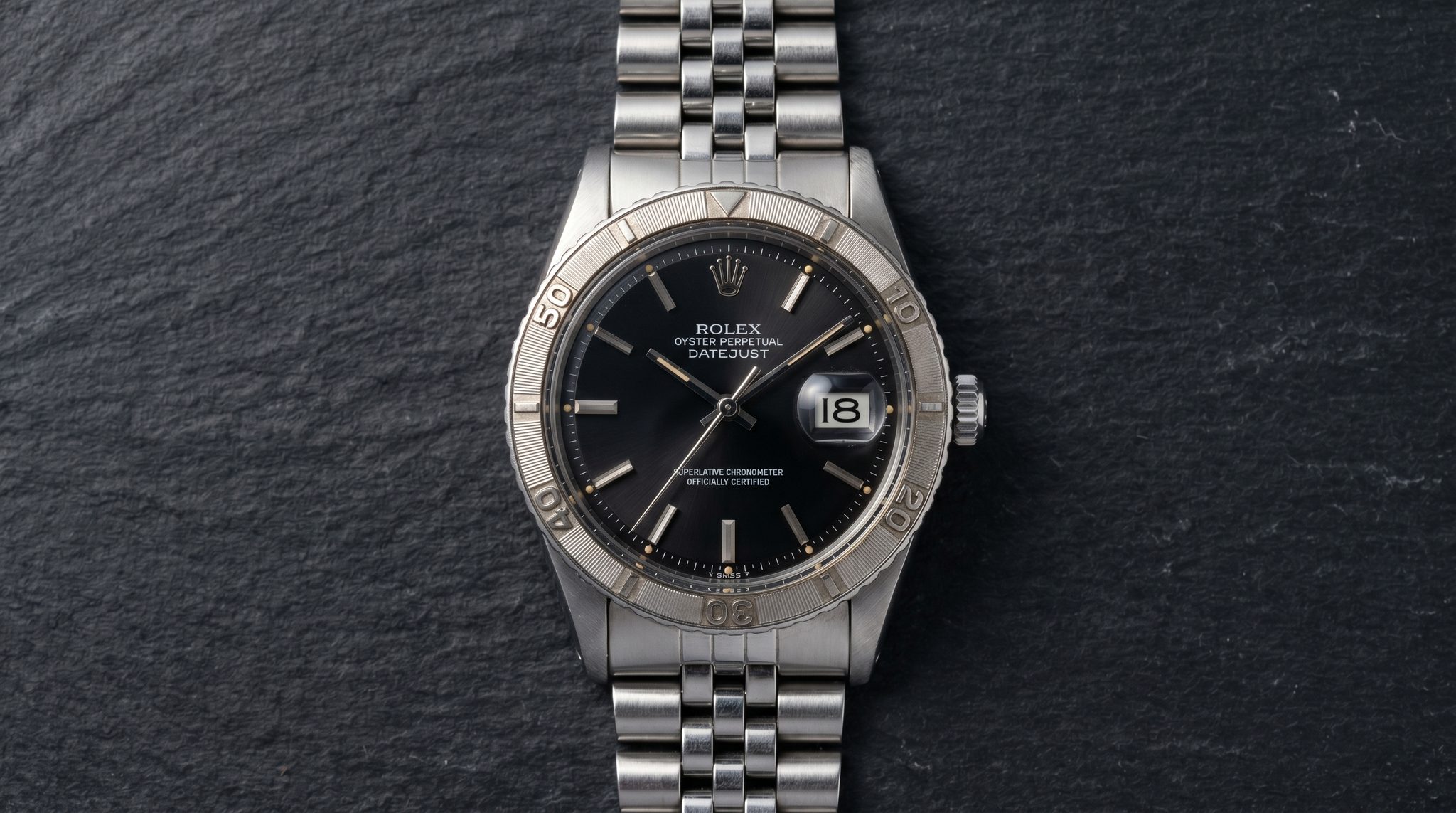
The Rolex Datejust 1625 is the Turn-O-Graph that fully settled into the Datejust collection, keeping the 36 mm Oyster Datejust format but adding a friction-fit rotating timing bezel that defines the line’s later references.
- Production
- c. 1959–1977
- Case
- Steel or 18k YG
- Diameter
- 36 mm
- Lug-to-lug
- 44 mm
- Bezel
- Rotating, friction-fit
- Crystal
- Plexiglass, Cyclops
- Water resist
- 10 ATM
- Movement
- Cal. 1570
- Power
- ~48h
- Chronometer
- Yes
- Lume
- Tritium (period)
The Rolex Datejust 1625 is the Turn-O-Graph that stopped feeling like an experiment and started reading like a mature Datejust variant, a 36 mm Oyster case with a rotating bezel that is held in place by a tight friction fit rather than clicks. That one physical detail, the smooth but forceful turn of the metal timing ring, sums up what the reference is: a Datejust made slightly more practical, without leaving the Datejust world.
Specialist histories generally place the Rolex 1625’s production from about 1959 to 1977. It arrives as the first Turn-O-Graph fully integrated into the Datejust line, and it sits as the direct ancestor of the later five-digit Datejust Turn-O-Graph references that replace it around 1977. In the Turn-O-Graph story, it follows the earlier four-digit and 6xxx-era rotating-bezel Datejust references such as 6309 and 6609, the watches that carried the early "Thunderbird" association in the United States.
In use, the 1625 behaves like a classic acrylic-crystal Datejust of its era, with a Cyclops date and chronometer-rated automatic movement, but it asks you to interact with the bezel. The scale is engraved in minutes, with numerals at the tens and marker hashes between, so the watch can time small, everyday intervals in a way a standard Datejust cannot. Collectors tend to care less about a rigid, sports-watch-style sequence of "marks" and more about coherence: case metal, bezel, dial execution, and lume signature are independent variables on this reference, and the most convincing examples look assembled by time, not assembled later.
“A 36 mm Datejust at heart, but defined by a smooth, friction-fit rotating bezel that turned the Turn-O-Graph into a stable Datejust sub-line.”
1625 across c. 1959–1977
The 1625 enters the Turn-O-Graph line at the moment the concept becomes inseparable from the Datejust. Earlier Turn-O-Graphs could read like timing-bezel tool watches that happened to share an Oyster case, including the early no-date 6202 with its Bakelite insert bezel, and then the 6309 and 6609 that introduce the metal bezel and, in U.S. context, the "Thunderbird" identity. With the 1625, the rotating bezel becomes a Datejust feature rather than an outlier, and the watch’s day-to-day feel is that of a standard Datejust until the moment the bezel is used.
The defining mechanical gesture is the bezel itself. Fratello describes it as bidirectional and held by a tight friction fit, so it turns smoothly under deliberate force rather than stepping from click to click. On solid-gold examples, the bezel is described as cast as one piece in 18-karat gold, with the tens numerals and the five-minute markers standing slightly proud, a relief effect that becomes more obvious as the bezel catches side light.
Inside, period examples are documented with Rolex’s cal. 1570 chronometer movement. In a 1974 example discussed in detail, it runs at 19,800 bph and offers roughly 48 hours of power reserve, it hacks for precise setting, and it retains the non-quickset date that defines the vintage Datejust experience. The reason Rolex kept the non-quickset date through this generation is not documented in the provided material, but its consequence is easy to feel: setting a stopped watch means cycling the hands through days rather than jumping the date.
A useful way to read the reference’s evolution is to separate what changes slowly from what changes abruptly. Dial finish, for example, tends to move from flatter, simpler looks toward more reflective sunburst metallic textures across the late 1960s into the 1970s, but the overlap is substantial and the exact cutoffs are not documented for the 1625. Lume, by contrast, leaves clearer fingerprints: many period dials carry tritium signatures such as “SWISS – T < 25,” while later service dials can show “SWISS” or “SWISS MADE” and brighter modern luminous plots, changes that occur decades after original production and therefore should not be mistaken for a 1970s production variation.
By the time the 1625 reaches the end of its run around 1977, the idea it represents is already established: a Datejust that can time. The later five-digit Datejust Turn-O-Graphs modernize the platform with quickset and sapphire, but the 1625 is the reference that made the rotating-bezel Datejust feel like a coherent, long-lived branch of the Datejust family rather than a brief detour.
- c. 1959Ref. debuts16xx ref. between lugs
- c. 1960 – 1977Tritium era“SWISS – T < 25” text
- c. 1960sDial finishSunburst radiates in light
- 1974Cal. 1570Seconds stops when setting
- 1977Phased out1625 replaced by 16xxx/162xx TOG refs
1625 against its neighbours
The 1625 makes the most sense when framed by what came immediately before and what replaced it. The earlier 6309 represents the Turn-O-Graph’s transition into a Datejust-associated watch with a metal bezel and the beginnings of the "Thunderbird" identity, while the five-digit 16264 illustrates the next step: the same basic idea moved into the sapphire-crystal, quickset era.
This reference 1625 Rolex · focal c. 1959–1977 | 16264 Successor line (five-digit) From 1977 (exact end unknown) | |
|---|---|---|
| Production | c. 1959–1977 | From 1977 |
| Case | Steel or 18k YG | Steel |
| Diameter | 36 mm | 36 mm |
| Bezel | Rotating, friction-fit | Rotating (TOG) |
| Crystal | Plexiglass, Cyclops | Sapphire |
| Water resist | 10 ATM | 100 m |
| Movement | Cal. 1570 | Quickset (cal. 3135) |
| Power | ~48h | ~48h |
| Chronometer | Yes | COSC |
| Lume | Tritium (period) | Super-LumiNova |
Seven dial generations across the run
The configuration most people picture for a Rolex 1625 is the Rolesor mix: a steel Oyster case paired with a yellow-gold rotating timing bezel, often on a matching Jubilee bracelet. Visually, the contrast is the point. The case reads cool and understated, while the bezel’s engraved minute scale and raised numerals catch the light and advertise the Turn-O-Graph function from across a room.
Identification is primarily about coherence. The case should read as steel at the flanks and caseback, while the bezel is distinctly yellow in tone, with the 60-minute scale engraved and the tens marked by Arabic numerals. Because bracelets, crowns, and even bezels are serviceable parts over decades, originality is judged by whether all the visible metals and their wear patterns make sense together rather than by any single isolated component.
What to check before buying a 1625
Buying a Rolex Datejust 1625 is less about hunting a single "correct" configuration and more about confirming that the watch’s story is internally consistent. The reference spans roughly 1959 to 1977, and the parts that most affect value and confidence are the ones that are easiest to swap over decades: the dial, hands, bezel, and bracelet.
Start with the traits that leave clear physical fingerprints. Period-correct dials commonly carry tritium signatures such as “SWISS – T < 25,” while later service dials are often marked “SWISS” or “SWISS MADE,” with brighter modern lume. Then move to the turning bezel itself, which should feel like a tight friction fit, and finally to the movement: documented examples use Rolex’s cal. 1570, a hacking, non-quickset chronometer movement that defines how the watch sets and wears.
The 1625 also rewards restraint when it comes to confident-sounding claims. The Thunderbird name can be a simple nickname, a dial detail, or a sales hook depending on the watch, and the provided material even conflicts on whether certain bezel metals belong to this reference or to later successors. The best purchases are therefore the most straightforward ones: clear reference engravings, a dial and hands that match each other, and a bezel and case whose wear looks like it happened together.
In daily use, the 1625 is a vintage Datejust first. The 36 mm case and acrylic crystal wear with the softness of the era, and the lack of a quickset date is a real part of ownership rather than a trivia point. The reward is a watch that can live as a classic Datejust until the rotating bezel is needed, at which point it becomes a small, practical timing tool that later generations modernized but did not replace.
Rolex Datejust 1625 for sale
Indicative market value from recent dealer, auction, and Grey Market sales: median ≈ $4,200, with a typical $3,500–$4,700 range across 47 comparable sales (updated this week).
Each point is a recent dealer or auction sale, banded to an indicative figure. The range shown is not a valuation.
Adjacent in the Datejust family
Common questions about the 1625
Specialist coverage generally places the Rolex Datejust 1625 Turn-O-Graph in production from about 1959 to 1977.
- #TBT The Rolex 1625 Turn-o-Graph Datejust Review (Fratello)fratellowatches.com
- Rolex Turn-o-Graph Ultimate Guide (SwissWatchExpo)swisswatchexpo.com
- Rolex Turn-O-Graph Ultimate Buying Guide (Bob's Watches)bobswatches.com
Show 7 more
- Rolex Datejust Turn-O-Graph 1625 (Chrono24 reference page)chrono24.com
- Rolex Turn-O-Graph: What You Should Know (Teddy Baldassarre)teddybaldassarre.com
- Rolex Turn-O-Graph Ref. 1625 Sunburst Grey Dial (Oliver & Clarke)oliverandclarke.com
- Rolex Datejust Turn-O-Graph 1625 Two-Tone Retailed by Tiffany & Co. (Loupe This)loupethis.com
- Used Rolex Turn-O-Graph 1625 18k 36mm auto watch (Gray & Sons)grayandsons.com
- Datejust Turn O Graph Ref. 1625 (Collector Square)collectorsquare.com
- Rolex Turn-O-Graph Reference 1625 overview (YouTube)youtube.com