

Rolex Milgauss 116400
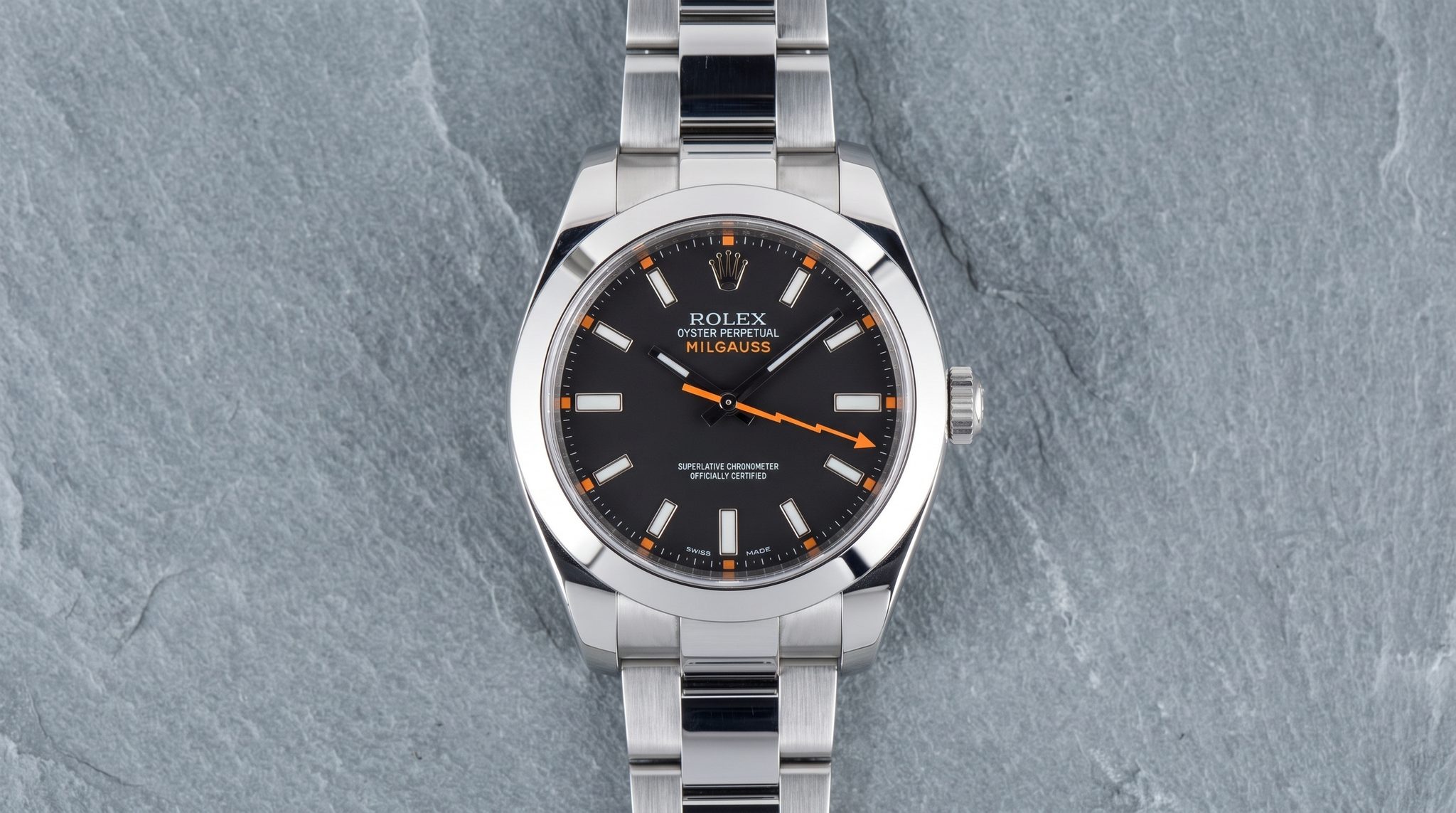
The Rolex Milgauss 116400 is the clear-crystal branch of the 2007 Milgauss revival, a version Rolex quietly phased out dial by dial while the green-glass GV carried the line to 2023.
- Production
- 2007–c. 2016
- Case
- Oystersteel
- Diameter
- 40 mm
- Thickness
- ~13–13.5 mm
- Lug width
- 20 mm
- Bezel
- Smooth, fixed
- Crystal
- Sapphire (clear)
- Water res.
- 100 m
- Dial
- Black or white
- Movement
- Cal. 3131
- Chronometer
- Yes
- Power res.
- ~48h
The Rolex Milgauss 116400 is the Milgauss revival in its most straightforward form, and its defining story is that it did not survive the revival’s second act: the clear-sapphire version launched in 2007, then disappeared by approximately 2016 as the green-crystal Milgauss (116400GV) remained in the catalog until the line’s final discontinuation in 2023. That split, clear versus green at the crystal edge, is the detail that decides whether a watch belongs to the short-lived 116400 branch or to the longer-running GV family.
In hand, the 116400 reads like a technical Rolex that allows itself a flash of color. The orange lightning-bolt seconds hand is the signature, and the dials pair white or black with vivid orange accents that keep the Milgauss from being mistaken for a Submariner-era professional Oyster. Inside is caliber 3131, the anti-magnetic movement used for the modern Milgauss, and the watch’s identity is tied to magnetic resistance up to 1,000 gauss. The case is a 40 mm Oystersteel Oyster, and independent measurements place it around 13–13.5 mm thick with a lug-to-lug measured in the 48.5–49.5 mm range, giving it a broad, flat stance on the wrist.
Collectors tend to talk about the Milgauss as one continuous 2007–2023 run, but the 116400 reference itself is better understood as a dial-by-dial phase-out: black with clear sapphire ends in the early-to-mid 2010s, white with clear sapphire lasts to around 2016, and after that only the green-crystal GV variants remain until 2023. That is why the single most important check on any Milgauss 116400 review, and any Milgauss 116400 for sale listing, is not the orange hand or the 40 mm case, but whether the crystal is truly clear.
“The 116400 is the Milgauss revival’s clear-crystal branch: introduced in 2007, then phased out by about 2016 while the green-glass GV carried the Milgauss name to its 2023 exit.”
116400 across 2007–c. 2016
Rolex brought the Milgauss back in 2007 as reference 116400, ending a long gap after the vintage era and reintroducing the model as a modern professional Oyster with an anti-magnetic movement and a deliberate visual signature. The 116400’s identity is the clear sapphire crystal, a choice that sounds like a footnote until it is set against what happened next: Rolex kept the same case and movement architecture while letting the 116400 branch narrow, then vanish.
The phase-out happened by dial rather than by reference renumbering. The black-dial 116400 is consistently placed in the early-to-mid 2010s, but the exact end year is not documented, and published dealer and guide timelines disagree on whether the last examples fall closer to 2013 or closer to 2015. The white-dial 116400 is easier to place, with multiple sources converging on discontinuation around 2016. After that point, the Milgauss continues only as 116400GV variants with green-tinted sapphire, including the Z‑Blue dial introduced in 2014.
One detail turns the whole story into something you can see: look at the crystal edge. A clear edge puts the watch inside the 116400’s shorter, earlier arc, while the green ring of the GV crystal places it in the later years when the Milgauss became, effectively, a single-crystal concept. The modern Milgauss run is often summarized as 2007–2023, but the 116400 is the proof that this was not one uninterrupted configuration. It was a family that narrowed over time until only the most visually distinctive member remained.
- 2007Revival launchClear sapphire, black or white dial
- c. 2014GV expandsOnly GV offers blue dial
- c. 2014/15Black endsBlack dial only seen as GV
- c. 2016White endsNo clear-crystal Milgauss sold
- 2023Line ends116400GV removed from catalog
116400 against its neighbours
The 116400 makes the most sense when framed by the watch that replaced it in the catalog (not by reference number, but by crystal concept) and by the vintage Milgauss it was reviving. The 116400GV is the closest sibling, sharing the same modern case and movement while keeping the green crystal and later dial options through 2023, and the ref. 1019 shows how far the 2007 revival moved the Milgauss from restrained vintage tool-watch simplicity toward a more expressive modern identity.
This reference 116400 Rolex · focal 2007–c. 2016 | |||
|---|---|---|---|
| Production | c. 1960–c. 1988/89 | 2007–2023 | 2007–c. 2016 |
| Case | Steel | Oystersteel | Oystersteel |
| Diameter | 38 mm | 40 mm | 40 mm |
| Crystal | Plexiglass | Sapphire (green-tint) | Sapphire (clear) |
| Bezel | Smooth, fixed | Smooth, fixed | Smooth, fixed |
| Movement | Cal. 1580 | Cal. 3131 | Cal. 3131 |
| Water res. | – | 100 m | 100 m |
| Dial | Silver or black | Black or Z‑Blue | Black or white |
| Chronometer | Yes | Yes | Yes |
| Power res. | 48h | ~48h | ~48h |
Two dial generations across the run
This is the modern Milgauss in its most literal, non-anniversary form: a black dial under a normal, clear sapphire crystal, with the orange lightning-bolt seconds hand providing the only immediate hint that it is not a conventional time-only Oyster. The layout mixes white baton markers with orange accents, and the overall impression is sharper and more technical than the vintage Milgauss it replaces.
Its importance is historical within the modern line. Black with clear sapphire is the combination that disappears first, and while sources disagree on the precise cutoff year, they agree it ends in the early-to-mid 2010s rather than running through the Milgauss’s 2023 discontinuation. In practical terms, a black, clear-crystal 116400 is generally not expected to overlap with the Milgauss’s final catalog years, which makes crystal tint the fastest authenticity check when a listing presents a later-year watch as a plain 116400.
What to check before buying a 116400
Buying a Rolex Milgauss 116400 is less about hunting for obscure production “marks” and more about preventing a simple category error: the plain 116400 is routinely conflated with the 116400GV, even though crystal tint is the trait that separates a reference that ends around 2016 from a sibling that continues to 2023. Because the black clear-crystal dial is also the earliest to disappear, sellers sometimes describe later Milgauss production years without making the crystal distinction explicit.
The safest approach is to treat originality as a set of visible pairings. The reference number should match the watch and its paperwork, but the watch itself should also make sense as a whole: clear crystal with black or white dial for 116400, and any green-tinted crystal belongs to a GV model by definition. Service replacement parts can matter more here than on many modern Rolex models because the crystal and dial combination is the collectible point.
Owning an 116400 is owning the less theatrical Milgauss that still carries the full modern concept: the 40 mm Oystersteel case, caliber 3131 and its anti-magnetic architecture, and the lightning seconds hand. It wears with real presence on account of its measured 13–13.5 mm thickness and near-49 mm lug span, and the clear sapphire makes it look more like a conventional tool watch than a GV, even though it is the reference that disappeared first.
Rolex Milgauss 116400 for sale
Indicative market value from recent dealer, auction, and Grey Market sales: median ≈ $8,000, with a typical $7,400–$8,600 range across 70 comparable sales (updated this week).
Each point is a recent dealer or auction sale, banded to an indicative figure. The range shown is not a valuation.
Adjacent in the Milgauss family
Common questions about the 116400
Rolex introduced the Milgauss 116400 in 2007. The black-dial clear-crystal 116400 is placed by sources as discontinued in the early-to-mid 2010s (often described as around 2013–2015), and the white-dial clear-crystal 116400 is more consistently placed as discontinued around 2016.
- Milgauss (Rolex)content.rolex.com
- Rolex Milgaussen.wikipedia.org
- Are the Non-GV Rolex Milgauss Watches Discontinued?bobswatches.com
Show 7 more
- Ultimate Guide to the Rolex Milgaussswisswatchexpo.com
- Rolex Milgauss Review & Buying Guidebobswatches.com
- Rolex Discontinues Milgauss 116400GVmillenarywatches.com
- What’s The Legacy Of The Rolex Milgauss?phillips.com
- Rolex Milgauss 116400 Rolex Watch Review (measurements)watchintyme.com
- Rolex Milgauss (116400GV) video review (measurements)youtube.com
- Rolex Milgauss (New) (dealer timeline)housekihiroba-en.com