

Patek Philippe Aquanaut 5167A
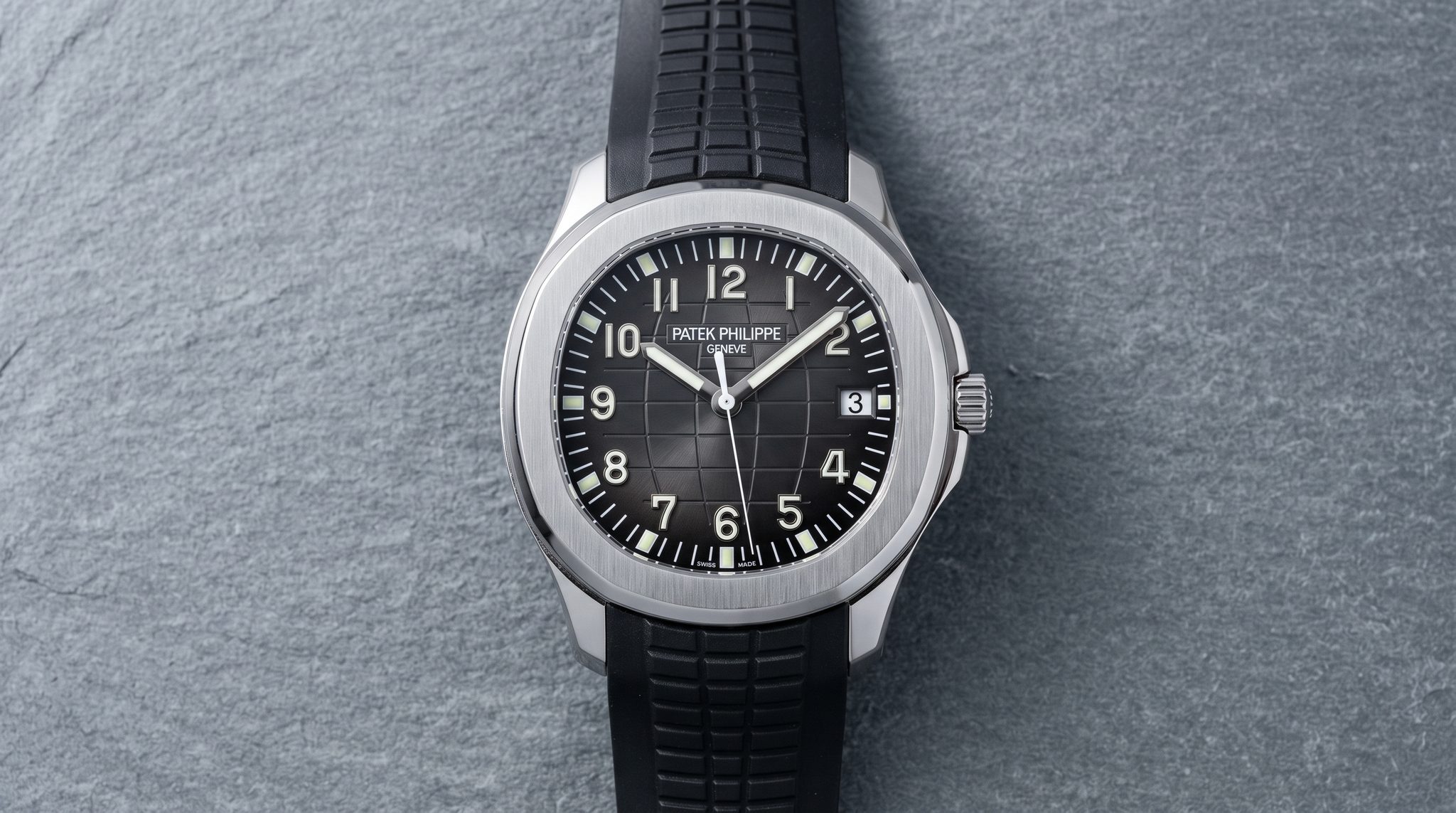
The Aquanaut 5167A is the long-running 40.8 mm steel, rubber-strap Aquanaut whose core look stayed steady while its catalog movement specification moved from Cal. 324 S C to Cal. 26‑330 S C.
- Production
- 2007–present
- Case
- Stainless steel
- Diameter
- 40.8 mm
- Thickness
- 8.1 mm
- Bezel
- Rounded octagon
- Crystal
- Sapphire
- Caseback
- Sapphire display
- Water res.
- 120 m
- Dial
- Embossed black
- Movement
- Cal. 26‑330 S C
- Power
- 35–45h
- Strap
- Tropical (composite)
The Patek Philippe Aquanaut 5167A has been in production since 2007.
- Production years
- 2007–present
- Replaced
- 5065A
- Movement
- Cal. 26‑330 S C
The Aquanaut 5167A is the rare modern Patek Philippe sports watch that can be dated more by what it is not than by what it is, because the watch has spent its life refusing to advertise its updates on the dial. The clearest, repeatable fact is physical: since its 2007 launch, Patek has kept the steel Aquanaut on rubber in the 40.8 mm “extra-large” case, while today’s catalog specification lists the newer self-winding Caliber 26‑330 S C behind the sapphire back.
That combination is the reference’s defining role in the Aquanaut line. Sotheby’s describes 2007 as a major evolution for the model, with the 5167A series introduced to replace the earlier 5065A. Patek still lists the 5167A-001 on its Tropical composite strap in the current collection, and recent coverage explicitly positions it as the steel entry point after the 2025 discontinuation of the bracelet sibling.
In the hand, the 5167A is recognizable for its thinness and its texture. Patek’s official 8.1 mm case height reads almost dress-watch slim for something rated to 120 m with a screw-down crown, and the embossed checkerboard dial looks less like printed decoration than a pressed surface that catches light across its squares. The applied Arabic numerals are in white gold with luminous coating, and the date at 3 o’clock is framed, with the “3” numeral omitted to make room for the window. Many notice that this omission leaves more open space on the right side of the dial than earlier Aquanauts with a full set of numerals.
The one place the 5167A does show its era is through the back. Patek’s current movement listing for the reference is the 26‑330 S C, a 4 Hz automatic caliber with central seconds and date, a 21K gold rotor, and a 35 to 45 hour power reserve, finished to the Patek Philippe Seal standard. Earlier examples are widely associated in the market with Cal. 324 S C. A claim that the very first 2007 pieces used Cal. 315 S C appears in one editorial history, but it is not corroborated by Patek’s own specification or by the major auction and dealer descriptions that consistently pair the 5167A with 324-era and later movements.
“The 5167A’s story is continuity you can wear: a 40.8 mm Aquanaut face that stayed steady from 2007 onward, even as the catalog movement specification moved to Cal. 26‑330 S C.”
Patek Philippe Aquanaut 5167A production years: 2007–present
The 5167A enters the record in 2007 as Patek’s larger Aquanaut generation, specifically described as replacing the 38 mm 5065A. That single change of scale is the only clearly documented “before and after” moment for the reference from the outside. Everything else that makes the 5167A feel modern is more about proportion than novelty: an officially thin 8.1 mm case, a dial whose embossed squares read like a material surface rather than a printed motif, and a layout that gives the date its own space by dropping the “3” numeral.
The movement story is the one area where the reference’s long production span becomes visible in a concrete way, because Patek’s current listing is not the same caliber that most older market descriptions cite. Patek now specifies Cal. 26‑330 S C for the 5167A-001, while many earlier examples are described with Cal. 324 S C. Patek does not publish a public cutover year for this change within the 5167A reference, which is why the most reliable way to confirm it on an individual watch is simply to look through the sapphire back and read the caliber marking.
A separate, narrower claim appears in one editorial history: that the very first 2007 pieces used Cal. 315 S C before a shift to 324 S C from 2008. That detail sits apart from the better-documented 324 and 26‑330 eras, and it remains disputed because the brand’s current specification does not mention 315 for this reference and the mainstream auction and dealer descriptions overwhelmingly pair the 5167A with 324-family and later movements.
The cleanest “zoom out” view of the 5167A is that its collectable identity is shaped less by visible, datable dial generations and more by the absence of them. In a model line where earlier Aquanauts are often discussed by casebacks, sizes, and family movement steps, the 5167A is the one that became a stable template: a steel Aquanaut on rubber that kept its face consistent enough that the market learned to anchor the watch by its measurements, its texture, and the caliber you can see through the back.
- 2007Introduced40.8 mm “extra-large” case
- 2007Early movement324 S C engraving (if present)
- c. 2008Lore claim315 S C on movement bridge
- 2025Sibling endsBracelet reference 5167/1A
- 2026Current spec26‑330 S C on movement
- 2026Still offeredRubber strap ref. 5167A-001
5167A against its neighbours
The 5167A makes the most sense when framed by the watch it replaced, the sibling that turned the same head into a bracelet watch, and the precious-metal counterpart that keeps the design but changes the entire tone. Together, these references show that the 5167A is not defined by dial “marks,” but by its role as the stable steel-on-rubber template of the modern Aquanaut line.
This reference 5167A Patek Philippe · focal 2007–present | 5167R-001 Precious-metal sibling 2010s–present | |||
|---|---|---|---|---|
| Production | 1997–c. 2006 | 2007–2025 | 2007–present | 2010s–present |
| Case | Stainless steel | Stainless steel | Stainless steel | 18k rose gold |
| Diameter | 38 mm | 40.8 mm | 40.8 mm | 40.8 mm |
| Thickness | ~8 mm | 8.1 mm | 8.1 mm | 8.1 mm |
| Water res. | 120 m | 120 m | 120 m | 120 m |
| Caseback | Sapphire display | Sapphire display | Sapphire display | Sapphire display |
| Dial | Embossed black | Embossed black | Embossed black | Embossed brown |
| Movement | Cal. 315 S C | Cal. 324 S C | Cal. 26‑330 S C | 324 S C; now 26‑330 |
| Strap | Tropical (composite) | Steel bracelet | Tropical (composite) | Tropical (composite) |
What to check before buying a 5167A
Buying a 5167A is less about hunting “Mk” dials and more about verifying configuration, condition, and paperwork on a watch whose details are supposed to be crisp. Market commentary consistently notes premiums for full sets and top condition, and on the 5167A those premiums can be easy to understand once the watch is in hand: the case relies on sharp transitions between brushed and polished surfaces, and the Tropical strap is meant to be cut to fit, so it is common for pre-owned examples to feel worn in ways that photos understate.
The other practical checkpoint is the one visible mechanical fork within the reference: earlier examples are commonly described with Cal. 324 S C, while Patek’s current catalog specification is Cal. 26‑330 S C. Patek does not publish a public cutover year, so the only clean way to avoid misunderstanding is to confirm the caliber marking through the display back and match that to the documents.
In day-to-day ownership the 5167A’s appeal is straightforward and unusually modern for the brand: a thin 40.8 mm steel sports case, 120 m water resistance with a screw-down crown, and a rubber strap that makes the watch wear lighter than its price category suggests. The reference’s long continuity means there is rarely a “wrong” year to own, but it also means the best examples are the ones that still look like they have never had their edges rounded off by refinement.
Patek Philippe Aquanaut 5167A price and value
Patek Philippe Aquanaut 5167A for sale
Auctions on Grey Market run on seven-day cycles, every watch verified before it sells. Browse what's live now, or consign your 5167A.
Grey Market runs watch auctions for vintage and neo-vintage pieces, every lot reviewed before it lists and verified before the seller is paid, and the Watch Exchange, where ID-verified collectors buy and sell at a fixed price. Selling one? See the ways to sell a Patek Philippe, or check what it’s worth. For more vintage Patek Philippe, see the Patek Philippe reference guide.
Adjacent in the Aquanaut family
Common questions about the 5167A
The Aquanaut 5167A-001 was introduced in 2007 and remains in production as a current catalog reference in recent sources.
- Aquanaut Date Black Strap Stainless Steel ref. 5167A-001 (official specifications)patek.com
- Everything About the Discontinued Patek Philippe Stainless Steel Aquanaut 5167/1Asothebys.com
- Aquanaut Men's - 5167A | Patek Philippe | Wempe Jewelerswempe.com
Show 7 more
- The complete history of the Patek Philippe Aquanaut41watch.com
- Patek Philippe 5167A-001 Aquanaut (video review, measurements)youtube.com
- Patek Philippe Aquanaut 5167A Reference Guidewatchprosite.com
- Patek Philippe Aquanaut: A Look at Its Evolution Through The Yearsthewatchcompany.com
- Why Patek Philippe's Recent Move Turned This Aquanaut Into an Collectible (5167/1A discontinuation context)swisswatchexpo.com
- 2023 Patek Philippe Aquanaut 5167A - Tiffany Stamp (example listing)gandgtimepieces.com
- Pre-Owned Patek Philippe Aquanaut Watches (price snapshot)watchfinder.com