

Tudor Submariner 7928
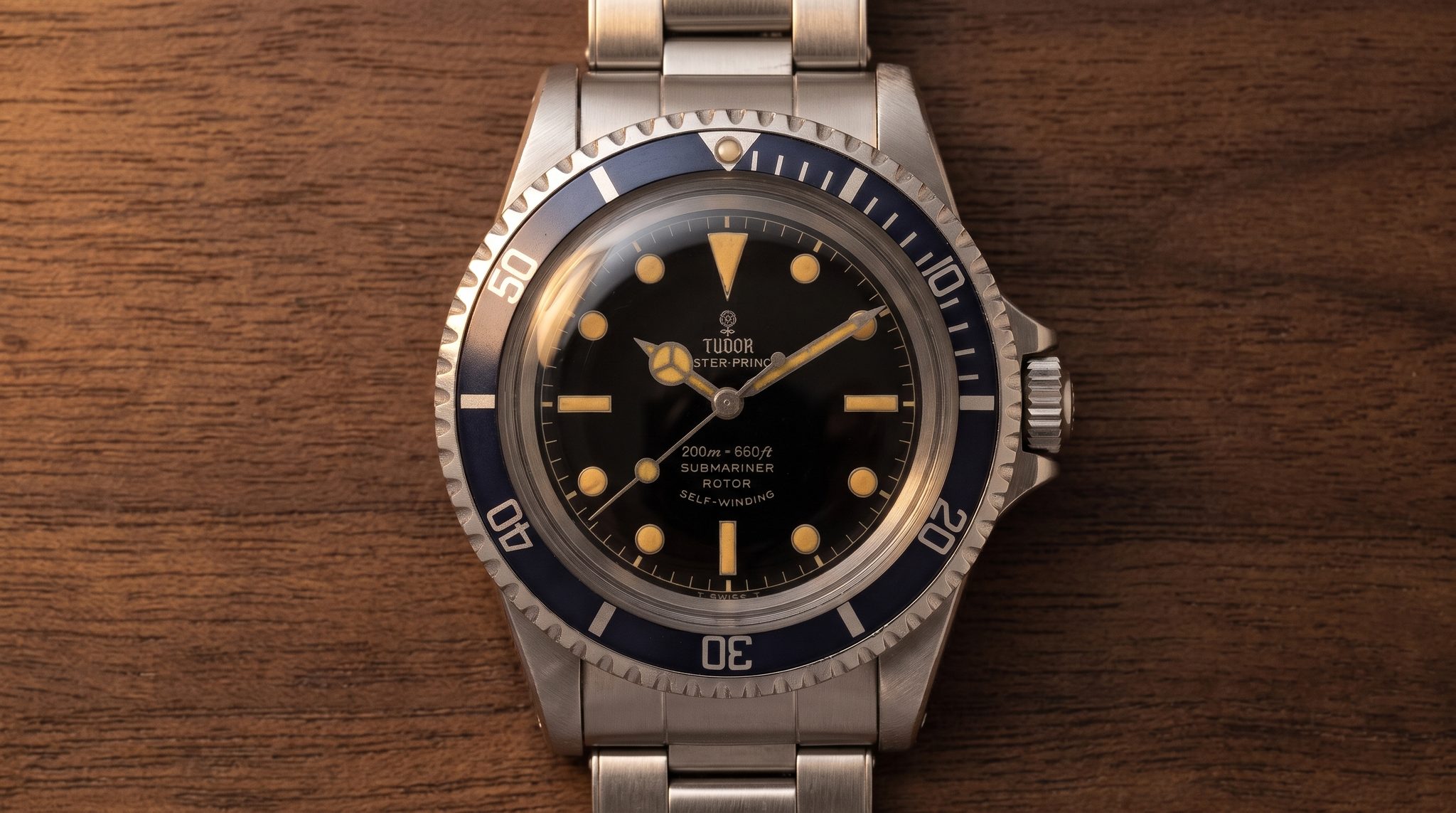
Introduced in 1959 with a 39 mm case and crown guards, the Tudor Submariner 7928 became the full-size diver whose identity was still being worked out in public, one case and dial execution at a time.
- Production
- 1959–1968
- Case
- Stainless steel
- Diameter
- ~39 mm
- Lug width
- 20 mm
- Thickness
- ~14 mm
- Bezel
- Bidirectional rotating
- Crystal
- Domed Plexiglas
- Water res.
- 200 m / 660 ft
- Dial
- Gilt or matte black
- Movement
- Tudor cal. 390
- Lume
- Swiss or tritium era
- Date
- No date
The Tudor Submariner 7928 was produced from 1959 to 1968.
- Production years
- 1959–1968
- Replaced
- 7924
- Replaced by
- 7016/0
- Movement
- Tudor cal. 390
The Tudor Submariner 7928 made the diver approximately 39 mm wide and gave it crown guards in 1959, but its lasting interest is that Tudor did not arrive at a finished identity all at once. Across roughly a decade, the case moved through square, eagle-beak, pointed and rounded guard forms, while the dial travelled from gilt printing and a closed chapter ring to later matte, open-chapter executions. It is a watch whose history remains visible in the details that changed around a stable mechanical core.
That core was Tudor-signed caliber 390, an automatic movement from the Fleurier/FEF family beating at 18,000 vibrations per hour, with 17 jewels and approximately 40 hours of power reserve. The movement carried over from earlier Tudor Submariners rather than being created specifically for the 7928, while the case represented the important architectural step beyond the 7924 Big Crown. The earlier reference had a large exposed crown and no guards; the 7928 protected a smaller crown and established the approximately 39 mm format that shaped the next generation.
The dial is where the reference becomes a dating problem in the best collector sense. Early examples show gilt printing, a gilt minute track and the four-line lower arrangement ending in “ROTOR” and “SELF-WINDING,” with “SWISS” at 6 o’clock. Early 1960s watches can retain a gilt outer track while using silver or white text, and later printed-track dials look more utilitarian. The exclamation dot around 1962 and underline around 1963 are separate markings, not interchangeable names for one dial period. Later matte, open-chapter dials are often seen with rhodium-colored hands and “T SWISS T,” but those features do not share one proven cutoff.
That separation is the practical key to a Tudor 7928. A crown-guard shape dates the case, a 6 o’clock marking dates a dial execution, and a bezel or bracelet may have been replaced. The strongest examples are not merely attractive; they are coherent, with case, dial, hands, movement and aging telling the same production story.
“The 7928 is the Tudor diver caught becoming itself: one approximately 39 mm case, four crown-guard forms, and a dial history that makes every surviving detail count.”
Tudor Submariner 7928 production years: 1959–1968
The 7928 began with a clear architectural reason: Tudor replaced the 7924’s exposed 8 mm crown and unguarded case with crown protection while retaining the automatic caliber 390 and 200 m rating. The first guards are square and block-like. Soon afterward, surviving cases show eagle-beak guards whose tips narrow into a hooked point, followed by more conventional pointed guards and, later, rounded ends. The record does not provide factory announcements for each transition, so the physical shape dates the case more securely than it dates the whole watch. A rounded guard can be late without proving a particular dial, and an early gilt dial does not prove that the case is square.
The dial changes require the same discipline. The early gilt dial catches light along its lettering and minute track, while the later mixed-graphic form keeps a gilt outer track beneath silver or white printing. Printed-track dials look flatter and more functional. The exclamation dot around 1962 and underline around 1963 are distinct 6 o’clock markings, each with its own reported window. Later matte open-chapter dials commonly carry white printing and “T SWISS T,” but open chapter, matte finish, rhodium-colored hands and tritium signing are separate traits rather than one synchronized package. The reason their exact cutoffs do not align is not documented.
The 7928’s production history therefore records more than a decade of adjustment before the line changed direction. With the arrival of the 7016 and 7021 generation, Tudor moved to Snowflake hands, square markers and a new movement-era design. The sequence shows a model line still testing its visual language in real time, not a fixed archetype reproduced unchanged.
- 1959IntroducedCrown guards replace exposed Big Crown form
- c. 1959Square guardsSquare-ended guards flank crown
- c. 1959Eagle-beak guardsSharp hooked guard tips
- 1963Pointed guardsLess-hooked pointed ends
- c. 1962Radiation markingsDot below 6 o’clock marker
- c. 1963Underline dialShort line beneath lower printing
- c. 1965 – 1968Late matte dialsMatte surface and T SWISS T
- c. 1968Production endsSnowflake hands and square markers
7928 against its neighbours
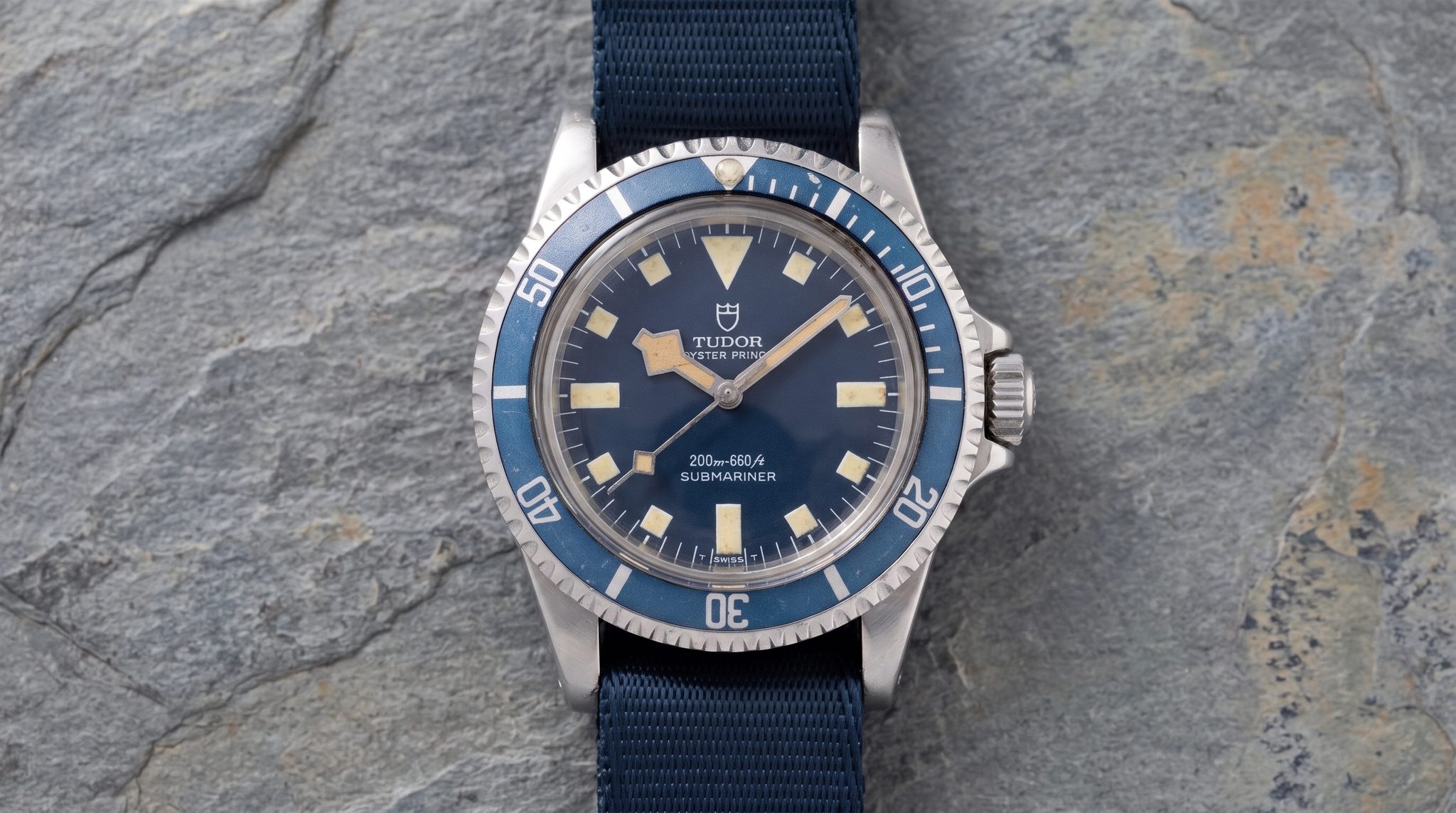
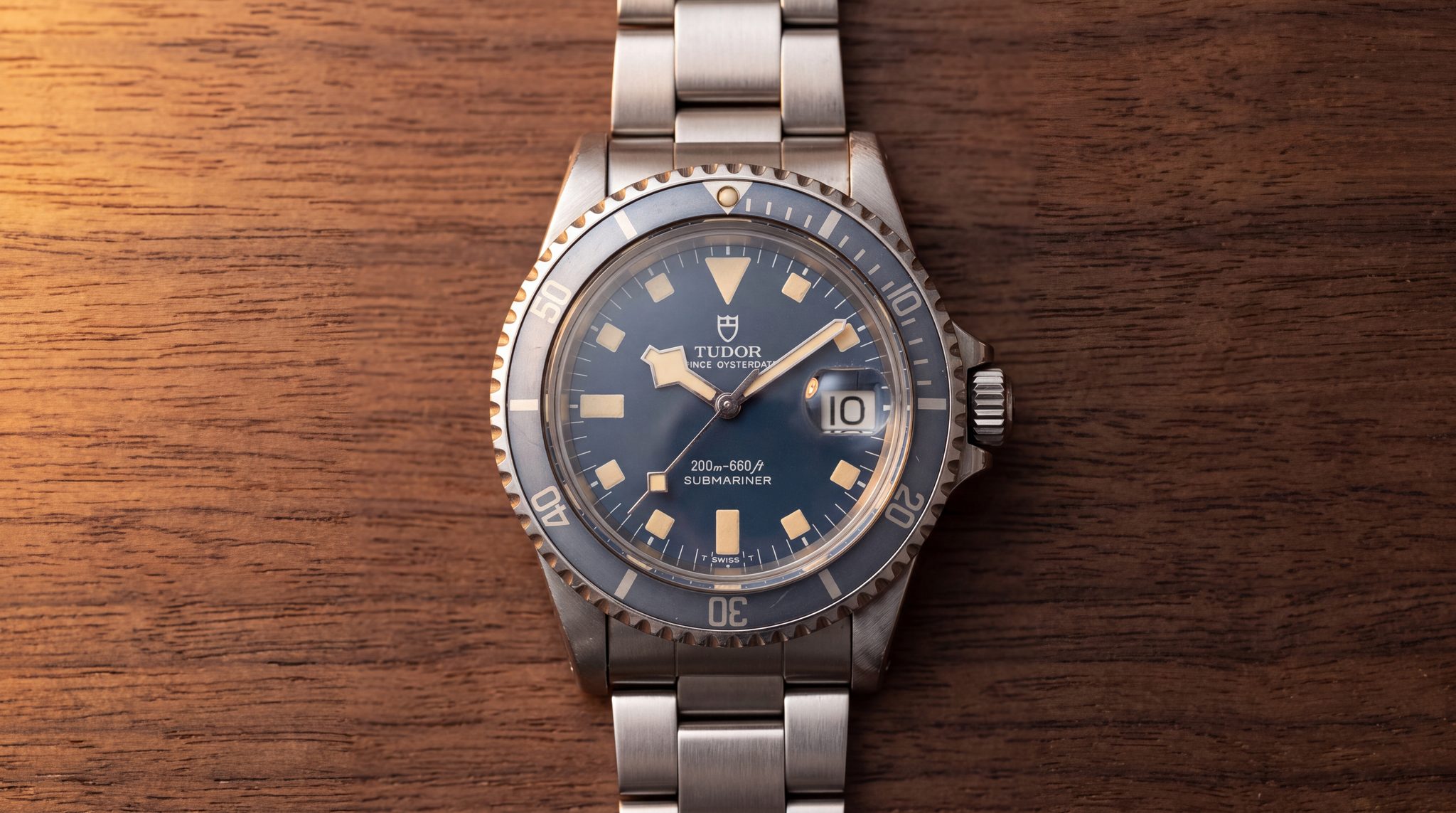
The 7924, 7016/0 and 7021/0 frame the 7928’s place in Tudor’s diver line. The 7924 shows what changed when crown guards arrived, while the 7016/0 and 7021/0 show the separate Snowflake generation that followed rather than treating its dials as late 7928 variants.
7924 Immediate predecessor c. 1958–1959 | This reference 7928 Tudor · focal 1959–1968 | 7021/0 Date successor sibling c. 1969–1975 | ||
|---|---|---|---|---|
| Production | c. 1958–1959 | 1959–1968 | 1969–1975 | c. 1969–1975 |
| Case | Stainless steel | Stainless steel | Stainless steel | Stainless steel |
| Diameter | ~37–39 mm | ~39 mm | ~39–40 mm | ~39–40 mm |
| Bezel | Rotating diver bezel | Bidirectional rotating | Black rotating bezel | Black rotating bezel |
| Water res. | 200 m | 200 m / 660 ft | 200 m | 200 m |
| Dial | Early gilt | Gilt or matte black | Snowflake, commonly black | Snowflake with date |
| Movement | Fleurier cal. 390 | Tudor cal. 390 | Tudor cal. 2483 family | Cal. 2483-based family |
| Date | No date | No date | No date | Date, Cyclops |
Ten dial generations across the run
The earliest 7928s present a compact, highly legible composition: gilt shield and printing catch warm highlights, the minute track is gilt, and the broad square guards make the crown look recessed between two blocks. The lower dial uses the four-line arrangement ending in “ROTOR” and “SELF-WINDING.” These watches are commonly associated with the first 1959 cases, but gilt printing alone cannot prove a square-guard case.
What to check before buying a 7928
Buying a Tudor Submariner 7928 means buying the relationship between parts, not simply the most dramatic dial or rarest-looking crown guard. The reference ran through several case and dial executions, and bezels, crowns, crystals, bracelets and hands are frequently replaced. A convincing example must make its case form, dial marking, movement and aging plausible together.
The practical risk is that a single attractive feature can conceal a composite watch. A rare guard shape does not authenticate the dial, and an old-looking dial does not prove original hands or bezel. The best purchase is a coherent survivor whose visible details support one production history.
Tudor Submariner 7928 price and value
A Tudor Submariner 7928 sells for about $8,500 at the median, typically $6,000 to $14,000 across 50 comparable sales.
Tudor Submariner 7928 for sale
Indicative figures from recent dealer, auction, and Grey Market sales (updated this week). Every watch is verified before it sells here.
Each point is a recent dealer or auction sale, banded to an indicative figure. The range shown is not a valuation.
Grey Market runs watch auctions for vintage and neo-vintage pieces, every lot reviewed before it lists and verified before the seller is paid, and the Watch Exchange, where ID-verified users buy and sell at a fixed price. Selling one? See the ways to sell a Tudor, or check what it’s worth. For more vintage Tudor, see the Tudor reference guide.
Adjacent in the Submariner family
Common questions about the 7928
The Tudor Submariner 7928 was produced from 1959 to 1968. The introduction in 1959 is well established, while the final year remains approximate because serial ranges overlapped later references and no universal cutoff is documented.
- TUDOR Diving Watches: Submariners 1954 to 1968tudorwatch.com
- Tudor Submariner Reference 7928, Sotheby’ssothebys.com
- Tudor Submariner Ref. 7928, Phillipsphillips.com
Show 7 more
- Tudor Submariner Ref. 7928, Hodinkee Shopshop.hodinkee.com
- 1967 Tudor Submariner Ref. 7928shop.hodinkee.com
- 1965 Tudor Submariner Ref. 7928 with Ghost Bezelshop.hodinkee.com
- 7928 Tudor Submariner reference historytudorsub.com
- Tudor Submariner 7928 guidelepage.fr
- Tudor Submariner 7928 auction exampleeverywatch.com
- Tudor Submariner 7928 reference listingwatchoyster.ch