

Tudor Prince Date-Day 76214
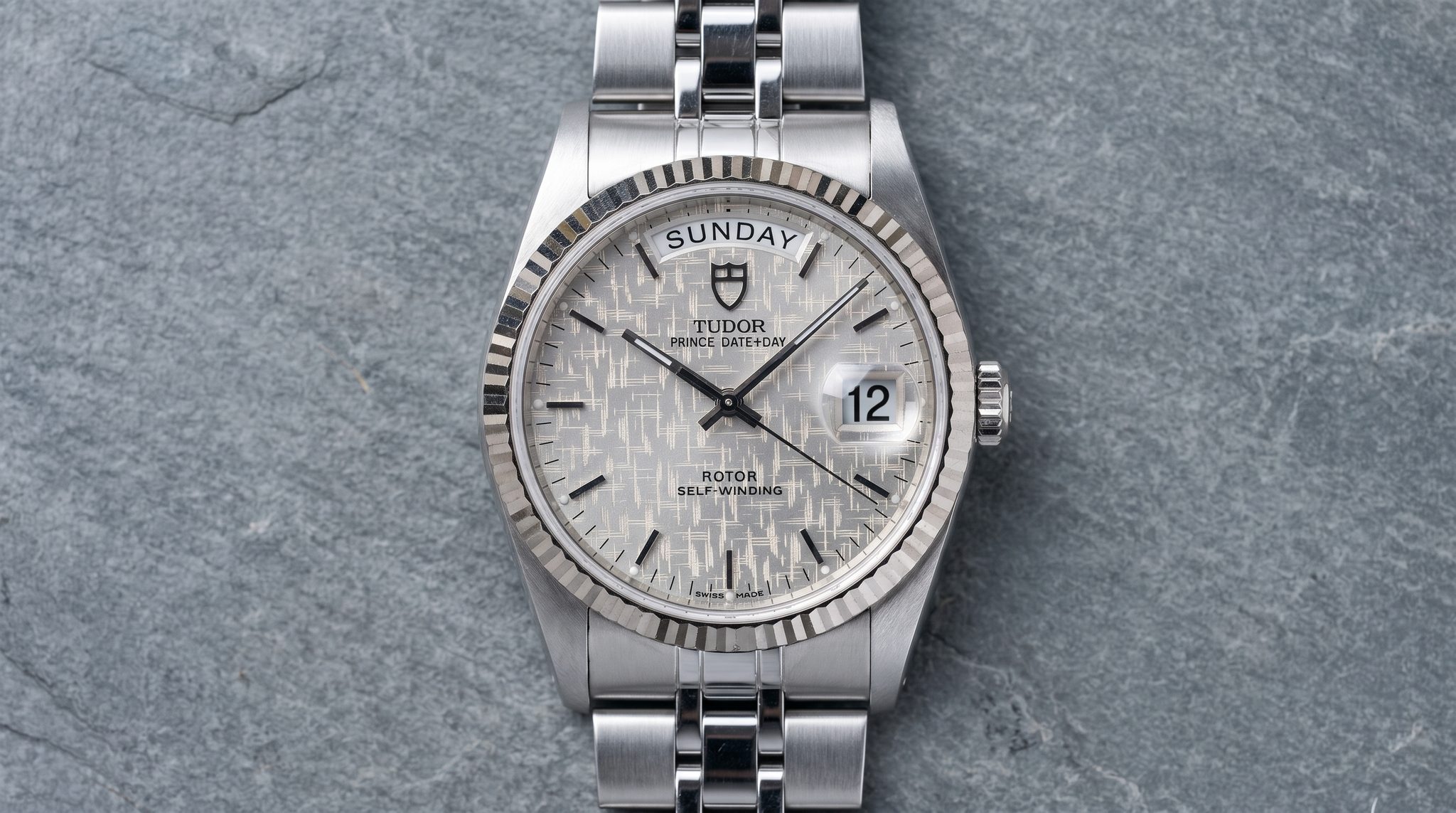
The Tudor Prince Date-Day 76214 is defined less by a clean production run than by its unusually broad palette of original dials around one compact steel-and-white-gold format.
- Production
- 1990s–c. 2020
- Case
- Steel / 18k white gold
- Diameter
- 36 mm
- Lugs
- 20 mm
- Bezel
- Fluted white gold
- Crystal
- Sapphire
- Water resistance
- 100 m
- Movement
- ETA 2834-2-based
- Reserve
- Approx. 38 h
- Beat rate
- 28,800 vph
- Calendar
- Day at 12, date at 3
- Crown
- Screw-down
The Tudor Prince Date-Day 76214 was produced from the 1990s to about 2020.
- Production years
- 1990s–c. 2020
- Replaced
- 94614
- Movement
- ETA 2834-2-based
The Tudor Prince Date-Day 76214 is a watch whose identity lives in configuration rather than a neat production date. One example is advertised as dating to 2001, later watches are identified by paperwork or serial information as 2016, 2018, and 2019, and a market-specific account places production in Hong Kong as late as 2020. That spread is not a nuisance around the story. It is the story: the reference remained recognizably the same compact steel-and-white-gold day-date while its dials and bezel executions gave individual watches their character.
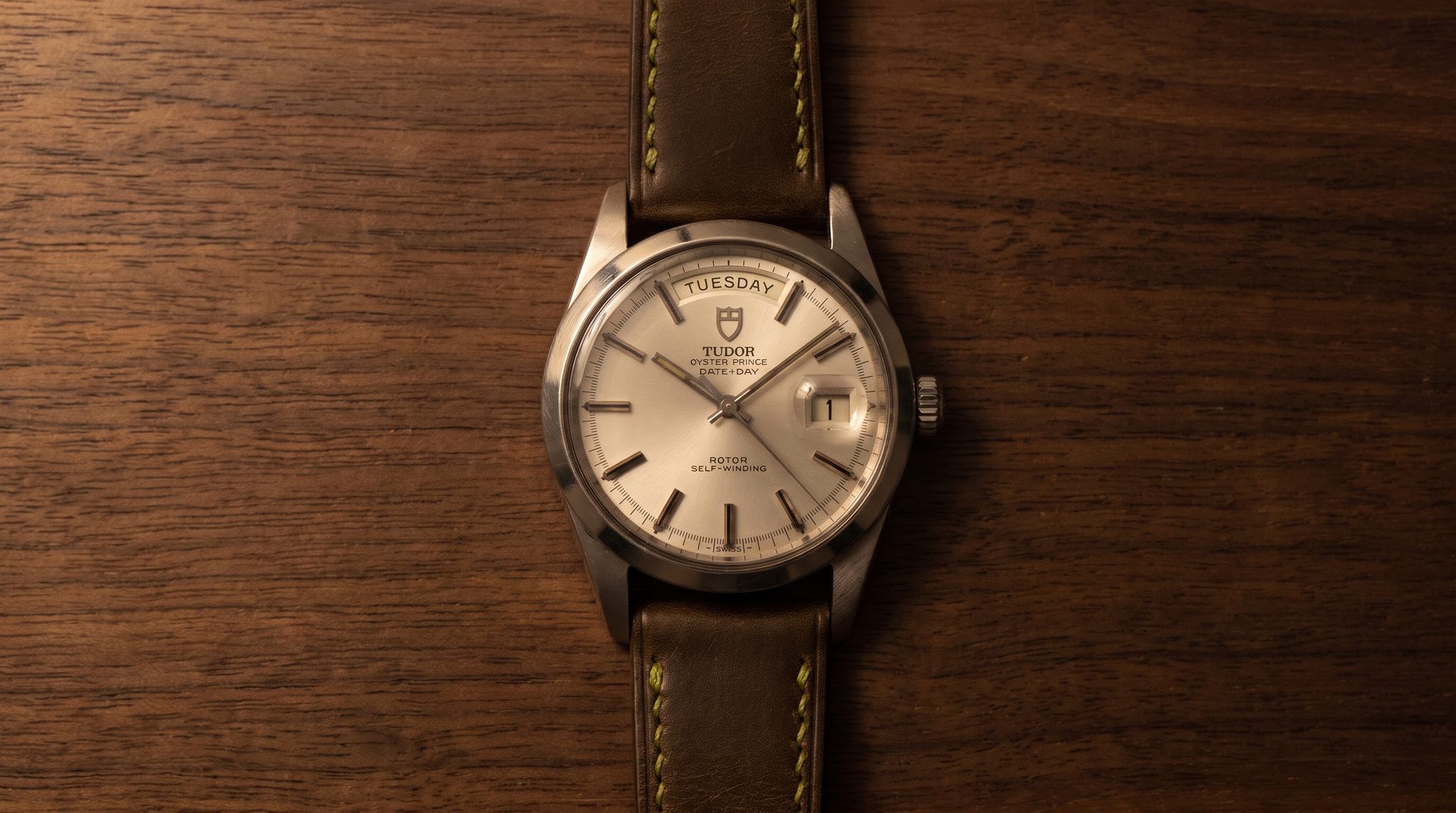
The format is immediately legible. A 36 mm stainless-steel case carries an 18-karat white-gold fluted bezel, with the day displayed at 12 o’clock and the date at 3. Documented examples use a sapphire crystal and 100 m water resistance, and are powered by an ETA 2834-2-based automatic movement running at 28,800 vibrations per hour with approximately 38 hours of reserve. The case measures 20 mm between the lugs and roughly 43 mm from lug to lug, placing it on the compact side by modern standards while retaining a substantial bracelet proportion. A cyclops magnifier is documented on the date in representative examples, but it should not be treated as a universal identifier for every early or transitional watch.
What makes the 76214 interesting is the independence of its variables. White Roman numerals, silver baton or diamond-marker dials, textured silver linen dials, and black dials appear within the same reference family. A gem-set white-gold bezel is another separate execution, not a date code and not proof of a particular dial era. The evidence does not establish sequential movement generations, defined lume periods, or a single global introduction and discontinuation year. In practice, the best 76214 is therefore not simply the latest or earliest one. It is the example whose dial, bezel, case finishing, bracelet, movement, and documentation form a coherent combination.
“The 76214 is a configuration-led Tudor: one compact steel-and-white-gold architecture, many original ways for time to show itself.”
Tudor Prince Date-Day 76214 production years: 1990s–c. 2020
The earliest useful evidence is not a factory launch date. It is an example advertised as 2001 with a silver diamond-marker dial, which establishes that execution by that date without proving when the reference began. Other documented listings place silver index and linen dials, black dials, and white Roman dials across the 2000s and 2010s. The reason Tudor offered these combinations, or changed their availability, is not documented, so dial style should be read as an independent configuration rather than a chronological ladder.
The same caution applies to the bezel. The fluted 18k white-gold bezel defines the ordinary 76214 format, while a diamond-set white-gold bezel is a separate documented execution. Because both can accompany different dial styles, the bezel cannot date a dial and the dial cannot date the bezel. The movement evidence is more stable: documented examples identify an ETA 2834-2 base, but the supplied record does not demonstrate a separate early or late movement generation within the reference.
By 2016, a white Roman-numeral example confirms that this dial remained present late in the documented run. Watches identified as 2018 and 2019 extend the evidence further, and a Hong Kong-market account places production as late as 2020. That final claim is geographically limited, so it cannot be converted into a worldwide discontinuation date. Taken together, the record shows how much individuality Tudor allowed inside a format that changed remarkably little in outline: the reference behaves less like a sequence of marks than a cabinet of configurations assembled across an uncertain run.
- c. 2001Early evidenceSilver dial with diamond hour markers
- c. 2000sDial rangeTexture and marker style change independently
- c. 2000sBezel executionsDiamond-set bezel, not a dial code
- 2016Late exampleApplied Roman numerals on white dial
- 2018 – 2019Documented runExamples identified as 2018 and 2019
- c. 2020Market-specific endMarket claim, not global discontinuation
76214 against its neighbours
The closest comparisons show what the 76214 is, and what it is not. The 94614 is the direct predecessor and can overlap visually in transitional examples, while the 76213 and 76200 retain the same broad family logic but change the metal treatment or bezel.
94614 Direct predecessor c. late 1980s–mid-1990s | This reference 76214 Tudor · focal 1990s–c. 2020 | |||
|---|---|---|---|---|
| Production | c. late 1980s–mid-1990s | c. 1988–at least 2017 | 1990s–2010s | 1990s–c. 2020 |
| Case | Stainless steel | Stainless steel | Steel and yellow gold | Steel / 18k white gold |
| Bezel | 18k white gold, fluted | Smooth, polished | Fluted yellow gold | Fluted white gold |
| Movement | ETA-based automatic | ETA 2834-2 automatic | ETA 2834-2 automatic | ETA 2834-2-based |
Seven case, bezel and dial variants across the run
This is the defining 76214 case execution: a 36 mm stainless-steel case capped by an 18k white-gold fluted bezel. In hand, the bezel should read as a separate precious-metal surface, with crisp fluting that catches light differently from the brushed or polished steel around it. Sharpness matters because polishing can soften the ridges without changing the reference engraved inside the case.
What to check before buying a 76214
Buying a Tudor Prince Date-Day 76214 is less a search for one correct year than an examination of whether the individual watch makes sense as a whole. The reference appears with several dials and at least two bezel executions, while early and transitional dating remains unresolved. Originality, case geometry, and coherent documentation therefore matter more than a seller’s isolated claim that a color or texture is rare.
The most revealing inspection is visual. Look at how the white-gold fluting catches light, whether the dial texture is consistent, and whether the day and date windows, hands, markers, and printed text belong together. The compact 36 mm case is easy to wear, but its relatively broad 20 mm lugs make bracelet condition part of the watch’s character. A good example is one that feels assembled by one production history, not one built from attractive replacement parts.
Tudor Prince Date-Day 76214 price and value
Tudor Prince Date-Day 76214 for sale
Auctions on Grey Market run on seven-day cycles, every watch verified before it sells. Browse what's live now, or consign your 76214.
Grey Market runs watch auctions for vintage and neo-vintage pieces, every lot reviewed before it lists and verified before the seller is paid, and the Watch Exchange, where ID-verified users buy and sell at a fixed price. Selling one? See the ways to sell a Tudor, or check what it’s worth. For more vintage Tudor, see the Tudor reference guide.
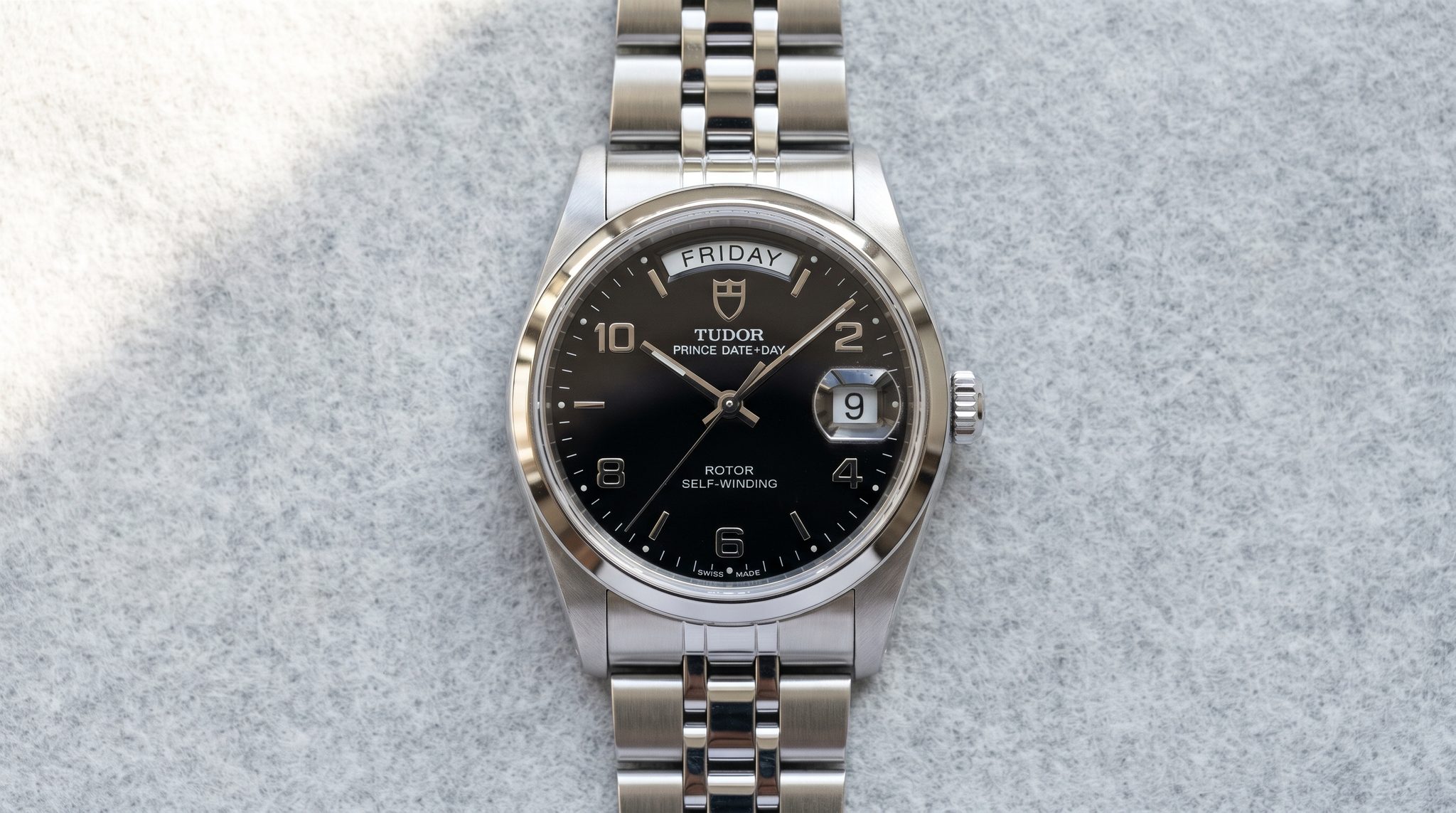
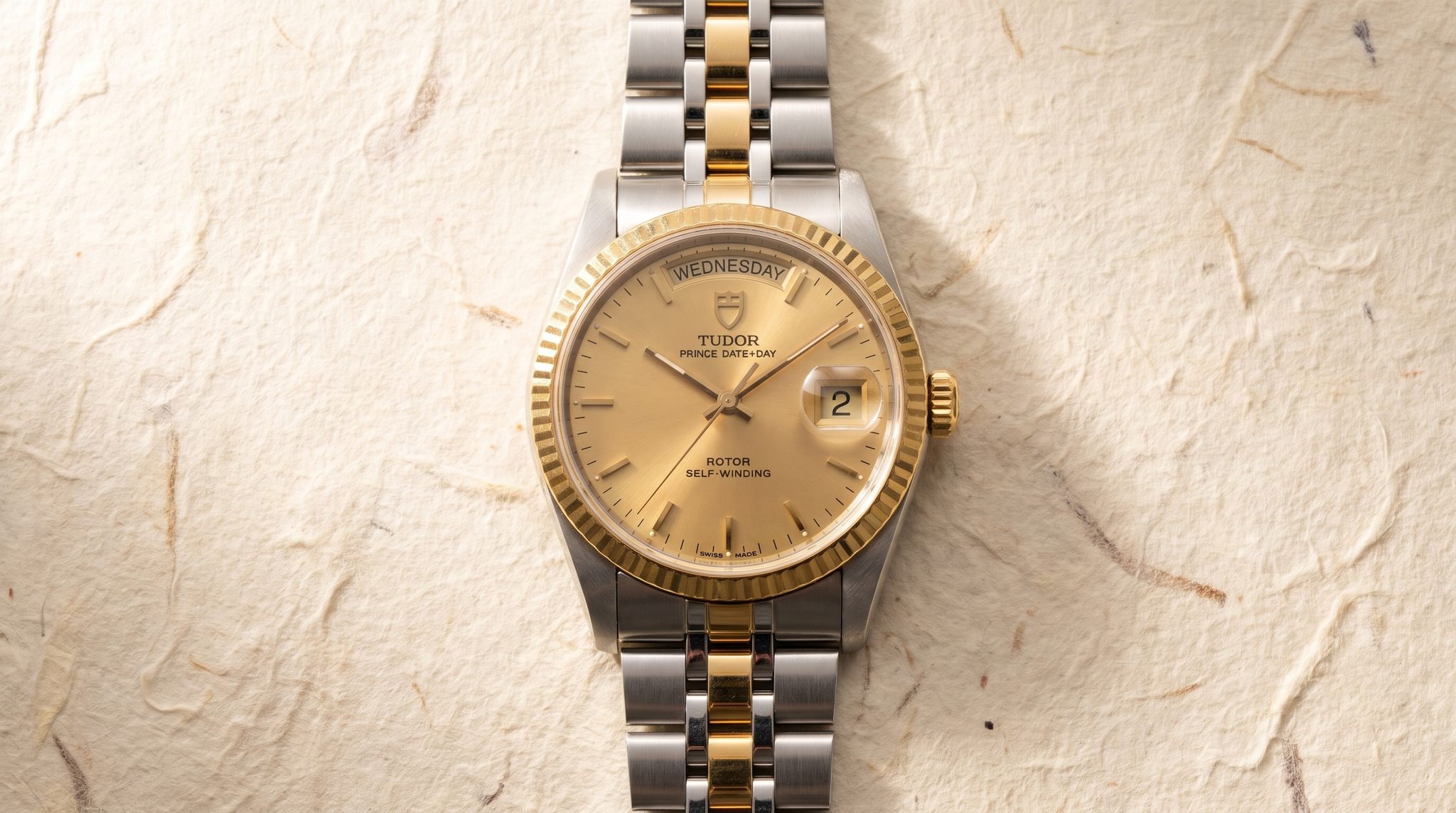
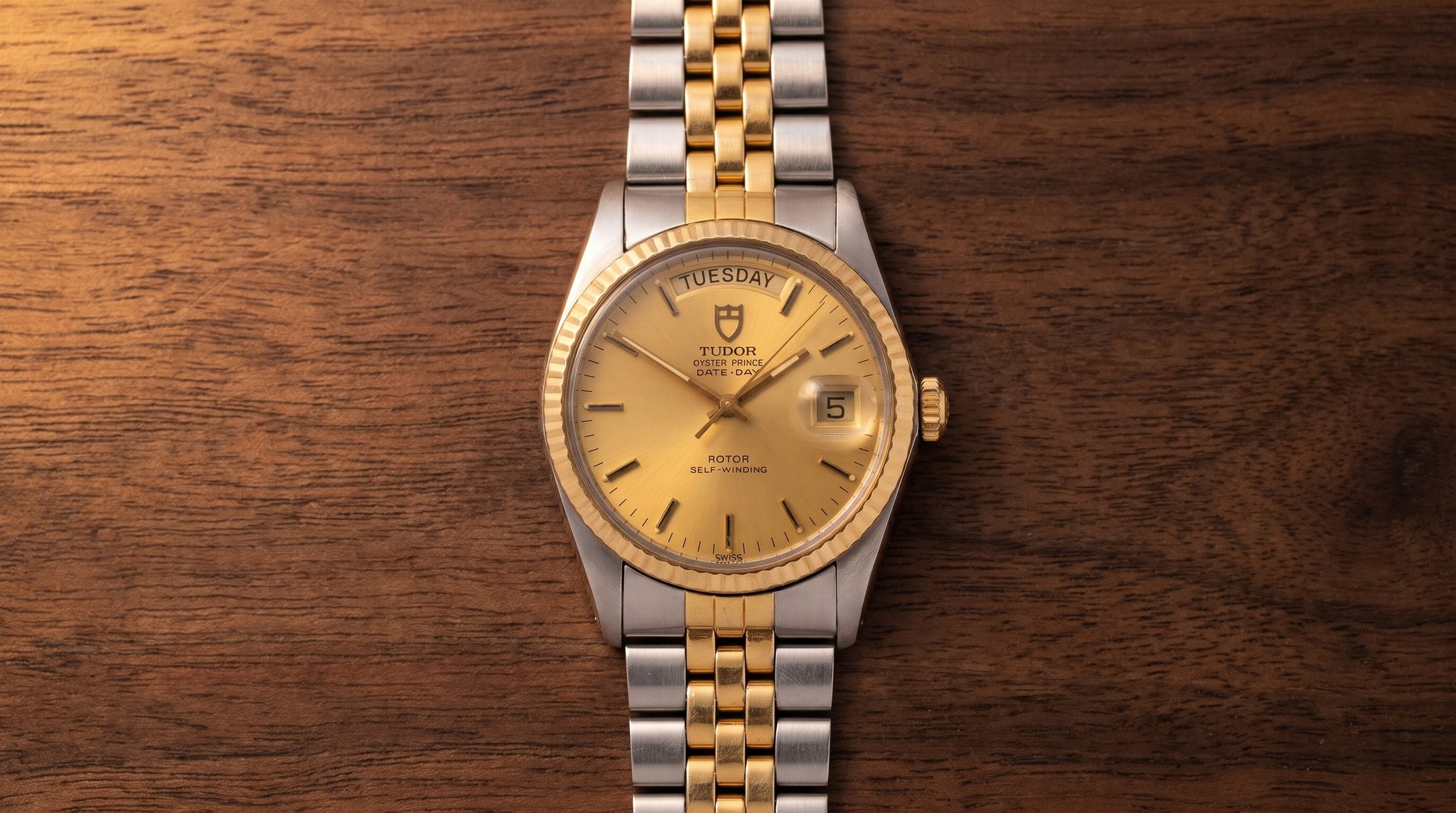
Adjacent in the Prince Date-Day family
Common questions about the 76214
The Tudor Prince Date-Day 76214 was produced from the 1990s to about 2020. Dealer records include examples dated 1994 and 1997, but the exact global introduction year and discontinuation date are unresolved. An example is advertised as 2001, later watches are identified as 2016, 2018, and 2019, and a Hong Kong-market account extends production to 2020.
- Tudor Prince Date-Day 76214, black dial, box and paperswatchoyster.ch
- Strap Guide: Tudor Prince Date Daydelugs.com
- Tudor Prince Date Day 76214, white dialkeepthetime.com
Show 7 more
- Tudor Prince Date-Day 76214, silver dialeverywatch.com
- Tudor Prince Date-Day 76214, black dial, 2000everywatch.com
- Tudor Prince Date-Day 76214, silver dialeverywatch.com
- Tudor Prince Date Day 76214, 2019 papersbo-watches.com
- Tudor Prince Date-Day 76214, silver linen dialchrono24.com
- Tudor Oyster Prince Date Day 76214 / 94614 transitionalchrono24.com
- Tudor Oysterdate Prince 7017 watchescollectorsquare.com