

Tudor Prince Date-Day 76213
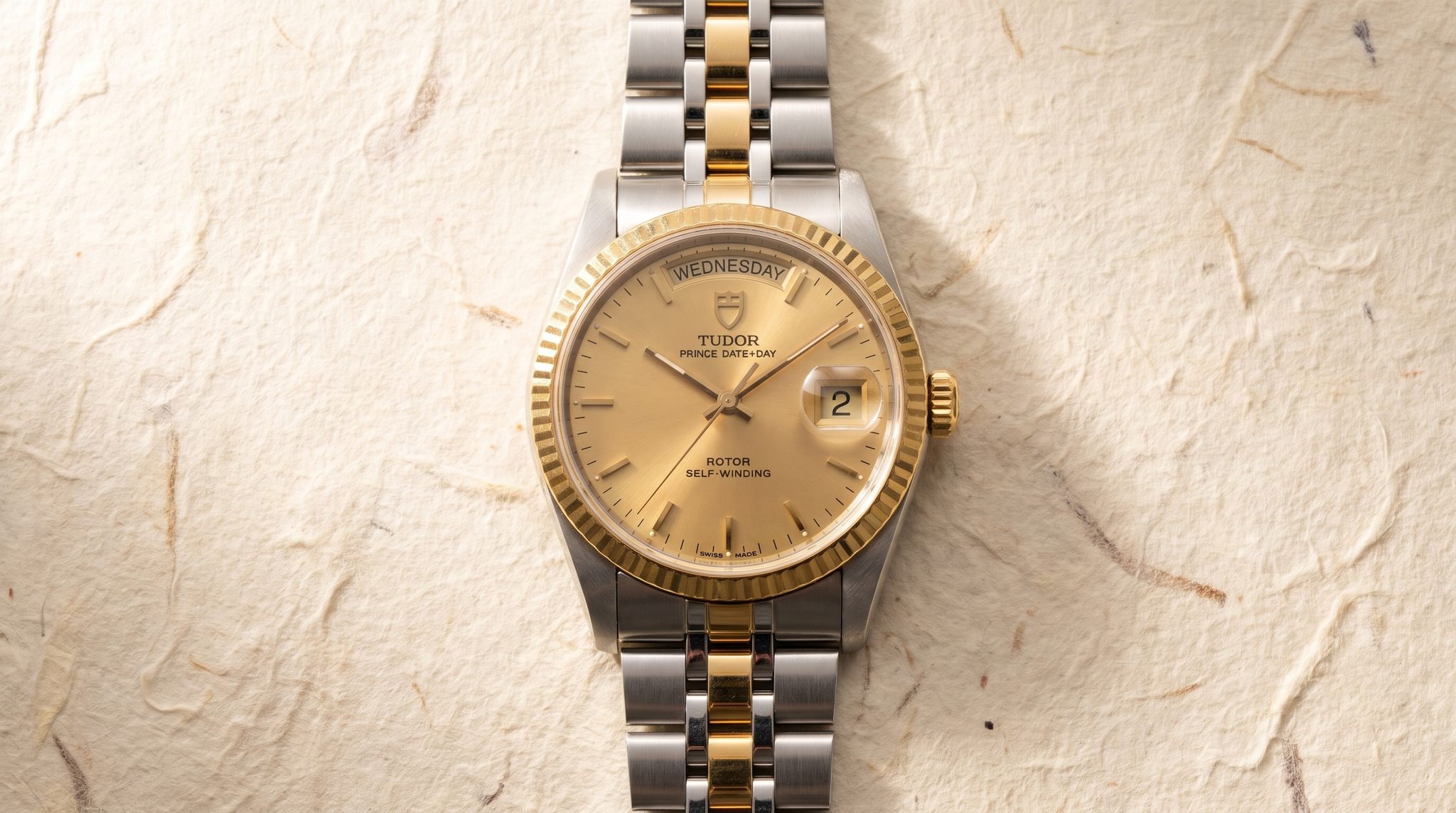
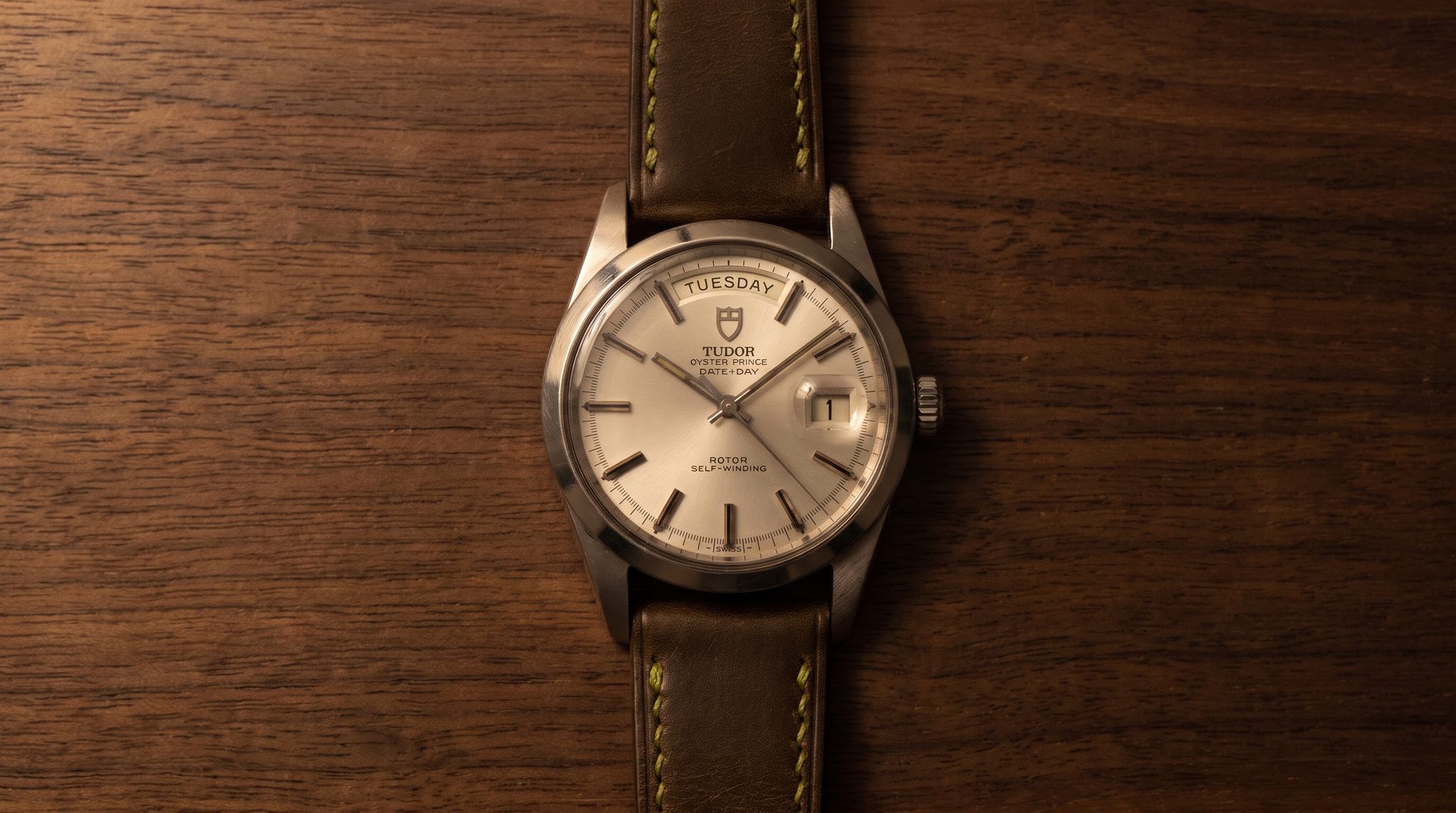
The Tudor Prince Date-Day 76213 is a reference defined less by dated marks than by the surviving combination of its two-tone case, ETA day-date movement, and parallel factory dial choices.
- Production
- 1990s–2010s
- Case
- 36 mm, steel/yellow gold
- Lugs
- 20 mm
- Thickness
- 10.5 mm listed
- Bezel
- Fluted yellow gold
- Crystal
- Sapphire
- Water resistance
- Often listed 100 m
- Movement
- ETA 2834-2 automatic
- Displays
- Day and date
- Bracelet
- Usually steel/yellow gold
- Crown
- Screw-down
The Tudor Prince Date-Day 76213 was produced from the 1990s through the 2010s.
- Production years
- 1990s–2010s
- Movement
- ETA 2834-2 automatic
The Tudor Prince Date-Day 76213 is a watch whose chronology remains broad even as its individual details are unusually legible: dated listings place examples from 1995 through 2014, while no factory record establishes a single beginning or end. That gap is the reference’s central collecting fact. The 76213 is not best understood as a neat succession of dial marks, but as a 36 mm steel-and-yellow-gold Oyster watch whose factory configurations overlap across the same general period. Its identity lies in the combination of a fluted yellow-gold bezel, day-and-date display, and ETA 2834-2 automatic movement, then in the exact dial and bracelet fitted to the individual example.
The proportions explain much of its character. A 36 mm case with 20 mm lugs presents more broadly than the diameter alone suggests, while the two-tone metal and fluted bezel give the compact case a distinctly formal visual language. The reference is commonly listed with a sapphire crystal and 10 ATM or 100 m water resistance, although the actual resistance of any surviving watch depends on seals, service history, and testing. Many listings show a Cyclops magnifier over the date, but the crystal should be verified on the watch itself rather than assumed from the reference number.
Its movement is the ETA 2834-2, a full automatic day-date calibre with the weekday aperture at 12 o’clock and the date at 3 o’clock. Listings give 25 jewels, a 28,800 A/h beat rate, and approximately 38 hours of reserve. Bidirectional winding is commonly included in descriptions of the calibre, but the available material does not establish that every Tudor example received an identical grade, regulator, rotor marking, or finish.
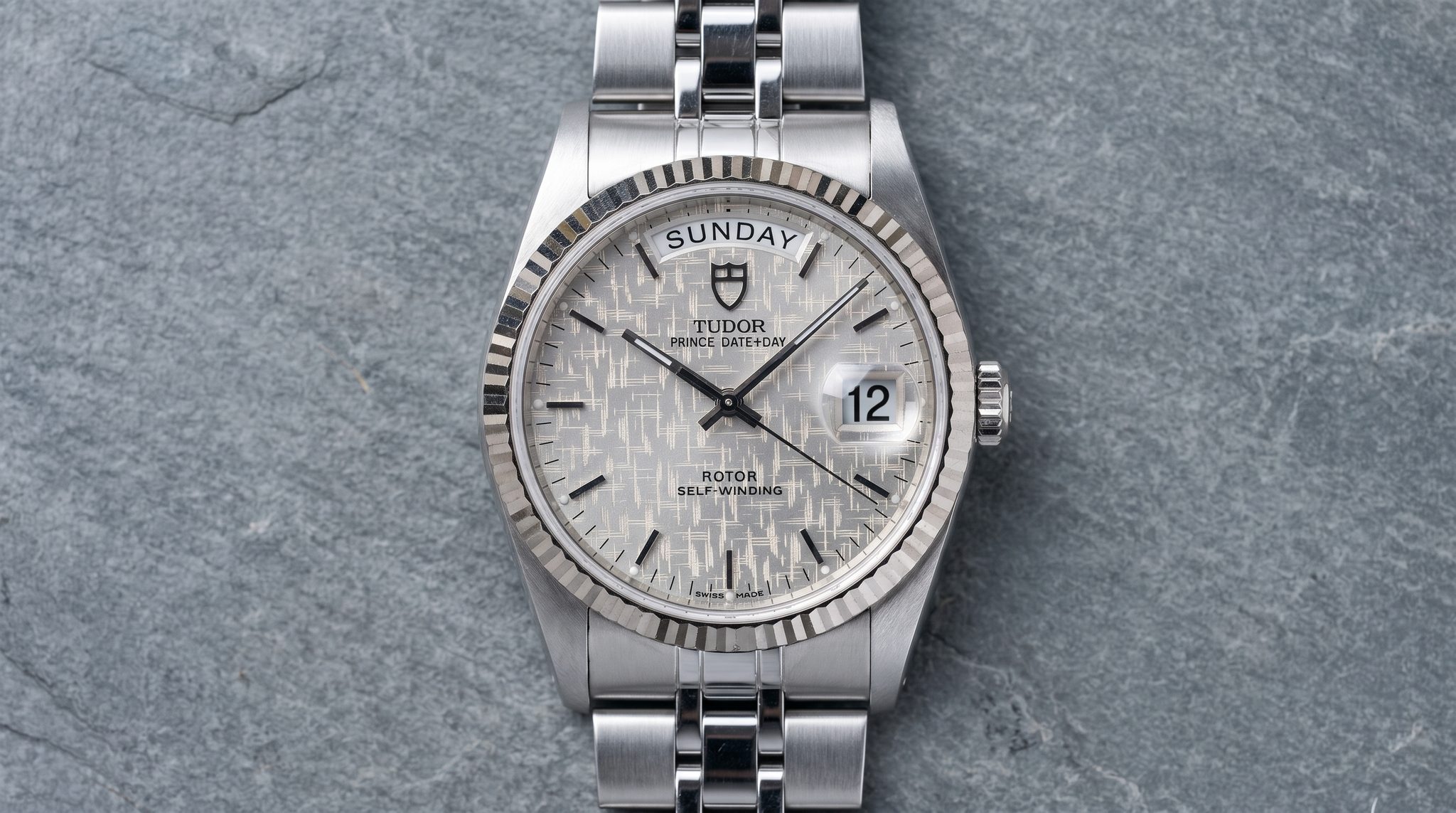
Dial choice supplies the most visible variation. Silver, white, champagne, linen or mosaic-textured, Roman-numeral, and diamond-marker executions are all documented. These are parallel configurations, not proven early and late generations. A champagne linen dial therefore does not date the watch by itself, and a diamond layout should not be bundled with a particular texture or lume period. Often shortened to Tudor 76213, the reference rewards an approach closer to object examination than to serial-number folklore: case, movement, dial, hands, crystal, and bracelet must make sense together.
“On the 76213, the dial is evidence of configuration, not a calendar: dated examples span the 1990s to the 2010s, while the factory never supplies a secure mark-by-mark timeline.”
Tudor Prince Date-Day 76213 production years: 1990s–2010s
The chronology begins with presence, not a launch announcement. A 1995 listing is currently the earliest dated evidence, and later listings continue through 2003, 2007, 2011, and 2014. Because listing dates can describe sale, cataloging, or an approximate model year, they establish a documentary span rather than a confirmed Tudor production run. The reason the available record lacks a factory start date is straightforward: the surviving material is dominated by marketplace and dealer records, not period Tudor catalogues or a serial-number study.
The mechanical identity is more stable. Across the documented examples, the ETA 2834-2 provides the full day-date display, with the weekday opening at twelve and the date at three. The available evidence does not establish an earlier and later movement generation within ref. 76213, so claims of a calibre handoff would confuse the reference with broader Prince family variations. The same caution applies to the case. Dealer descriptions around 35 and 36 mm are better read as measurement conventions than as proof of a redesign, while the repeatedly reported 36 mm figure and a listed 20 mm lug width define the practical proportions.
Dial variation follows a different logic from movement and case identity. Silver, white, champagne, linen or mosaic, Roman-numeral, and diamond-marker executions appear within the same broad period. The evidence does not show that porcelain replaced linen at a particular date, that diamond setting marked a later generation, or that Roman numerals belonged to an earlier run. Collectors can infer parallel catalogue or regional options because these executions overlap in dated listings, but no period catalogue supplied here assigns them a chronological order. Lume is even less useful: no reliable material establishes tritium or Super-LumiNova cutoffs for this reference.
By the time the documented examples reach the 2010s, the 76213 looks less like a reference moving through successive technical generations than like one platform carrying several visual choices. That is the useful zoom-out: what appears at first to be a timeline of small changes is, on the available evidence, a stable day-date architecture surrounded by independently changing surfaces. The watch was assembled by configuration, while later collecting tends to assemble a chronology that the records do not securely provide.
- c. 1995Earliest listingsTwo-tone case and day-date layout reported
- c. 2000Core configurationDay aperture at twelve, date at three
- c. 2003Parallel dialsLinen or mosaic texture varies independently
- c. 2007Diamond optionsSelected hour positions carry factory-style diamonds
- c. 2011Later examples36 mm case, gold fluted bezel, day-date display
- c. 2014Latest listingsNo proven discontinuation record is available
76213 against its neighbours
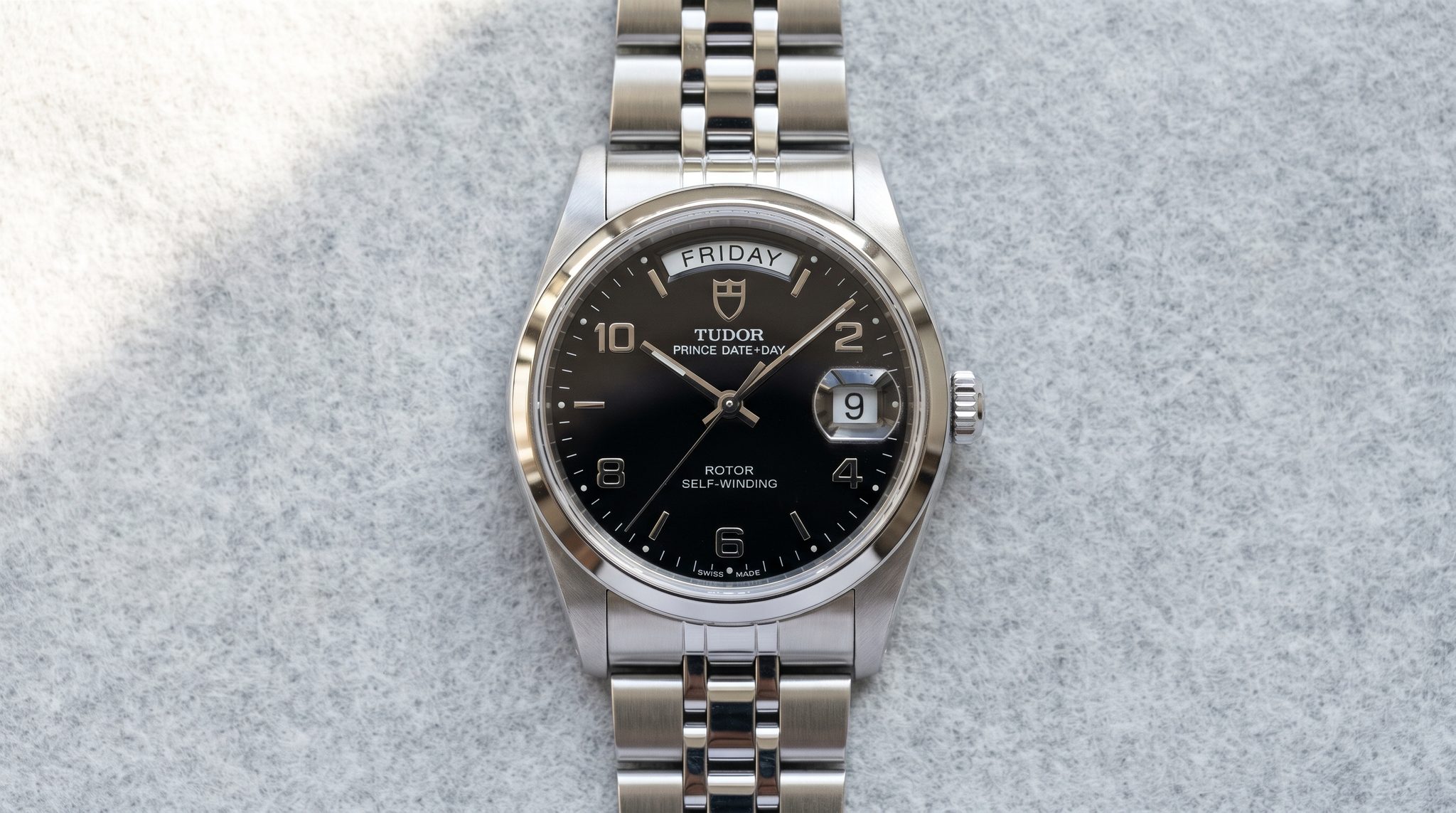
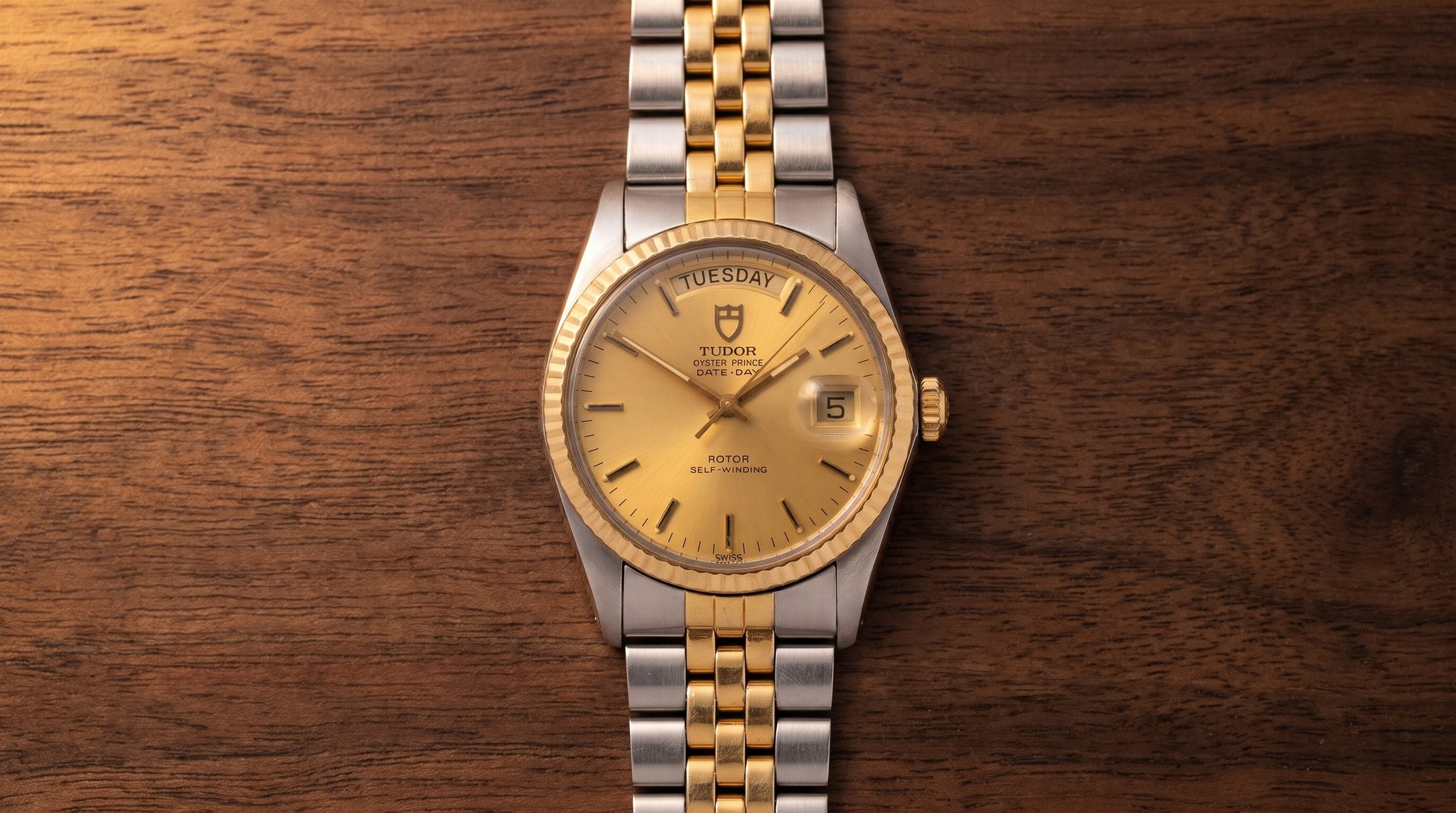
The closest comparisons frame a problem of nomenclature rather than a clean mechanical succession. The broader 76200 family shows how many Prince Date-Day configurations shared the ETA-based architecture, while 76214 illustrates why a later reference number should not automatically be treated as a documented generational replacement.
This reference 76213 Tudor · focal 1990s–2010s | |||
|---|---|---|---|
| Production | c. 1988–at least 2017 | 1990s–c. 2020 | 1990s–2010s |
| Case | Stainless steel | Steel / 18k white gold | 36 mm, steel/yellow gold |
| Bezel | Smooth, polished | Fluted white gold | Fluted yellow gold |
| Crystal | Sapphire | Sapphire | Sapphire |
| Movement | ETA 2834-2 automatic | ETA 2834-2-based | ETA 2834-2 automatic |
Five dial generations across the run
This is the principal documented configuration: a stainless-steel case with a yellow-gold fluted bezel, commonly accompanied by a two-tone bracelet. On the wrist, the contrast is structural rather than decorative, with gold concentrated in the bezel and, depending on the bracelet configuration, the center links or crown. The broad evidence span does not establish when this arrangement began or ended, and a dated listing cannot by itself prove a manufacture window.
What to check before buying a 76213
Buying a Tudor Prince Date-Day 76213 means buying the specific watch in front of you, not an abstract production year. The reference is documented with several dial executions, bracelet arrangements, and occasional leather straps, while its exact factory chronology remains unsettled. A convincing example must make sense as a whole: case, movement, dial, hands, crystal, bracelet, and service history should agree.
Tudor Prince Date-Day 76213 price and value
A Tudor Prince Date-Day 76213 sells for about $1,400 at the median, typically $1,300 to $2,400 across 8 comparable sales.
Tudor Prince Date-Day 76213 for sale
Indicative figures from recent dealer, auction, and Grey Market sales (updated this week). Every watch is verified before it sells here.
Each point is a recent dealer or auction sale, banded to an indicative figure. The range shown is not a valuation.
Grey Market runs watch auctions for vintage and neo-vintage pieces, every lot reviewed before it lists and verified before the seller is paid, and the Watch Exchange, where ID-verified users buy and sell at a fixed price. Selling one? See the ways to sell a Tudor, or check what it’s worth. For more vintage Tudor, see the Tudor reference guide.
Adjacent in the Prince Date-Day family
Common questions about the 76213
The Tudor Prince Date-Day 76213 was produced from the 1990s to the 2010s. Available listings include examples dated 1995, 2003, 2007, 2011, and 2014, but those dates do not establish a confirmed factory start or end date.
- Tudor Prince Date Day 76213 automatic steel/gold dialchrono24.com
- Tudor Prince Date Day 76213 gold linen dialchrono24.com
- Tudor Prince Date 76213 yellow gold and stainless steeleverywatch.com
Show 7 more
- Tudor Prince Date Day 76213 diamond linen dialchrono24.com
- Tudor Prince Date Day 76213 listingschrono24.com
- Tudor Prince Date-Day 76213 dealer listingeverywatch.com
- Tudor 76213-0016 Prince Date watcheschrono24.co.uk
- Tudor 76213 reference listingschrono24.hk
- Tudor Prince Date-Day 76213 white dialeverywatch.com
- Tudor Prince Date Day Golden Dial Automaticchrono24.com