

Tudor Prince Date-Day 76200
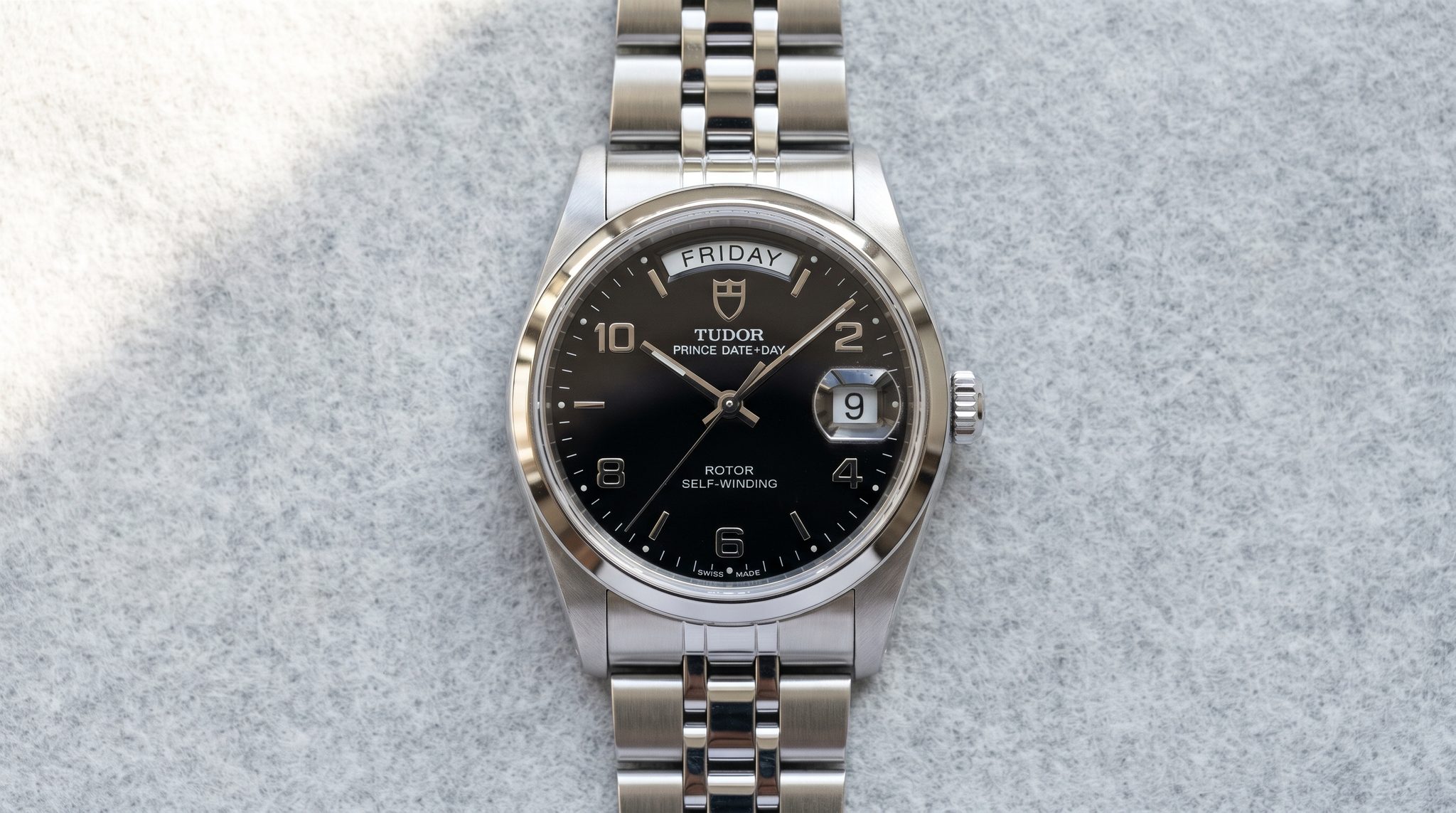
The Tudor Prince Date-Day 76200 is the 36 mm steel reference whose changing dials matter more than any clean production story.
- Production
- c. 1988–at least 2017
- Case
- Stainless steel
- Size
- 36 mm
- Lug width
- 20 mm
- Thickness
- ~10–10.5 mm
- Bezel
- Smooth, polished
- Crystal
- Sapphire
- Water resistance
- 100 m / 10 ATM
- Movement
- ETA 2834-2 automatic
- Functions
- Day and date
- Bracelet
- Integrated Oyster-style steel
The Tudor Prince Date-Day 76200 was produced from about 1988 to at least 2017.
- Production years
- c. 1988–at least 2017
- Movement
- ETA 2834-2 automatic
The Tudor Prince Date-Day 76200 is best understood not as a watch with one perfectly bounded era, but as a stable 36 mm platform that accumulated different faces over time. One documented example is dated approximately 1988, another is identified as a 1997 watch, and later records reach 2017. That unusually wide spread, combined with the absence of a factory-confirmed start or end date, is the reference’s defining collecting fact: the dial and the condition of the individual watch often tell more than the number 76200 alone.
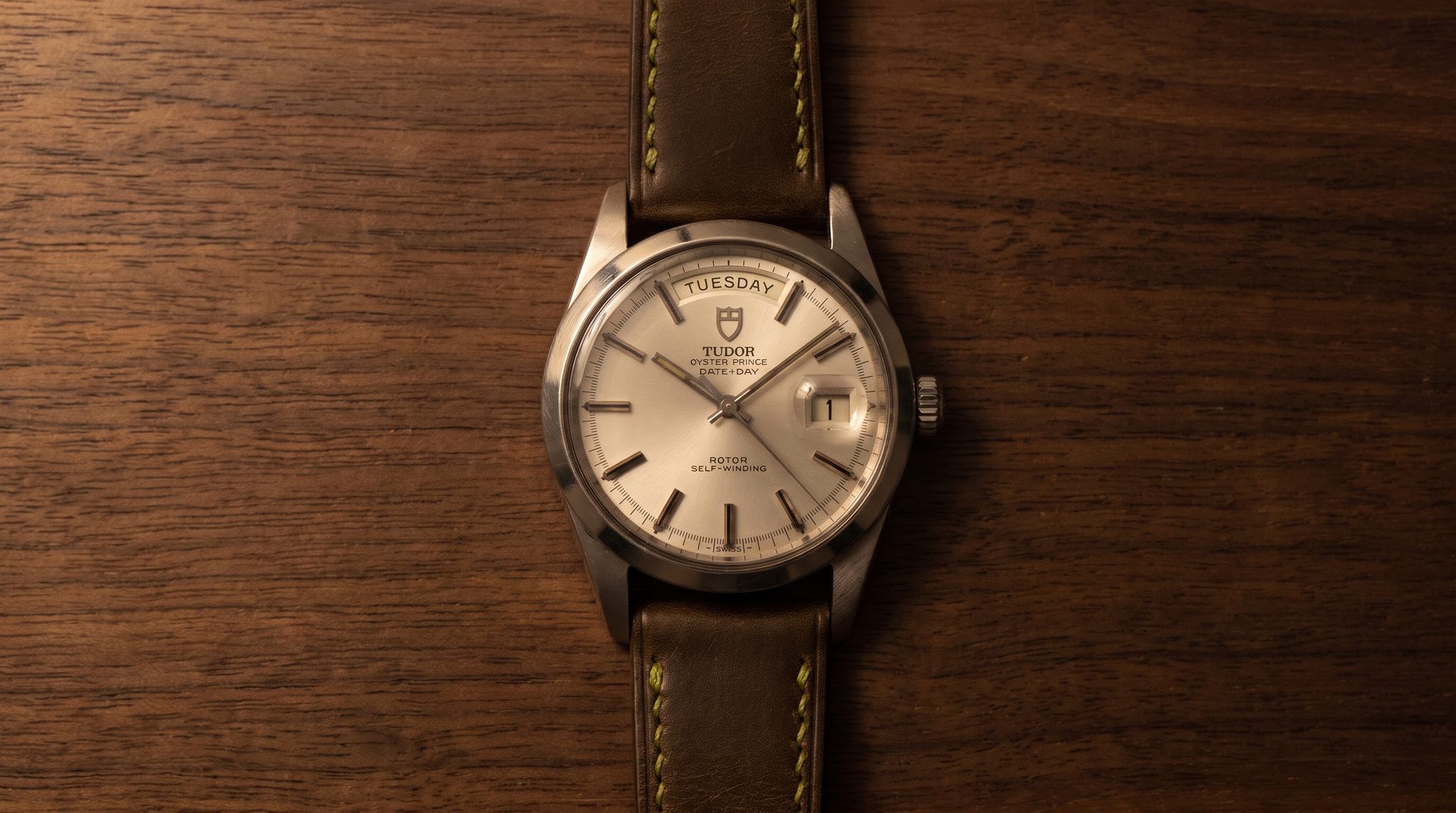
Its underlying design is reassuringly consistent. The 76200 uses a stainless-steel Oyster-style case with a smooth polished bezel, sapphire crystal, integrated steel bracelet, and an automatic ETA 2834-2 movement. The day aperture sits at 12 o’clock and the date at 3, giving the watch the full calendar presence of a traditional day-date while retaining Tudor’s compact 36 mm proportions. At roughly 10 to 10.5 mm thick, with 20 mm lugs and a lug-to-lug span of approximately 42.9 to 43.4 mm, it wears as a practical dress watch rather than a small novelty.
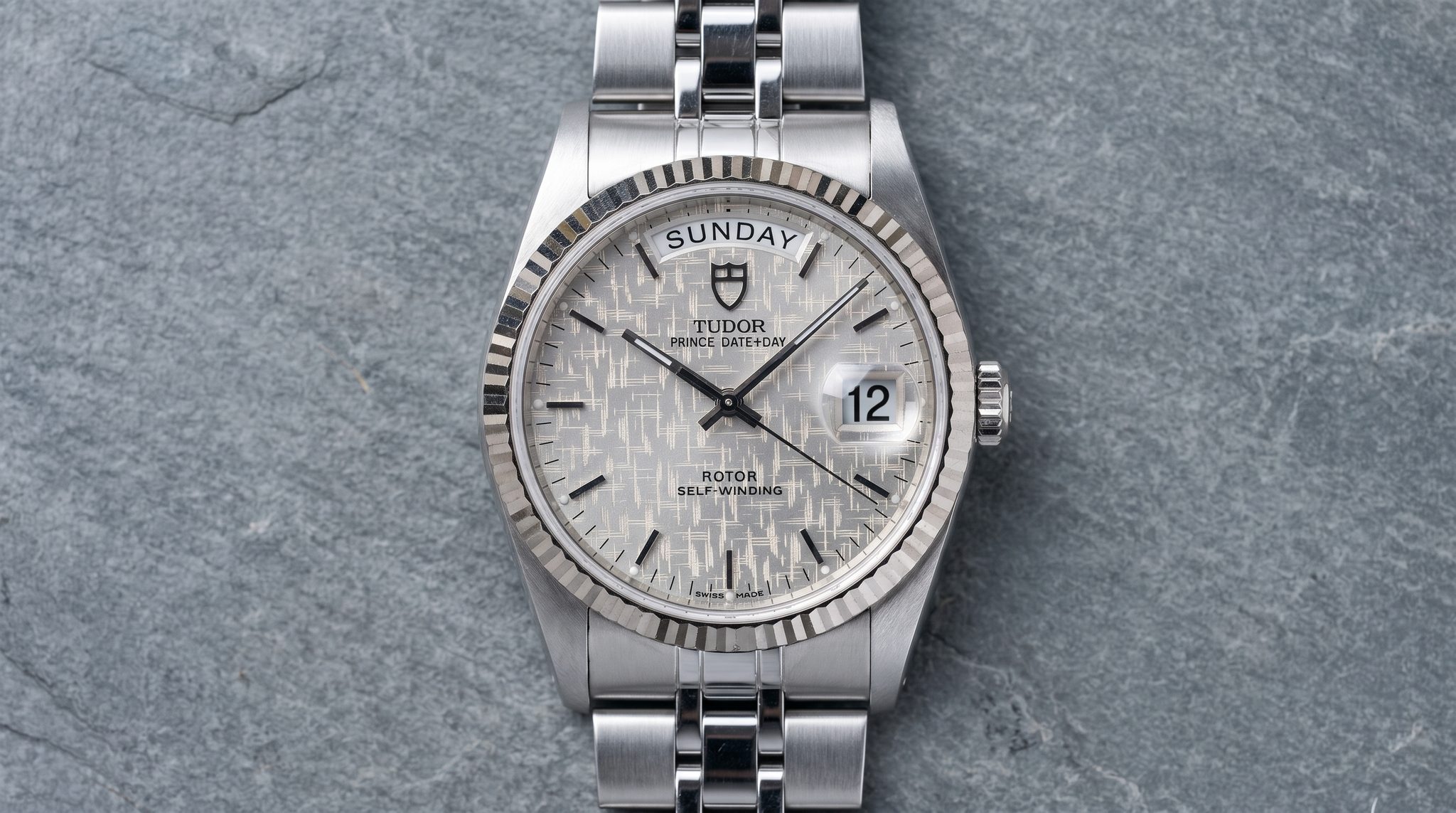
What changes is the surface. Black, blue, plain silver, and silver linen or textured dials are documented, alongside different numeral and marker treatments. Those details are collectible precisely because they do not form a securely proven sequence. A linen dial shows a woven-looking texture that breaks the light across the otherwise restrained case; a blue dial changes the watch’s character without changing its reference; an Arabic-numeral layout makes the same day-date architecture feel more openly graphic. None of those appearances, by itself, proves a particular year or movement generation.
That makes the 76200 a watch to assess as a complete object. The ETA 2834-2 is a recurring technical identifier, but the evidence does not establish multiple chronological movement generations. Bracelet, leather, and textile configurations also need to be separated from factory reference changes. The strongest example is therefore not simply the oldest or the rarest-looking one, but the one whose dial, hands, case, movement, bracelet, and stated date make a coherent whole.
“The 76200 is a watch whose stable case hides an unstable chronology: from approximately 1988 to at least 2017, the dial is often the more revealing object.”
Tudor Prince Date-Day 76200 production years: c. 1988–at least 2017
The earliest date attached to the 76200 is approximately 1988, but it comes from an individual dealer listing rather than a Tudor production register. The 1997 auction example matters for a different reason: it confirms that the reference was established with the ETA 2834-2 by that point. The movement therefore dates the watch’s mechanical configuration, not necessarily its dial, since the same calibre is documented across different dial executions.
During the 1990s and 2000s, the evidence expands sideways rather than along a clean sequence. Black, plain silver, blue, and silver linen or textured silver dials are all documented, yet no reliable catalogue establishes that one replaced another at a fixed date. The reason for the absence of a definitive dial chronology is not documented. What can be seen on the watch is more useful than a presumed order: linen breaks reflected light into a fine woven pattern, while blue changes the visual weight of the compact case without changing its reference. Colour and texture are independent traits, so neither should be used as a proxy for the movement.
Strap evidence follows the same logic. Steel-bracelet examples establish the normal visual baseline, while leather and textile listings show that alternate configurations existed or were fitted later. A strap alone cannot prove a separate factory variant. By 2017, the reference still appears in the documented record with the same broad 36 mm steel and ETA 2834-2 identity. Across nearly three decades of dated examples, the striking fact is how little the architecture changes while the available surfaces multiply. The 76200 was not a single frozen specification so much as a durable form that allowed its identity to move to the dial.
- c. 1988Early example36 mm case, smooth bezel, day-date layout
- 1997Movement documentedAutomatic day-date movement
- c. 1990s – 2000sDial breadthColour and surface change, case remains steel
- c. 2000sConfiguration spreadSteel bracelet, leather, or textile strap
- 2017Later exampleETA 2834-2, 36 mm stainless-steel case
76200 against its neighbours
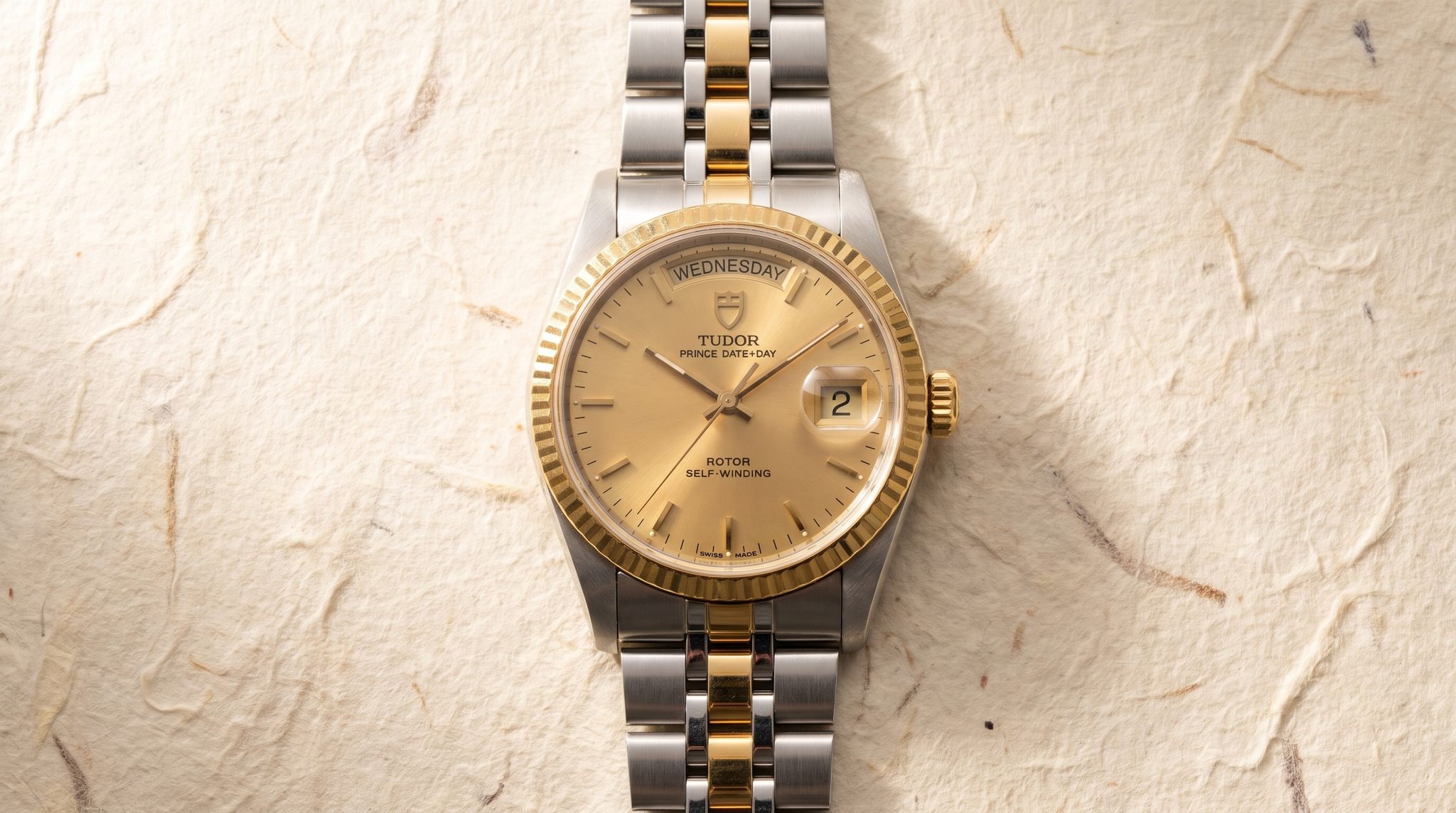
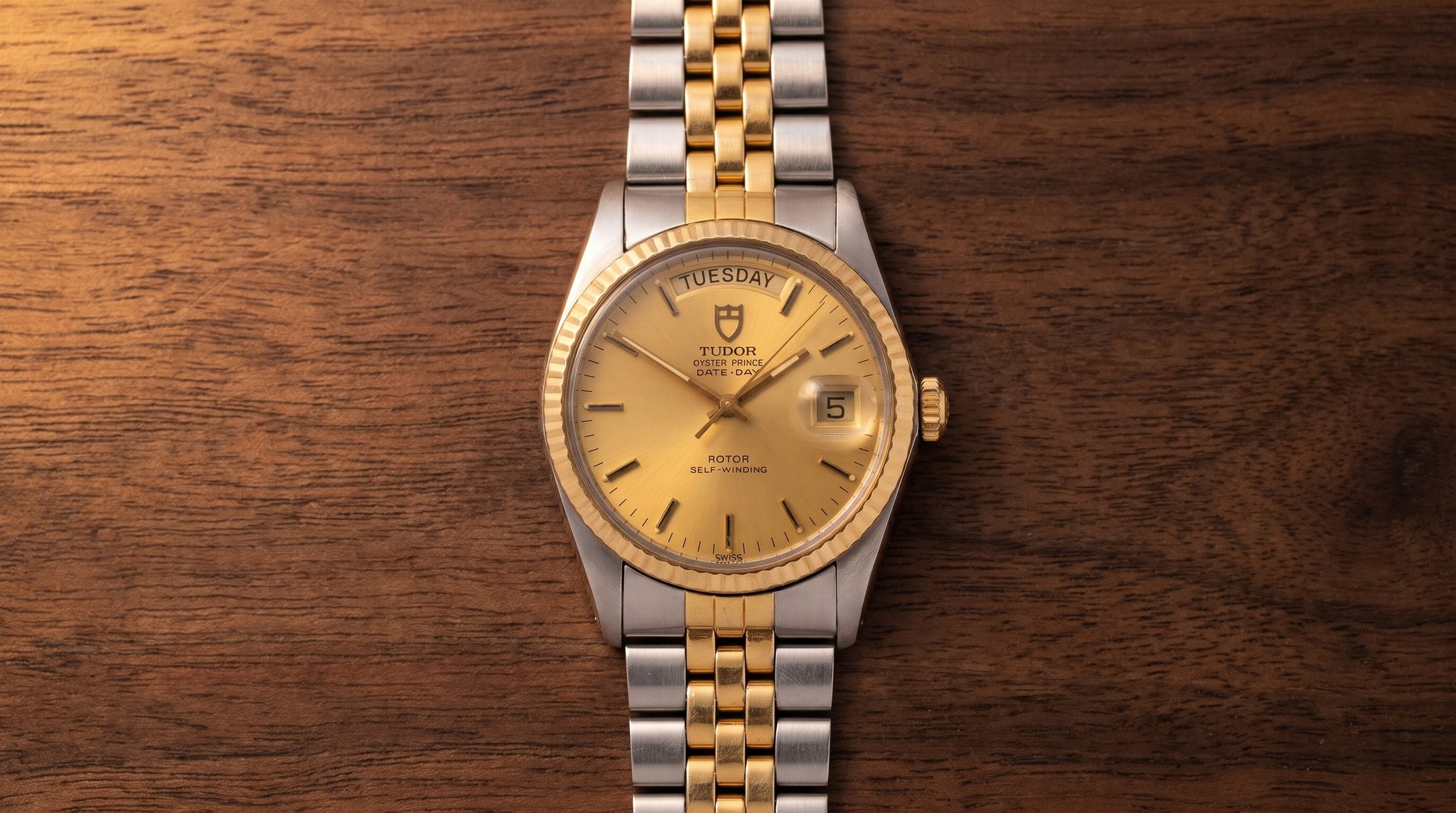
The closest comparisons show why the 76200 should be read as the plain-steel baseline of an overlapping family, not as one step in a simple linear succession. The 76214 keeps the steel case but adds a fluted white-gold bezel, while the 76213 changes the metal specification through two-tone construction.
This reference 76200 Tudor · focal c. 1988–at least 2017 | |||
|---|---|---|---|
| Production | c. 1988–at least 2017 | 1990s–c. 2020 | 1990s–2010s |
| Case | Stainless steel | Steel / 18k white gold | Steel and yellow gold |
| Size | 36 mm | 36 mm | 36 mm |
| Bezel | Smooth, polished | Fluted white gold | Fluted yellow gold |
| Movement | ETA 2834-2 automatic | ETA 2834-2 | ETA 2834-2 |
Four dial generations across the run
The black-dial 76200 is the most restrained reading of the case. Against the polished bezel, the dark surface makes the day and date apertures appear especially prominent, while Arabic numerals or linear markers alter the dial’s graphic character. Black examples are documented across later listings, but no evidence establishes a single black-dial production window or proves that every unusual numeral layout was factory-original.
What to check before buying a 76200
Buying a Tudor Prince Date-Day 76200 is less about locating the one correct era than about deciding whether the particular watch is internally coherent. The reference has a stable mechanical and case identity, but its production dates, dial sequence, and strap history are not fully documented. That leaves originality, condition, and the relationship between dial, hands, movement, case, and bracelet carrying unusual weight.
Tudor Prince Date-Day 76200 price and value
A Tudor Prince Date-Day 76200 sells for about $2,000 at the median, typically $1,600 to $3,000 across 7 comparable sales.
Tudor Prince Date-Day 76200 for sale
Indicative figures from recent dealer, auction, and Grey Market sales (updated this week). Every watch is verified before it sells here.
Each point is a recent dealer or auction sale, banded to an indicative figure. The range shown is not a valuation.
Grey Market runs watch auctions for vintage and neo-vintage pieces, every lot reviewed before it lists and verified before the seller is paid, and the Watch Exchange, where ID-verified users buy and sell at a fixed price. Selling one? See the ways to sell a Tudor, or check what it’s worth. For more vintage Tudor, see the Tudor reference guide.
Adjacent in the Prince Date-Day family
Common questions about the 76200
The Tudor Prince Date-Day 76200 was produced from approximately 1988 through at least 2017. Those endpoints come from individually dated examples rather than a confirmed Tudor factory chronology, so the exact start and end dates remain unresolved.
- Tudor Prince Date-Day 76200 Black Dial Men's Watch Auctionliveauctioneers.com
- Tudor Prince Date-Day Ref 76200 Automatic Mens Wristwatch Auctionliveauctioneers.com
- Tudor Prince Date-Day 76200 Automatic Stainless Steel Mens Wristwatch Auctionliveauctioneers.com
Show 7 more
- Tudor Prince Date-Day 76200 Stainless Steel Silver 1988 Germanyeverywatch.com
- 2017 Tudor Prince Date+Day Ref. 76200tickingtimehomme.com
- Tudor Prince Date Day 76200chrono24.com
- Tudor Prince Date-Day 76200swissemporium.com.au
- Tudor Prince Date 76200chrono24.ca
- Tudor Prince Date + Day Ref. 76200waecce.com
- Tudor Prince Date-Day 36MM Blue Dial Steel Braceletgrailzee.com