

Tudor Prince Date-Day 7017
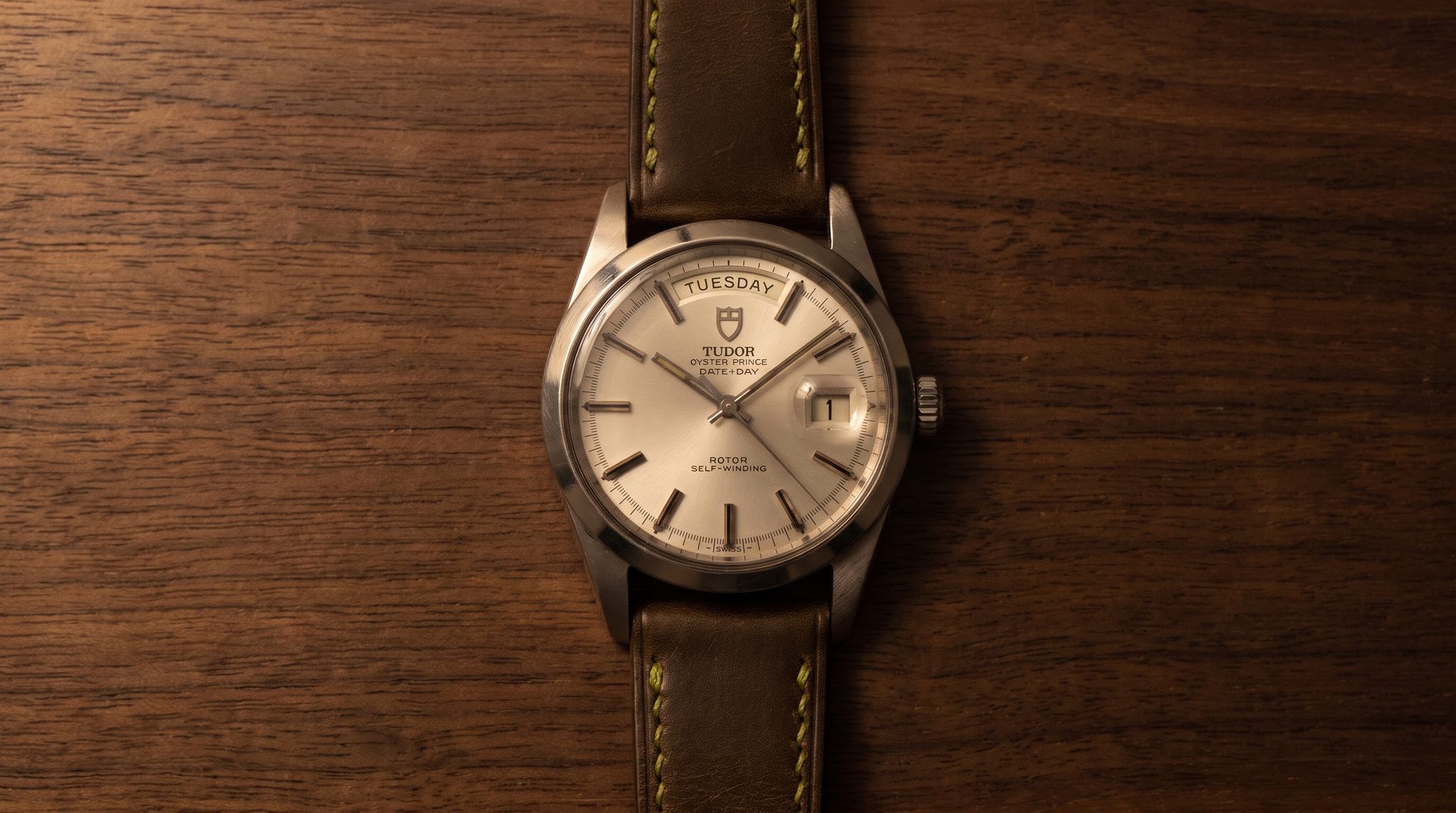
The Tudor Prince Date-Day 7017 is the first large Tudor day-date, a 37.5 mm experiment whose many independent details make every surviving example a study in transition.
- Production
- 1969–late 1970s
- Case
- Stainless steel, 37.5 mm
- Bezel
- Inclined/fluted-style
- Crystal
- Cyclops date lens
- Dial
- Day at 12, date at 3
- Caseback
- Screw-down Oyster
- Crown
- Screw-down Rolex-signed
- Movement
- A. Schild cal. 1895
- Winding
- Automatic
- Lume
- Hands; some markers
- Calendar
- Day and date
The Tudor Prince Date-Day 7017 was produced from 1969 to the late 1970s.
- Production years
- 1969–late 1970s
- Replaced by
- 94500
- Movement
- A. Schild cal. 1895
The Tudor Prince Date-Day 7017 is the watch in which Tudor’s day-date idea first became physically unmistakable: at 37.5 mm, it was notably large for its period, yet its surviving details do not settle into a neat sequence of official dial marks. Tudor introduced the model in 1969, and examples continued into at least the 1970s, but the meaningful story is not a simple run of replacements. It is a watch whose dial color, logo, lume, crown marking, and movement have to be read as separate evidence.\n\nThat makes the 7017 more than an early calendar watch. Its stainless-steel Rolex Oyster case carries the day aperture at 12 o’clock and a magnified date at 3, while the Tudor-signed A. Schild calibre 1895 provides automatic winding, centre seconds, and both calendar indications. The case is large enough to give the display architectural presence, but restrained enough to remain a formal watch rather than a tool model. Tudor’s archive identifies the case at 37.5 mm; auction and dealer measurements commonly land closer to 37 or 38 mm, a difference that can reflect measuring method, polishing, or listing practice.\n\nIn the hand, the collectible interest lies in the distinctions that do not line up automatically. A rose emblem points toward the earlier logo era, while Christie’s associates the applied Tudor shield with production after 1969. That does not date the lume, crown underline, or dial color by itself. Silvered, champagne-toned, blue, slate-blue, and black executions are documented, as are examples with luminous hands alone or with additional luminous dots. None of those traits forms a securely documented Mark I, II, or III system.\n\nThe result is a reference that rewards inspection rather than shorthand. A coherent 7017/0 is an early, oversized steel Date-Day with a recognizable Oyster architecture and a period movement. A composite watch can look equally convincing from across the room. The 7017’s singular place in Tudor history is therefore also its collecting consequence: it is the first large Date-Day, and its variations record a model still being worked out in real time.
“The 7017 is Tudor’s first large Date-Day, but its real lesson is that a dial color, a logo, and a lume plot do not necessarily share a calendar.”
Tudor Prince Date-Day 7017 production years: 1969–late 1970s
The 7017 began as a clear expansion of Tudor’s calendar format, not as a documented replacement for one earlier Date-Day reference. Tudor’s archive places its introduction in 1969 and names the A. Schild calibre 1895, so the large case and day-date mechanism belong to the model’s starting identity rather than a later upgrade. The reason for the case’s unusually generous size is not documented, but its 37.5 mm figure explains why collectors later called it “Jumbo.”\n\nThe logo is the strongest broad chronological clue. Christie’s identifies the applied Tudor shield as post-1969, because the rose had been retired by then. Collectors can therefore use rose and shield as evidence of an earlier or later logo era, but not as a master key for every other component. The available record does not prove that the logo transition happened simultaneously with a lume change, a crown-marking change, or a movement change.\n\nDial color follows a different logic. Silvered and champagne-toned, blue and slate-blue, and black dials are documented across the 7017 family, but no authoritative sequence assigns each color to a fixed run. On the wrist, the distinction is immediately visible: blue can read slate or grey-blue under changing light, while a black dial presents a flatter, darker field behind the applied steel markers. Those appearances identify the dial execution, not a production date.\n\nLume must be read separately again. Some examples show luminous inserts in the hands, while others also describe luminous dots or markers at the outer five-second divisions. The reason those elements do not share a documented cutoff is simple: the surviving descriptions show them occurring independently. The Twinlock crown indication is another separate clue, with an underline beneath the Rolex coronet described by Christie’s, but no reliable date maps that marking cleanly to a particular dial or calibre.\n\nBy the time examples appear in the 1970s, the reference had accumulated several visible combinations without becoming a formal series of marks. That is the larger point of the 7017: a model now read as a Tudor archetype was still being resolved component by component, and the surviving watches preserve that unfinished process.
- 1969Model introduced37.5 mm Oyster case, day at 12
- 1969Calibre establishedAutomatic centre-seconds movement
- c. 1969Logo transitionShield instead of rose emblem
- c. 1970sDial executionsColor changes without new reference
- c. 1970sLume remains variableHands luminous, dots optional
- c. 1970sDocumented continuationNo authoritative final year
7017 against its neighbours
The 7017 is best understood against the later ETA-powered 94500, which shows what changed when Tudor's Date-Day moved to a later movement generation and what stayed with the early steel Oyster Prince format.
This reference 7017 Tudor · focal 1969–late 1970s | 94500 Later successor c. 1985 example | |
|---|---|---|
| Production | 1969–late 1970s | c. 1985 example |
| Case | Stainless steel, 37.5 mm | Stainless steel Oyster |
| Movement | A. Schild cal. 1895 | ETA cal. 2834-2 |
| Dial | Day at 12, date at 3 | White Roman numerals |
Eight dial generations across the run
The light metallic dials are the most restrained expression of the 7017. Silvered surfaces can catch the light as a soft sunburst, while champagne-toned examples warm the steel case without turning it into a precious-metal watch. Applied faceted batons, an outer minute and fifth-second track, the day aperture at 12, and the Cyclops date at 3 establish the reference. This is a dial execution within 7017/0, not a separate factory reference, and its exact cutoff is not documented.
What to check before buying a 7017
Buying a Tudor Prince Date-Day 7017 is less about finding the right advertised color than about testing whether the parts belong together. The reference is documented with several dial executions and independent logo, lume, crown, and movement details, while the exact production cutoffs remain incomplete. A watch that looks attractively old may still be a composite of a refinished dial, replacement hands, later crown, or substituted movement.
Tudor Prince Date-Day 7017 price and value
Tudor Prince Date-Day 7017 for sale
Auctions on Grey Market run on seven-day cycles, every watch verified before it sells. Browse what's live now, or consign your 7017.
Grey Market runs watch auctions for vintage and neo-vintage pieces, every lot reviewed before it lists and verified before the seller is paid, and the Watch Exchange, where ID-verified users buy and sell at a fixed price. Selling one? See the ways to sell a Tudor, or check what it’s worth. For more vintage Tudor, see the Tudor reference guide.
Adjacent in the Prince Date-Day family
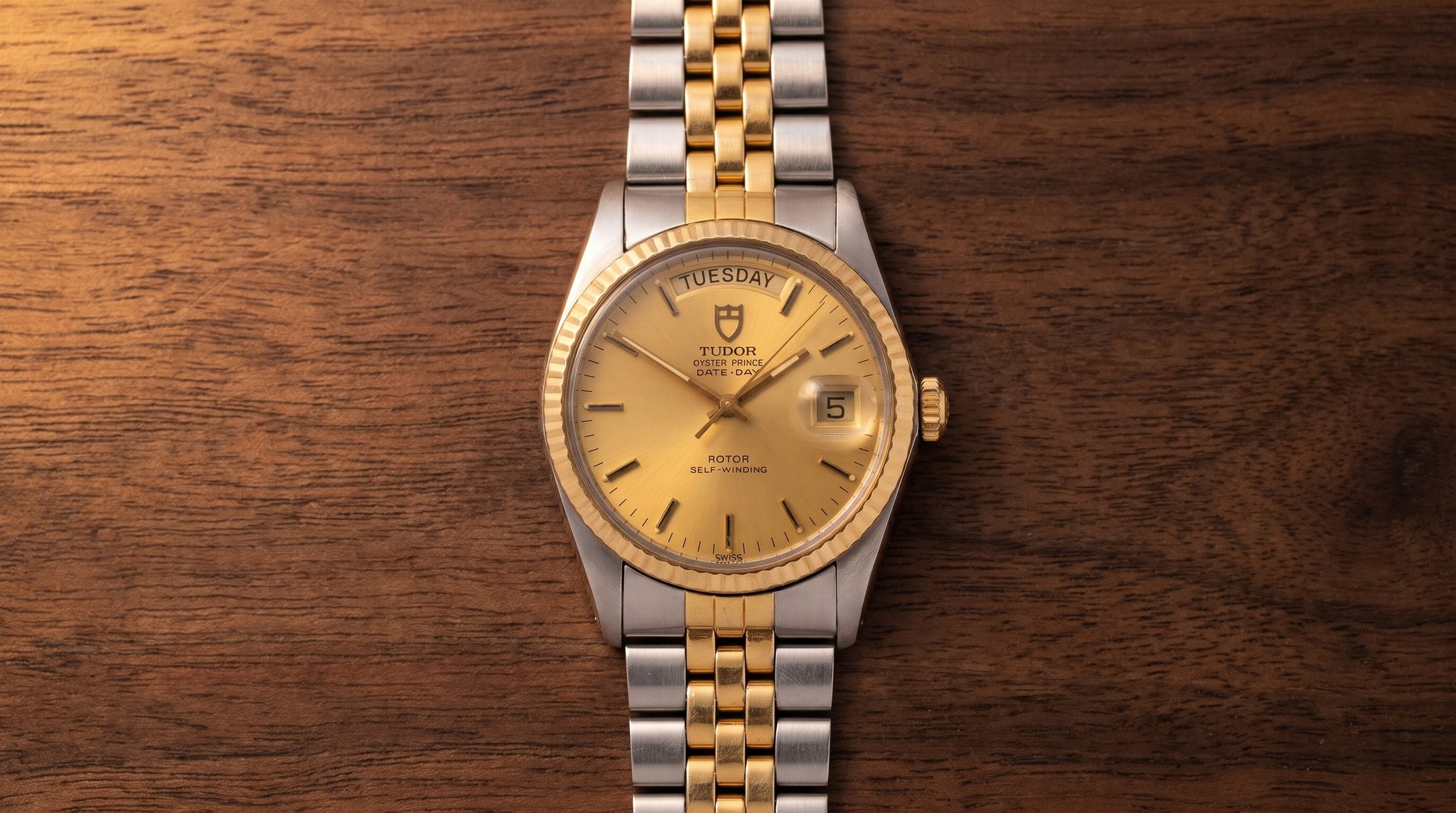
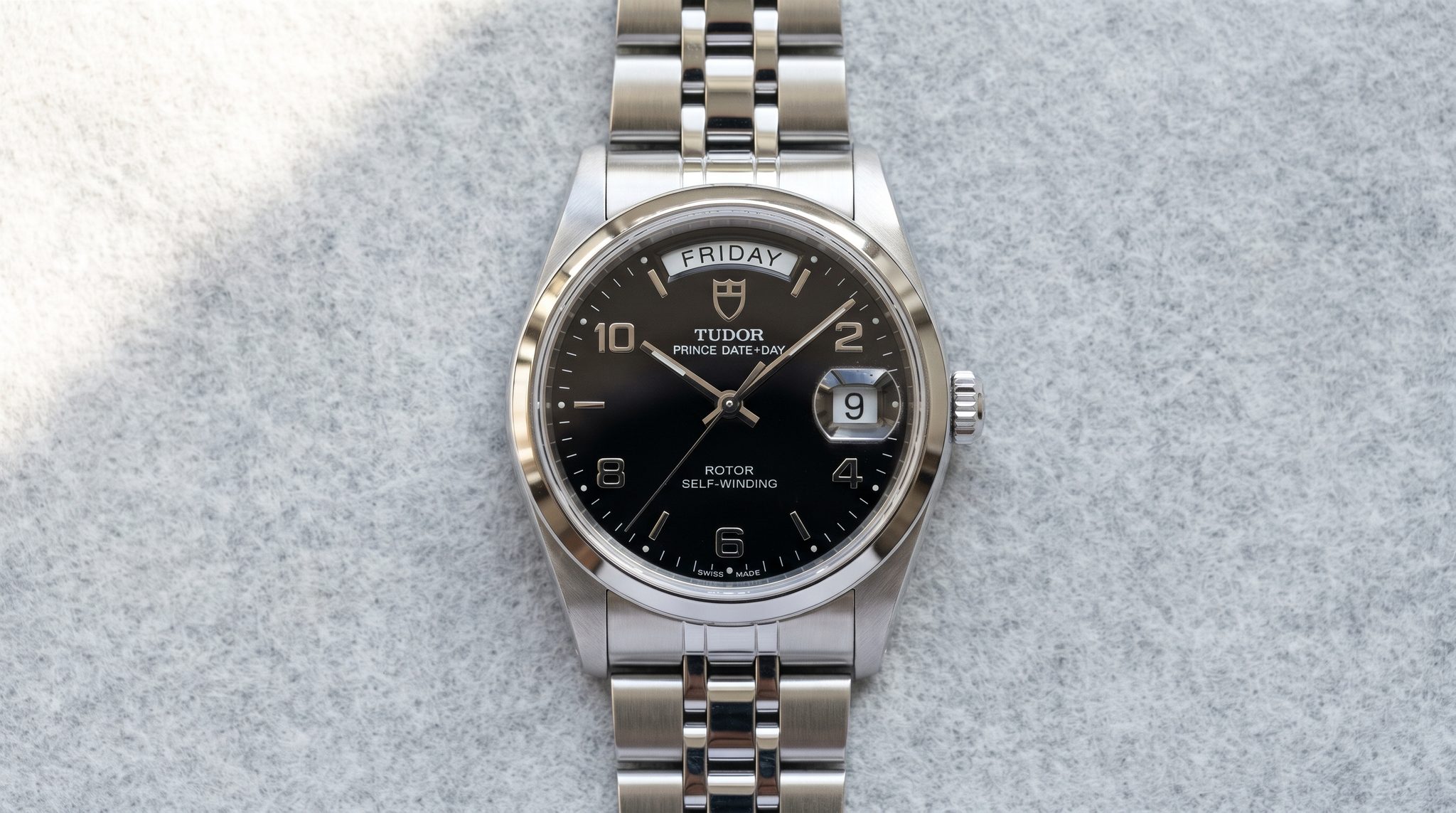
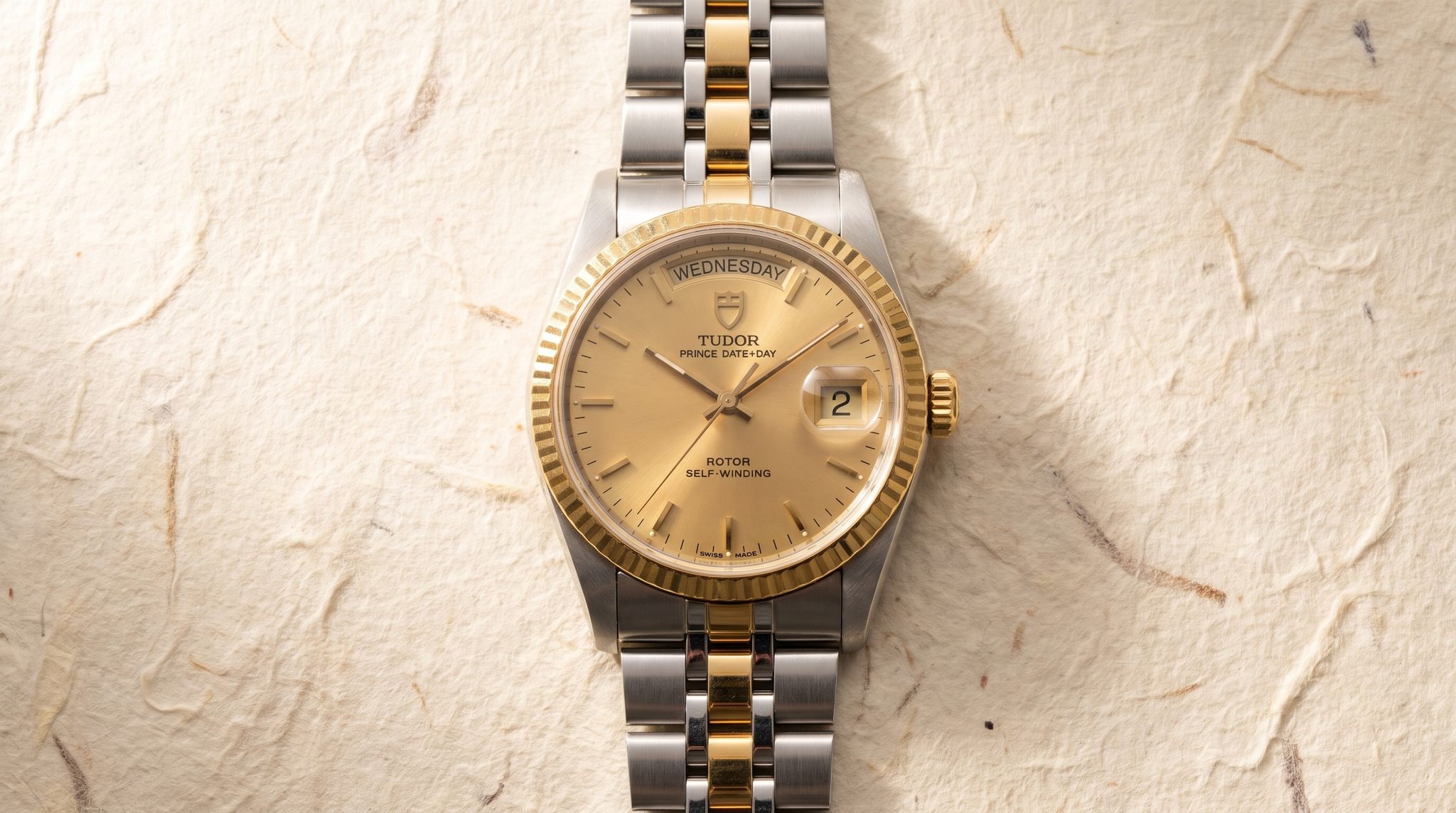
Common questions about the 7017
The Tudor Prince Date-Day 7017 was produced from 1969 to the late 1970s. Tudor’s archive gives the introduction as 1969 and describes the model as produced from 1969 onward, but the available authoritative material does not establish a firm final year.
- Tudor History: The Origins, from 1960 to 1969tudorwatch.com
- Deconstructed: Tudor Day-Date, Ref. 7017, circa 1969christies.com
- TUDOR Ref. 7017 Date Day Steelantiquorum.swiss
Show 6 more
- Tudor Oysterdate Prince 7017 Watches Indexcollectorsquare.com
- Tudor Oyster Prince Day-Date 7017/0timemerchants.ca
- Tudor Prince Date Day 7017/0chrono24.com
- Oyster Prince Day-Date Reference 7017/0chrono24.com
- Tudor Prince 7017/0 Stainless Steel Blueeverywatch.com
- Oysterdate Prince Ref. 94500collectorsquare.com