

Rolex Yacht-Master 16628
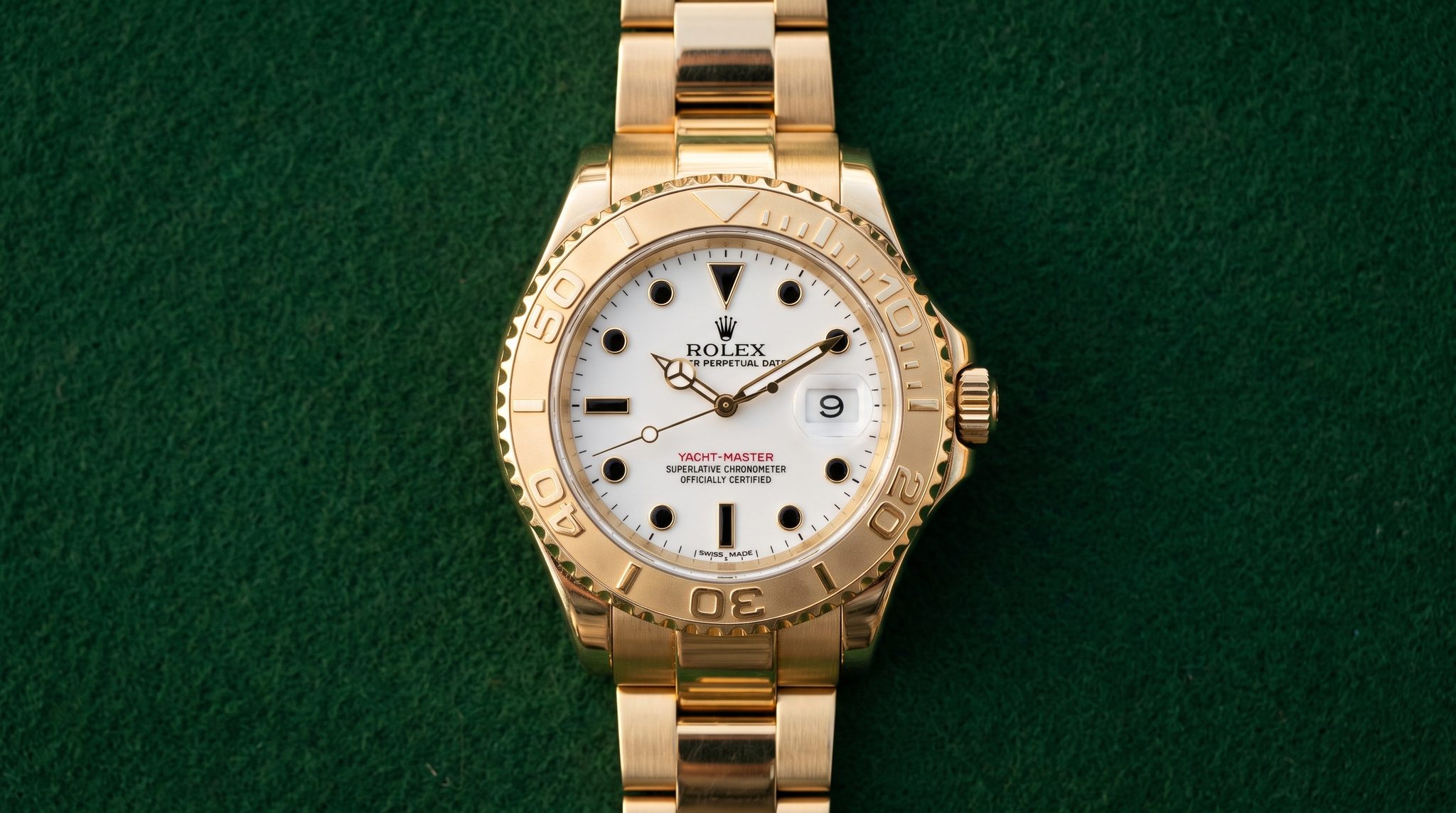
The Rolex Yacht-Master 16628 is the original Yacht-Master, launched in 1992 as a 40 mm, solid 18 ct yellow-gold sports watch powered by the Cal. 3135.
- Production
- 1992–c. 2000s/early 2010s
- Case
- 18 ct yellow gold
- Diameter
- 40 mm
- Thickness
- ~11.5–12.0 mm
- Lug width
- 20 mm
- Lug-to-lug
- 47.3 mm
- Bezel
- YG, bidir 60-min
- Water res.
- 100 m
- Movement
- Cal. 3135
- Chronometer
- Yes (COSC)
- Power
- ~48h
- Dial
- White (launch), others
The Rolex Yacht-Master 16628 entered the catalog as a finished luxury sports watch on its very first day, because the Yacht-Master line began in 1992 with a 40 mm model made entirely in 18 ct yellow gold. Often shortened to Rolex 16628, it set the formula Rolex would keep for decades: an Oyster case, a date at 3 o’clock, and a bidirectional 60-minute bezel whose raised, mirror-polished numerals sit proud of a matte ground like deck hardware.
Under the surface, the ref. 16628 is anchored by the Rolex Cal. 3135, the same movement used in contemporary Submariner and Sea-Dweller references, with quickset date and stop-seconds for precise setting. That combination of familiar Rolex architecture and conspicuously precious metal is the reference’s defining tension: it wears like a 5-digit sports Rolex in proportions (20 mm lugs and a case that measures about 11.5–12.0 mm thick), but it announces itself in weight and sheen.
The simplest historical fact about the 16628 is also the one that matters most when evaluating one today. There is no earlier Yacht-Master reference to “compare it to” for correctness, because this is the beginning of the family. The variations that do exist are mainly about how the watch presents itself at a glance, through dial executions that range from the documented launch white dial to later alternatives, rather than about fundamental shifts in case or movement.
“The Yacht-Master began in 1992 as ref. 16628: a 40 mm Oyster sports watch rendered entirely in 18 ct yellow gold, with the Cal. 3135 doing familiar Rolex work beneath an unapologetically luxurious exterior.”
16628 across 1992–c. 2000s/early 2010s
The Yacht-Master story starts unusually cleanly: the family does not evolve into existence through multiple references, it appears in 1992 with ref. 16628 in 18 ct yellow gold. The watch borrows the underlying logic of Rolex’s 5-digit sports Oyster cases and pairs it with a bezel designed for elapsed time on deck rather than for dive-time safety. That is why the bezel turns in both directions, and why its numerals are not printed but raised and polished, a detail that reads as jewelry finishing even before the rest of the watch does.
Rolex expanded the concept outward rather than replacing it. Smaller all-gold versions followed in 1994 (68628 and 69628), and in 1999 the 40 mm Rolesium ref. 16622 arrived as a cooler, steel-and-platinum alternative. A two-tone 40 mm reference, 16623, joined in 2005. These introductions explain the 16628’s role across its lifespan: it was the flagship expression of the idea while the rest of the line explored different sizes and metal mixes.
The one timeline detail that resists a neat date is the ending. Secondary sources disagree on when Rolex stopped producing the ref. 16628, with one placing it in the mid-2000s and others extending it to around 2011–2012. That uncertainty is part of the reference’s practical collecting identity: the 16628 is not a watch dated by a single headline transition, but by the coherence of its documentation and by the watch’s physical consistency with its claimed era.
A useful zoomed-out way to see the 16628 is as an origin point that stayed structurally stable while the Yacht-Master became a family. The model line that many people now associate with Rolesium tones and later strap options began as a full-gold, Cal. 3135-powered 40 mm watch, and everything else arrived alongside it, not instead of it.
- 1992Introduced18 ct gold, raised-numeral bezel
- 1994Sizes expand35 mm and 29 mm cases
- 1999Rolesium arrivesPlatinum bezel on steel
- 2005Two-tone optionSteel case with gold accents
- c. 2007End debatedCheck papers and serial era
- c. 2011 – 2012End debatedLater example documentation
16628 against its neighbours
The Yacht-Master 16628 is best understood by placing it between its closest 40 mm siblings: the Rolesium ref. 16622, which shares the same Cal. 3135-driven layout but changes the entire mood with steel and platinum, and the two-tone ref. 16623, which splits the difference in metal. None is a “predecessor” to 16628, because 16628 is where the line begins.
This reference 16628 Rolex · focal 1992–c. 2000s/early 2010s | 68628 Close sibling (midsize) from 1994 | |||
|---|---|---|---|---|
| Production | 1992–c. 2000s/early 2010s | from 1994 | 1999–c. 2012 | 2005–c. 2016 |
| Case | 18 ct yellow gold | 18k yellow gold | 904L steel + platinum | Steel + yellow gold (Rolesor) |
| Diameter | 40 mm | ~35 mm | 40 mm | 40 mm |
| Bezel | YG, bidir 60-min | – | 950 platinum, bidir | – |
| Water res. | 100 m | – | 100 m | – |
| Movement | Cal. 3135 | – | Cal. 3135 | – |
| Chronometer | Yes (COSC) | – | Yes (COSC) | – |
| Dial | White (launch), others | – | Platinum/rhodium | – |
Four dial generations across the run
The launch configuration that established the Yacht-Master look pairs the full yellow-gold case and bracelet with a bright white dial. In photos it reads crisp and nautical, and in person it makes the bezel’s raised numerals look even more sculptural because the polished gold catches light while the dial stays flat and clean. This is the best-documented starting point for the reference, and it is the closest thing the 16628 has to a “baseline” when evaluating originality.
Identification is largely about the overall composition rather than a hidden mark: white dial, date at 3 o’clock, gold Mercedes hands with luminous inserts, and the signature bidirectional bezel with raised polished numerals on a matte background.
What to check before buying a 16628
Buying a Yacht-Master 16628 is less about hunting an obscure technical sub-reference and more about judging whether a very expensive-looking object has lived an honest life. Solid yellow gold makes the usual Rolex condition topics matter immediately: polishing can soften the case, and bracelet wear and stretch can become a real cost issue on an all-gold Oyster bracelet.
Authenticity checks are also unusually visual on this reference. The Yacht-Master bezel should look and feel like precisely machined gold, with raised polished numerals standing cleanly above a matte background, and it should rotate smoothly in both directions. A bezel that looks flat, poorly finished, or behaves like a one-way dive bezel is a warning sign.
Finally, do not treat the stated production year on a listing as the whole story. The 16628’s discontinuation is documented inconsistently in secondary sources, so the safest path is coherence: paperwork that matches the watch, a configuration that makes sense for the era, and dial and hands that look born together rather than swapped later.
Rolex Yacht-Master 16628 for sale
Indicative market value from recent dealer, auction, and Grey Market sales: median ≈ $18,500, with a typical $12,750–$22,250 range across 32 comparable sales (updated this week).
Each point is a recent dealer or auction sale, banded to an indicative figure. The range shown is not a valuation.
Adjacent in the Yacht-Master family
Common questions about the 16628
Rolex introduced the Yacht-Master 16628 in 1992. Secondary sources disagree on the discontinuation year, placing it variously in the mid-to-late 2000s or around 2011–2012, so the most defensible statement is that production ran from 1992 into at least the mid-2000s with a disputed endpoint.
- Fratello: Some Rolex Yacht-Master Historyfratellowatches.com
- Bob's Watches: History of the Rolex Yacht-Masterbobswatches.com
- RolexMagazine: The Complete History of the Rolex Yacht-Masterrolexmagazine.com
Show 7 more
- The 1916 Company: Rolex Yacht Master Yellow Gold (16628) Reviewwatch.the1916company.com
- Strapfreak: Rolex Lug Width Tablestrapfreak.com
- Wikipedia: Rolex Yacht-Masteren.wikipedia.org
- Gray & Sons: History and Evolution of the Rolex Yacht-Mastergrayandsons.com
- RLXCPO: Rolex Oyster Perpetual Yacht-Master 40 16628 – Prices & Listingsrlxcpo.com
- WatchCharts: Rolex Yacht-Master 16628 overviewwatchcharts.com
- Chrono24: Rolex Yacht-Master ref. 16628 listings and production spreadchrono24.com