

Rolex Yacht-Master 116622
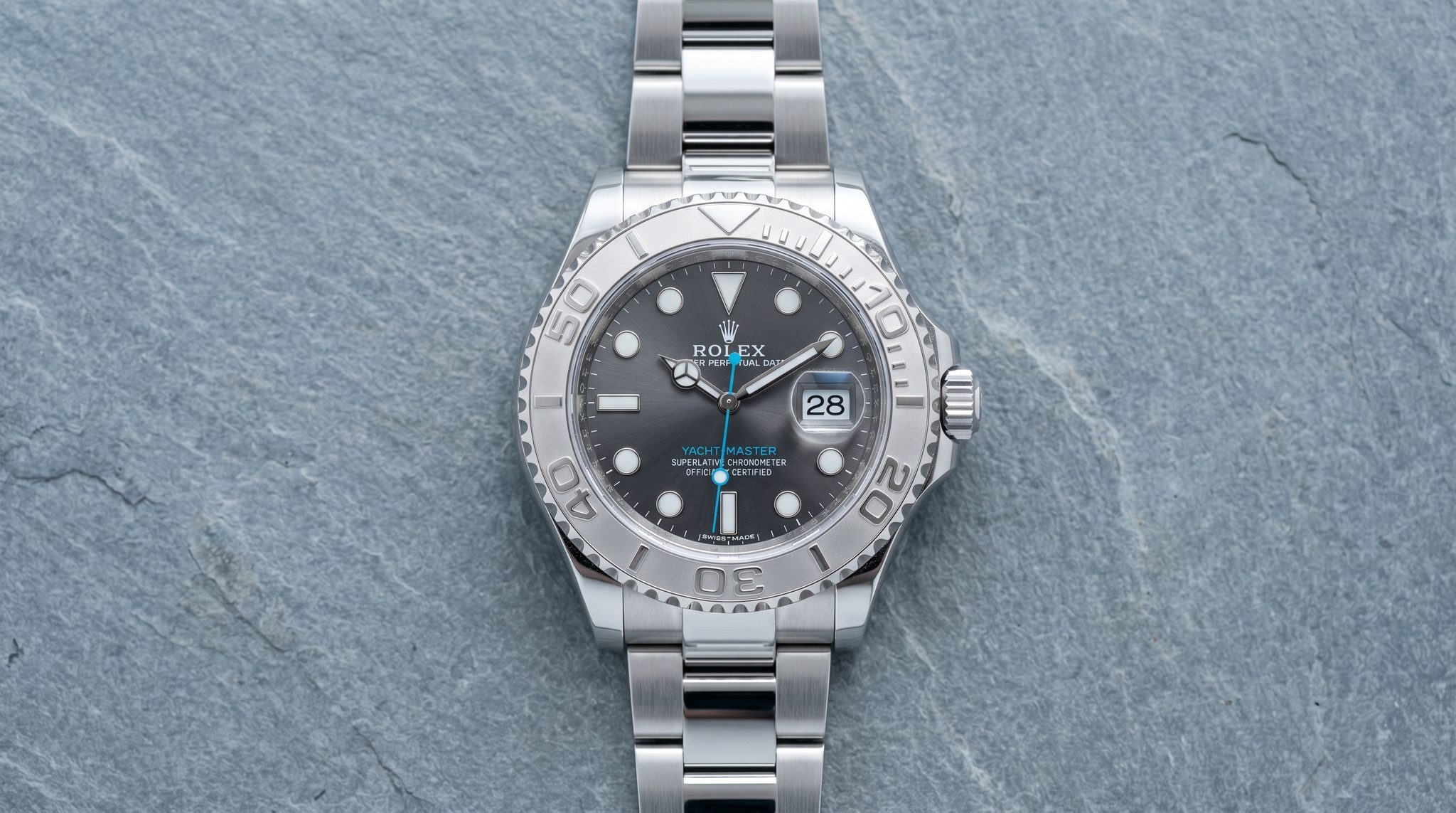
The Rolex Yacht-Master 116622 is the short-run (c. 2012–2019) Rolesium Yacht‑Master 40 that keeps its case, platinum bezel, and caliber 3135 constant while Rolex does most of its visible work through dial execution.
- Production
- c. 2012–2019
- Case
- Oystersteel
- Diameter
- 40 mm
- Thickness
- ~11.5–12.0 mm
- Lug-to-lug
- 47 mm
- Lug width
- 20 mm
- Bezel
- Platinum, bidir timing
- Crystal
- Sapphire, Cyclops
- Water res.
- 100 m
- Dial
- Blue / platinum / rhodium
- Movement
- Cal. 3135
- Lume
- Chromalight
The Yacht‑Master 116622 is Rolex’s clearest modern example of a reference defined more by its dials than by its hardware. Across its c. 2012–2019 run, the 40 mm Rolesium formula stays fixed, an Oystersteel case and bracelet paired with a sandblasted platinum bezel whose numerals stand up in polished relief, while the watch’s character is set by three factory dial executions that arrive and depart on their own timelines.
That concentration of change is unusually easy to see on the wrist. Tilt the bezel and the matte platinum field scatters light while the raised numerals flash; then the dial does the rest, shifting from a tone‑on‑tone platinum sunburst with red accents, to a bright metallic blue with white printing, to a late dark rhodium sunburst with bright blue text and a matching seconds hand. Underneath, the technical package is deliberately steady: a 40 mm case rated to 100 m, sapphire crystal with Cyclops date, and Rolex’s caliber 3135 throughout.
In the Yacht‑Master line, ref. 116622 sits between the first‑generation Rolesium 16622 and the movement‑updated 126622. It is also the point where the Rolesium Yacht‑Master becomes recognizably modern in daily wear details, with an upgraded clasp that adds the Easylink extension and a shift to blue‑glowing Chromalight lume, while retaining the familiar platinum timing bezel and the proven 3135 architecture. Collectors tend to treat the Rolex 116622 as the generation where dating and desirability inside the reference can be read most cleanly from the dial alone.
“Ref. 116622 keeps the Rolesium case, platinum bezel, and caliber 3135 constant, then lets dial color and accent scheme do almost all the within-reference distinguishing.”
116622 across c. 2012–2019
Rolex’s update from the 16622 to the 116622 lands around 2012 and reads like a targeted modernization rather than a reinvention. The Rolesium architecture remains the point, a steel Yacht‑Master 40 topped by a solid platinum bezel, but the feel in hand changes where owners notice it daily: reference guides describe the move to blue‑glowing Chromalight lume, and the clasp gains Rolex’s Easylink comfort extension.
What does change most visibly is the dial program. At launch, buyers could choose between a sunburst blue dial and a platinum‑tone sunburst dial whose red “YACHT‑MASTER” text and red seconds hand echo the earlier, more monochromatic platinum‑dial aesthetic of the 16622. In 2016, Rolex adds a third option at Baselworld: a dark rhodium sunburst dial that flips the accent color to bright blue, pairing blue dial text with a blue seconds hand. It is a small detail on paper, but it is instantly legible across a room, and it becomes the late-run signature of the reference.
The phase-out of the platinum dial is the only significant within-reference disappearance, and even its exact cutoff is debated. Dial-focused market summaries place its last production around 2017 and its effective catalog exit around 2018, while other editorial shorthand cites a 2016 retirement. What stays uncomplicated is the broader arc: the blue dial spans the full run, the dark rhodium dial is a late addition (c. 2016–2019), and the reference ends in 2019 when Rolex moves the Rolesium Yacht‑Master 40 to ref. 126622 and the newer caliber 3235.
Taken together, the 116622 shows how a modern Rolex sports watch can evolve with almost no mechanical drama. The movement remains the 3135, the case remains 40 mm, and the platinum bezel remains the tactile centerpiece, yet the watch reads as three distinct objects in photographs and on the wrist because Rolex concentrates change where the eye goes first.
- 2012IntroducedRolesium, Chromalight, Easylink clasp
- 2012Core dialsWhite vs red “YACHT‑MASTER” text
- 2016Rhodium debutsBlue text and blue seconds hand
- c. 2016 – 2018Platinum exitsPlatinum dial no longer catalogued
- 2019ReplacedCal. 3235 generation begins
116622 against its neighbours
Ref. 116622 makes the most sense framed by the Rolesium Yacht‑Master immediately before and after it: the 16622 establishes the steel-and-platinum formula and monochromatic dial idea, while the 126622 keeps the same external concept but marks the movement handoff to caliber 3235 and a longer power reserve. Between them, the 116622 is the 3135-era Rolesium Yacht‑Master with the Easylink clasp upgrade, Chromalight lume, and the three dial variants introduced during this generation.
This reference 116622 Rolex · focal c. 2012–2019 | |||
|---|---|---|---|
| Production | 1999–c. 2012 | c. 2012–2019 | 2019–present |
| Case | Stainless steel | Oystersteel | Oystersteel |
| Diameter | 40 mm | 40 mm | 40 mm |
| Bezel | Platinum, rotating | Platinum, bidir timing | Platinum, timing |
| Crystal | Sapphire | Sapphire, Cyclops | Sapphire, Cyclops |
| Water res. | 100 m | 100 m | 100 m |
| Movement | Cal. 3135 | Cal. 3135 | Cal. 3235 |
| Lume | Tritium → Super-LumiNova | Chromalight | Chromalight |
Three dial generations across the run
This is the most monochromatic 116622 configuration, the dial’s light grey sunburst finish sitting close in tone to the platinum bezel so the watch reads almost tone-on-tone. Identification is straightforward in hand because Rolex keeps the accents warm: the “YACHT‑MASTER” line is printed in red, and the seconds hand is red as well. Reference guides describe it as present early in the run and phased out before the reference ends, but the exact cutoff is not fixed. Some summaries place its last production year in 2017 with an effective catalog exit around 2018, while other editorial shorthand cites a 2016 retirement. The safe conclusion is that platinum-dial 116622s are earlier-leaning examples and are not expected as late as the final year of the reference.
What to check before buying a 116622
Most of the buying risk in a Yacht‑Master 116622 is not about obscure mid-run spec changes, because Rolex keeps the case, bezel concept, Chromalight lume, and caliber 3135 stable. The practical risk is condition, especially on the parts that are expensive to make look right again.
The platinum bezel is the first place to look. It should show a matte, sandblasted field with crisp raised numerals that catch light sharply; heavy polishing rounds those edges and can make the textured background look unnaturally smooth and reflective. The second focus is bracelet integrity: a tight Oyster bracelet and a correct, properly functioning Oysterlock clasp with Easylink matter more here than chasing minor typography. Finally, buy the dial you actually want. The blue dial runs the full c. 2012–2019 span, the dark rhodium dial is a late 2016–2019 configuration, and the platinum dial disappears before the reference ends, with published cutoffs differing. Owning one is straightforward in daily use, because it wears like a compact modern 40 mm Rolex (about 47 mm lug to lug), is rated to 100 m, and uses the familiar 3135 service universe. The watch rewards restraint: a sharp bezel and an honest dial are what make the Rolesium idea feel intact years later.
Rolex Yacht-Master 116622 for sale
Indicative market value from recent dealer, auction, and Grey Market sales: median ≈ $11,500, with a typical $10,000–$12,500 range across 71 comparable sales (updated this week).
Each point is a recent dealer or auction sale, banded to an indicative figure. The range shown is not a valuation.
Common questions about the 116622
Most specialist references place Rolex Yacht‑Master ref. 116622 in production from about 2012 to 2019, with the model introduced around Baselworld 2012 and replaced by ref. 126622 in 2019.
- WatchBase: Rolex Yacht-Master 116622-0001watchbase.com
- Gray & Sons: History and Evolution of the Rolex Yacht-Mastergrayandsons.com
- The 1916 Company: Rolex Blue Dial Yacht-Master 116622 Review (measurements)watch.the1916company.com
Show 7 more
- WatchProSite: Rolex 116622 Yacht-Master detail pagewatchprosite.com
- Prestige Watch Guide: Rolex Yacht-Master referencesprestigewatchguide.com
- Time+Tide: Yacht-Master 116622 dark rhodium dialtimeandtidewatches.com
- WatchCharts: Blue, Rhodium, Platinum, the Rolex Yacht-Master 116622 by dialwatchcharts.com
- Chrono24: Rolex ref. 116622 listings hubchrono24.com
- ChronoCheck: Rolex Yacht-Master 40 ref. 116622 market value pagechronocheck.de
- Grymrkt: Rolex Yacht-Master 16622 reference guide (lineage context)grymrkt.co