

Rolex Milgauss 116400GV
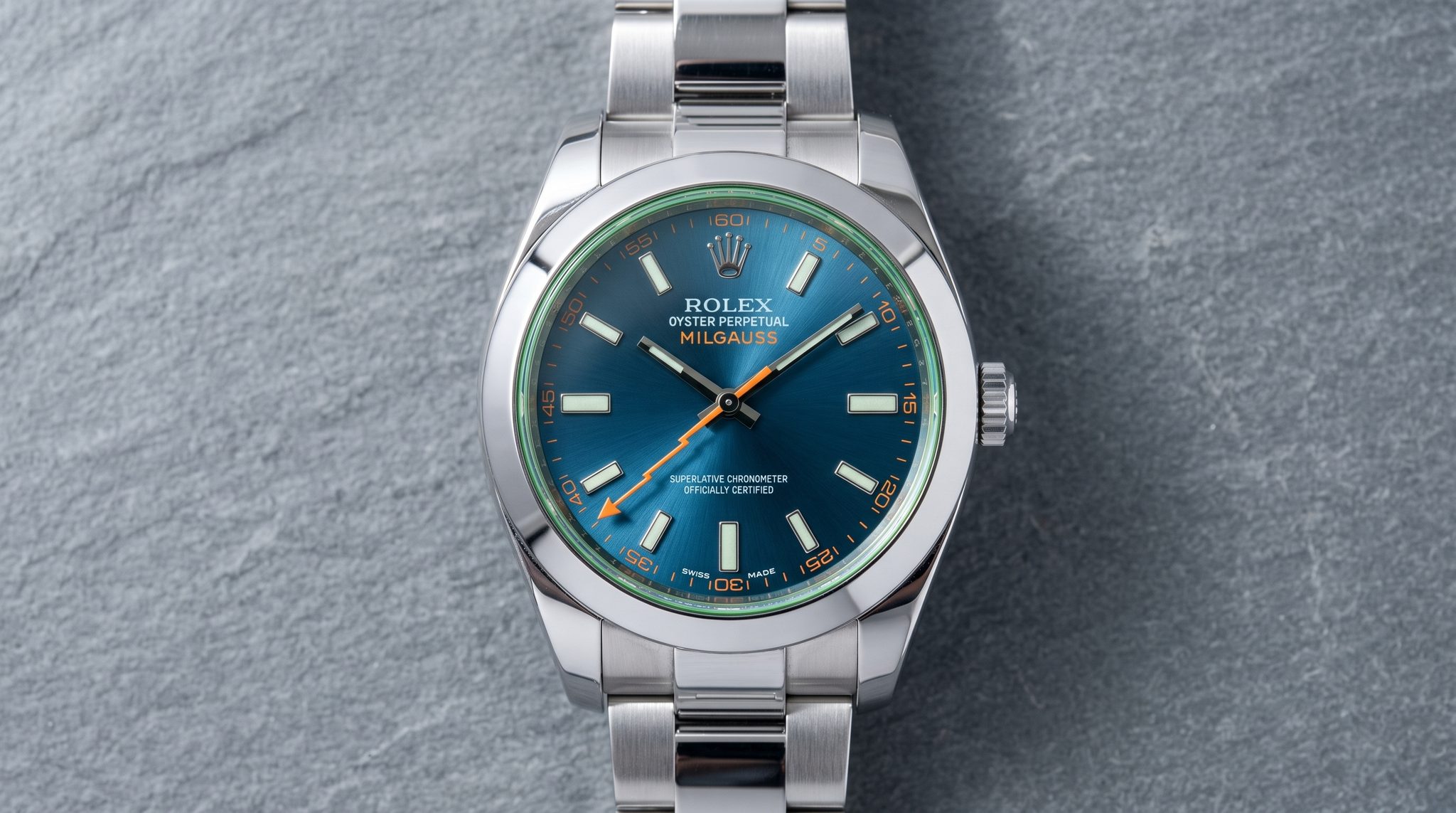
The Rolex Milgauss 116400GV is the modern Milgauss distilled into one defining object: a green-tinted sapphire crystal over an anti-magnetic, no-date Rolex sports watch, with the entire reference ultimately remembered by the two dials that lived beneath that green glass.
- Production
- 2007–2023
- Case
- Oystersteel
- Diameter
- 40 mm
- Bezel
- Smooth steel
- Crystal
- Green sapphire
- Water res.
- 100 m
- Dial
- Black or Z‑Blue
- Movement
- Cal. 3131
- Power
- ~48h
- Chronometer
- Yes
- Lume
- Bi‑color or Chromalight
- Bracelet
- Steel Oyster
The verdict on the Rolex Milgauss 116400GV is simple: it is a reference built around a single visual fact, the green-tinted sapphire crystal, and everything collectors care about flows from what Rolex chose to place beneath it. Rolex used that green “Glace Verte” crystal only here in serial production, and over the modern Milgauss run it effectively turned the watch into a two-chapter story: the original black “Anniversary GV,” then the 2014 Z‑Blue dial that goes turquoise under the same glass.
That clarity is what makes the 116400GV unusually legible as a reference. The case, movement, and purpose stay fixed from start to finish, a 40 mm Oystersteel, smooth-bezel Milgauss with Rolex calibre 3131 inside and anti-magnetic construction rated to 1,000 gauss. What changes is the face and, with it, the night-time signature: the black GV keeps its distinctive bi‑color glow (orange at 3, 6, and 9; green elsewhere), while the Z‑Blue arrives with blue-glowing Chromalight from day one.
The result is a modern Rolex that can be understood by looking, not decoding: the crystal’s green edge tint at an angle, the orange lightning-bolt seconds hand, and then the dial choice that defines the era. When Rolex removed the Milgauss from the catalogue in 2023, it ended without a direct successor, leaving the 116400GV as the final, most immediately recognizable expression of the line’s modern return.
“A fixed Milgauss built around one decision: green sapphire, then two dials that define the whole reference.”
116400GV across 2007–2023
Rolex reintroduced the Milgauss in 2007 after a long hiatus, and the 116400GV was positioned from the start as the version you could identify across a room. The green-tinted sapphire crystal (Glace Verte) is the reference’s anchor: it does not come and go, and there is no “clear crystal” sub-variant within 116400GV. That stability matters because it shifts attention to the few things that truly do vary.
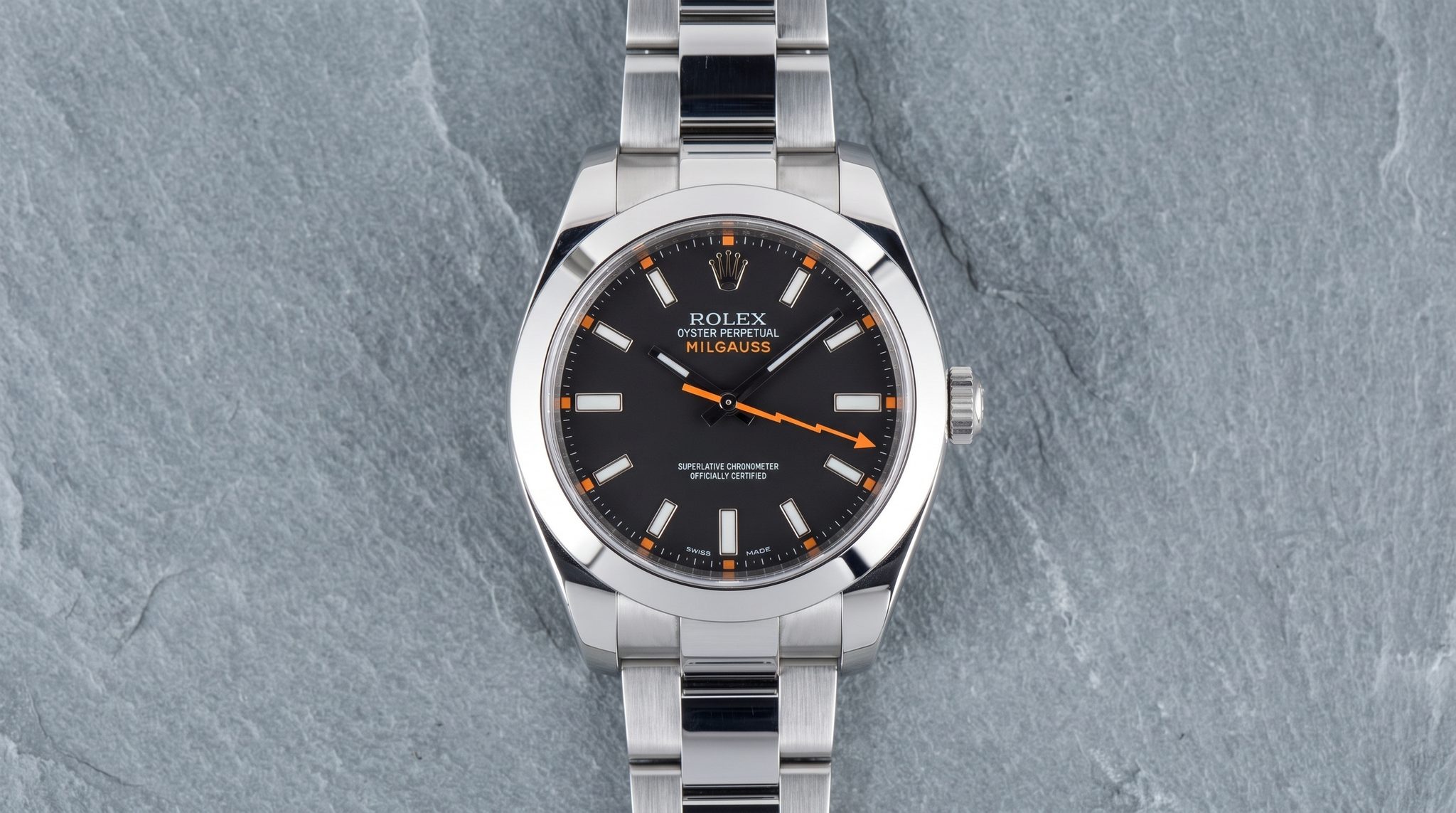
The first chapter is the black-dial 116400GV, often described as the “Anniversary” GV. In daylight it is a restrained black dial with orange peripheral details, made unmistakable by the orange lightning-bolt seconds hand that defines the modern Milgauss. In the dark it becomes something else: a deliberate bi‑color lume layout, with orange-glowing plots at 3, 6, and 9 and green elsewhere, a pattern explicitly described as different from the non‑GV black-dial Milgauss.
In 2014 Rolex added the Z‑Blue dial under the same 116400GV reference. It is described as a metallic electric blue that shifts toward turquoise through the green sapphire, and it brought a cleaner luminous identity: blue-glowing Chromalight across all markers from its introduction, with no documented earlier Z‑Blue period using the older mixed-color scheme.
The zoomed-out point is how intentionally narrow the 116400GV’s evolution is. From 2007 to the line’s quiet catalogue exit in 2023, Rolex left the mechanics and the case alone and changed only the visual language that the green crystal filters. That is why the 116400GV is both easy to classify and surprisingly hard to fake well: the “GV” look is not a single part, but a coherent stack of crystal, dial, accents, and correct luminous behavior that has to agree with itself.
- 2007Reference launchedGreen edge tint on crystal
- 2007Cal. 31313131 noted in Milgauss literature
- 2014Z‑Blue addedMetallic blue dial turns turquoise
- 2014ChromalightAll plots glow blue at night
- 2023DiscontinuedLast-year warranty dates
116400GV against its neighbours
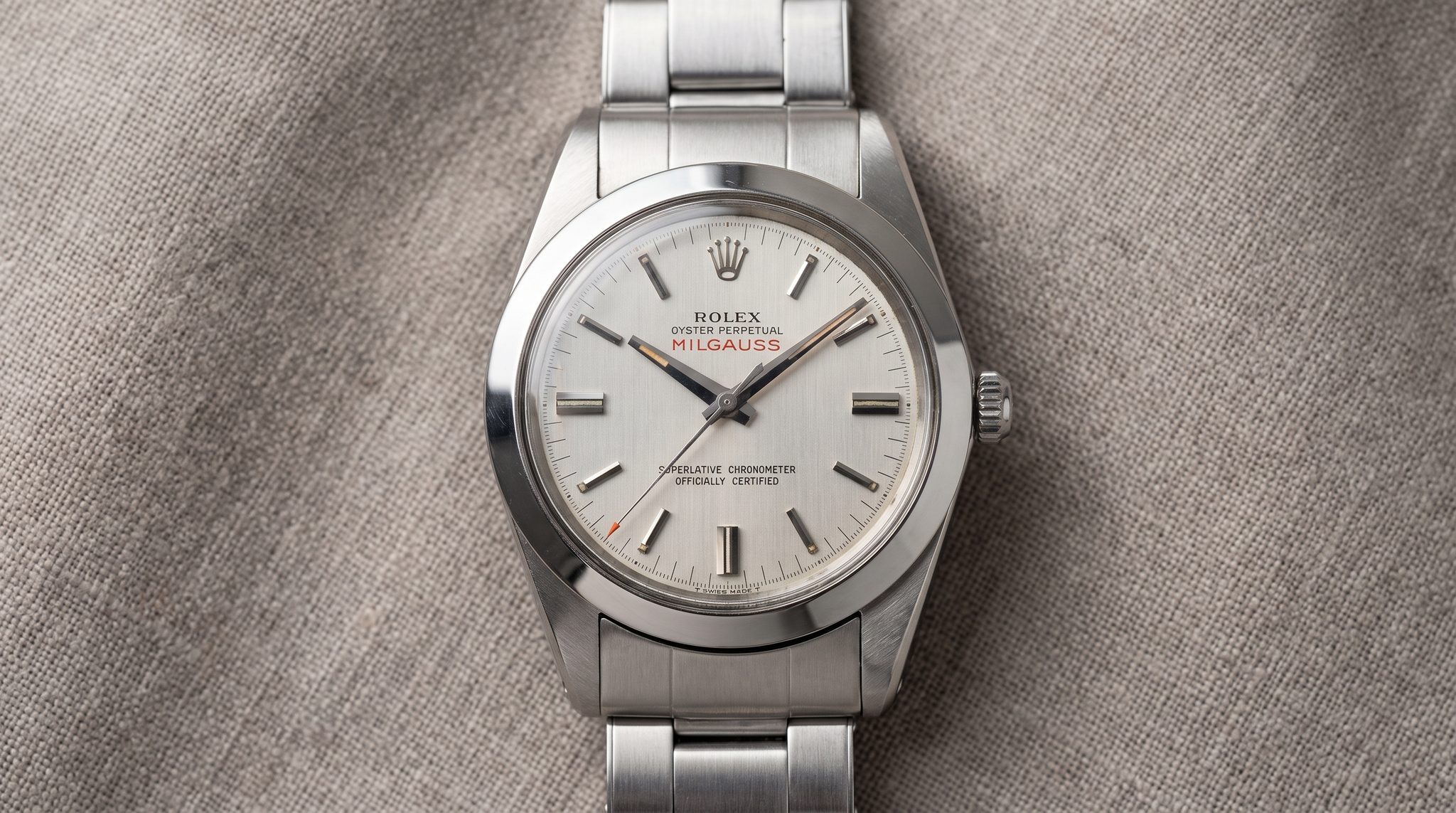
The 116400GV makes the most sense when framed against its closest sibling, the clear-crystal Milgauss 116400, because the two share the same case and calibre 3131 yet feel like different watches in the hand. Adding the historic Milgauss 1019 shows what Rolex kept from the original idea (anti-magnetism and restraint) and what the modern GV changed (size, color accents, and the green sapphire signature).
This reference 116400GV Rolex · focal 2007–2023 | |||
|---|---|---|---|
| Production | c. 1960s–late 1980s | 2007–c. 2016 | 2007–2023 |
| Case | Steel | Oystersteel | Oystersteel |
| Diameter | 38 mm | 40 mm | 40 mm |
| Bezel | Smooth, fixed | Smooth steel | Smooth steel |
| Crystal | Clear crystal | Clear sapphire | Green sapphire |
| Water res. | – | 100 m | 100 m |
| Movement | Cal. 1580 (auto) | Cal. 3131 | Cal. 3131 |
| Power | 48h | ~48h | ~48h |
| Chronometer | Yes | Yes | Yes |
| Dial | Silver or black; CERN no-lume | Black or white | Black or Z‑Blue |
| Lume | Tritium or none | Green (black dial) | Bi‑color or Chromalight |
| Bracelet | Oyster (steel) | Steel Oyster | Steel Oyster |
Two dial generations across the run
In its original form, the 116400GV reads almost monochrome until light catches the orange details. The seconds hand is the giveaway: a bright orange lightning bolt that slices across the dial and immediately separates the modern Milgauss from Rolex’s other three-hand sports watches. Under the green sapphire, the black dial stays black, but the crystal adds a faint green cast at the edge and in reflections, like a filter you notice most when you tilt the watch.
This black GV dial is also defined by what happens after dark. A documented design detail is the split personality of the lume: the 3, 6, and 9 o’clock plots glow orange, while the rest glow green. That bi‑color layout is specifically described as different from the non‑GV black-dial 116400, whose lume is described as uniformly green. For collectors, it is a useful sanity check because it ties the dial, hands, and reference identity together in a way that is difficult to fake convincingly with mismatched parts.
What to check before buying a 116400GV
Buying a Rolex Milgauss 116400GV is less about hunting obscure “marks” and more about making sure the watch’s few defining parts agree with each other. The green sapphire crystal is both the value driver and the most consequential authenticity point, because replacing it with a clear crystal erases the “GV” identity even if the rest of the watch is genuine.
Condition carries outsized weight on this reference. The smooth-bezel Milgauss case has large polished surfaces and no crown guards, so over-polishing quickly rounds the geometry and makes the watch look soft. Discontinuation in 2023 also amplified the importance of completeness, with box and papers repeatedly singled out as confidence and value multipliers, especially for the higher-priced Z‑Blue configuration.
Owning one is straightforward in the best way. The 116400GV wears like a modern 40 mm Oystersteel Rolex with a simple three-hand display and a robust calibre 3131 inside, but it looks unlike anything else Rolex made in volume because the crystal itself is part of the design. It is the kind of watch that rewards ordinary wear, since the green edge tint and the dial’s color shift only really show themselves as the light changes across a day.
Rolex Milgauss 116400GV for sale
Indicative market value from recent dealer, auction, and Grey Market sales: median ≈ $10,500, with a typical $8,800–$12,250 range across 201 comparable sales (updated this week).
Each point is a recent dealer or auction sale, banded to an indicative figure. The range shown is not a valuation.
Adjacent in the Milgauss family
Common questions about the 116400GV
Rolex produced the Milgauss 116400GV from 2007 until the Milgauss line was discontinued in 2023. Within that span, the Z‑Blue dial variant is documented as running from 2014 to 2023.
- Rolex Milgauss (model overview)wikipedia.org
- Milgauss brochure (ref. 116400GV)content.rolex.com
- Rolex Milgauss 116400 vs 116400GV: Green Crystal and Blue Dial Reviewwatchguys.com
Show 7 more
- Are the Non-GV Rolex Milgauss Watches Discontinued?bobswatches.com
- The Rolex Milgauss Is Now Discontinuedbobswatches.com
- Rolex Milgauss Buying Guide 2026: 116400 vs 116400GVthewatchology.com
- Rolex Milgauss 116400GV reference pagechrono24.com
- Rolex Milgauss authentication guidancewatchscanning.com
- Rolex Milgauss: Complete History & Guidethe1916company.com
- History and chronology of Milgauss productsgc-yukizaki.com