

Rolex Milgauss
The Rolex Milgauss is the anti-magnetic Rolex that stayed a niche tool watch by design, then returned in 2007 with one modern tell, a green sapphire crystal that only this line wears.
The Rolex Milgauss is the Rolex line that treated magnetism as a primary design problem, not a background spec. Its defining promise was explicit from the start: resistance to 1,000 gauss, achieved with a soft-iron shielding system that turned a mechanical movement into something closer to a lab instrument than a dress watch.
That purpose explains both the Milgauss’s unusual timeline and its unusually readable family tree. The model is widely traced to early-1950s demand from scientists associated with CERN in Geneva, then launched commercially in 1956. From there the story is less about constant iteration and more about Rolex repeatedly deciding how visible a “scientist’s watch” should look on the wrist. In the vintage era, the Milgauss shifts from an overtly tool-like identity to a deliberately restrained one, then disappears from the catalogue in the late 1980s. When it returns in 2007, Rolex keeps the basic modern architecture stable and lets a small set of visual cues do the work of distinguishing references.
Three published Milgauss references map cleanly onto that idea of visibility. Ref. 1019 is the long-running vintage expression, outwardly conservative, identified mainly by what the dial does and does not say, rather than by a dramatic case feature. The modern revival splits into two branches that look similar until a single detail is viewed at an angle: ref. 116400 has a clear sapphire crystal and was phased out by approximately the mid-2010s, while ref. 116400GV uses a green-tinted sapphire crystal and carries the modern Milgauss to the line’s 2023 discontinuation.
The one zoomed-out lesson in Milgauss history is that Rolex treated the model like a controlled experiment in emphasis. Across decades, the engineering brief stays consistent, precision near magnetic fields, but the watch alternates between hiding that brief in plain sight and broadcasting it through one unmistakable object, the green “GV” crystal. That is why a Rolex Milgauss reference guide can be unusually practical: on this family, what you can see is often what you are buying.
What each Milgauss reference trades for
3 references across 3 eras
Understated vintage instrument
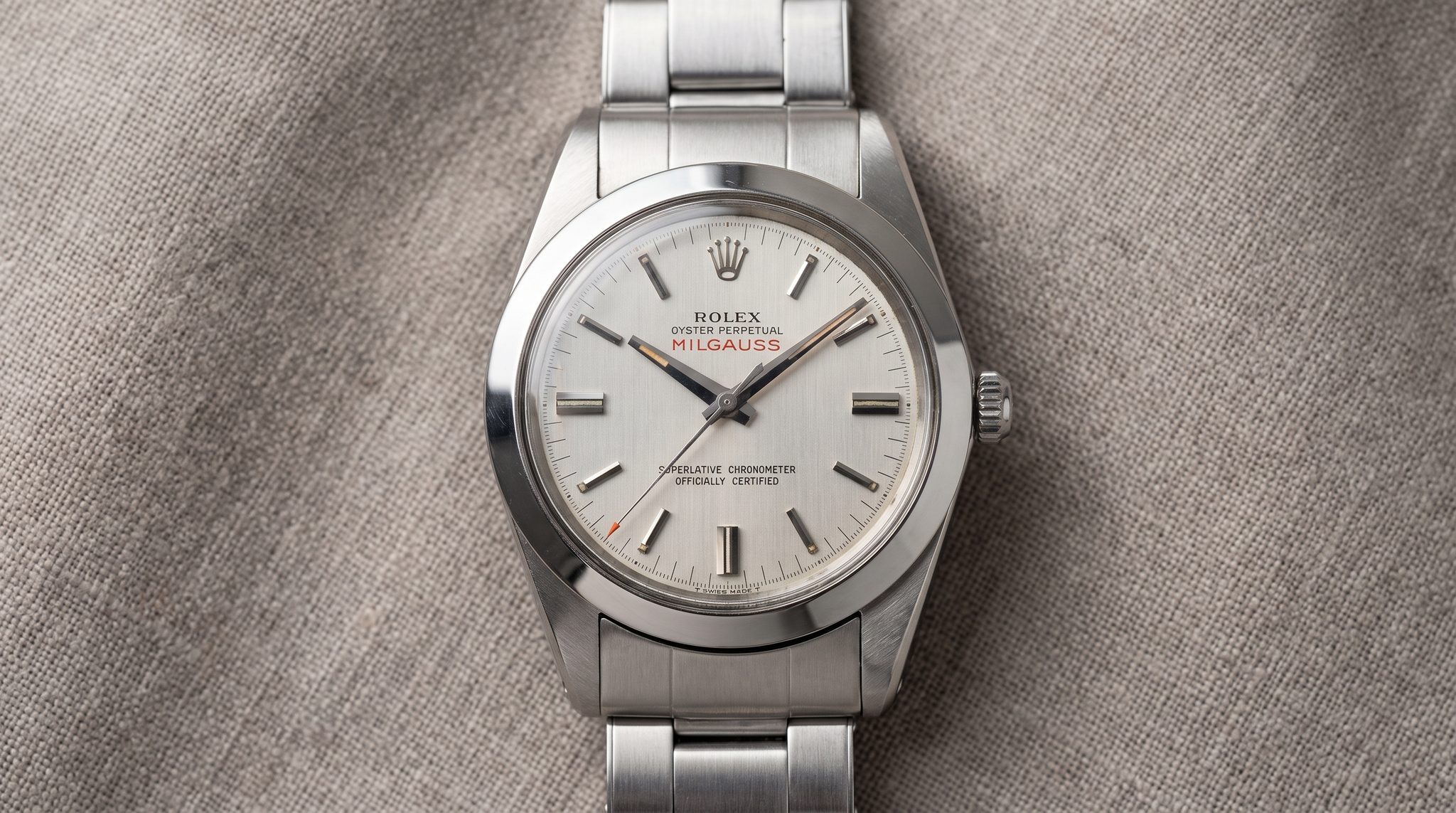
Ref. 1019 defines the Milgauss as a scientific tool that refuses to look like one. In photographs it reads as a plain, smooth-bezel steel Oyster with a simple three-hand layout, the sort of watch that could be missed entirely if the dial did not say “Milgauss.” That restraint is the point of the generation, a repositioning away from the earlier, more idiosyncratic Milgauss look toward something closer to Rolex’s broader professional aesthetic. It runs for decades with minimal external redesign, and sources disagree slightly on the exact end year, usually placing discontinuation in the mid to late 1980s. The reason for the line’s end is not documented beyond the model’s niche status in-period.
Modern revival, clear crystal
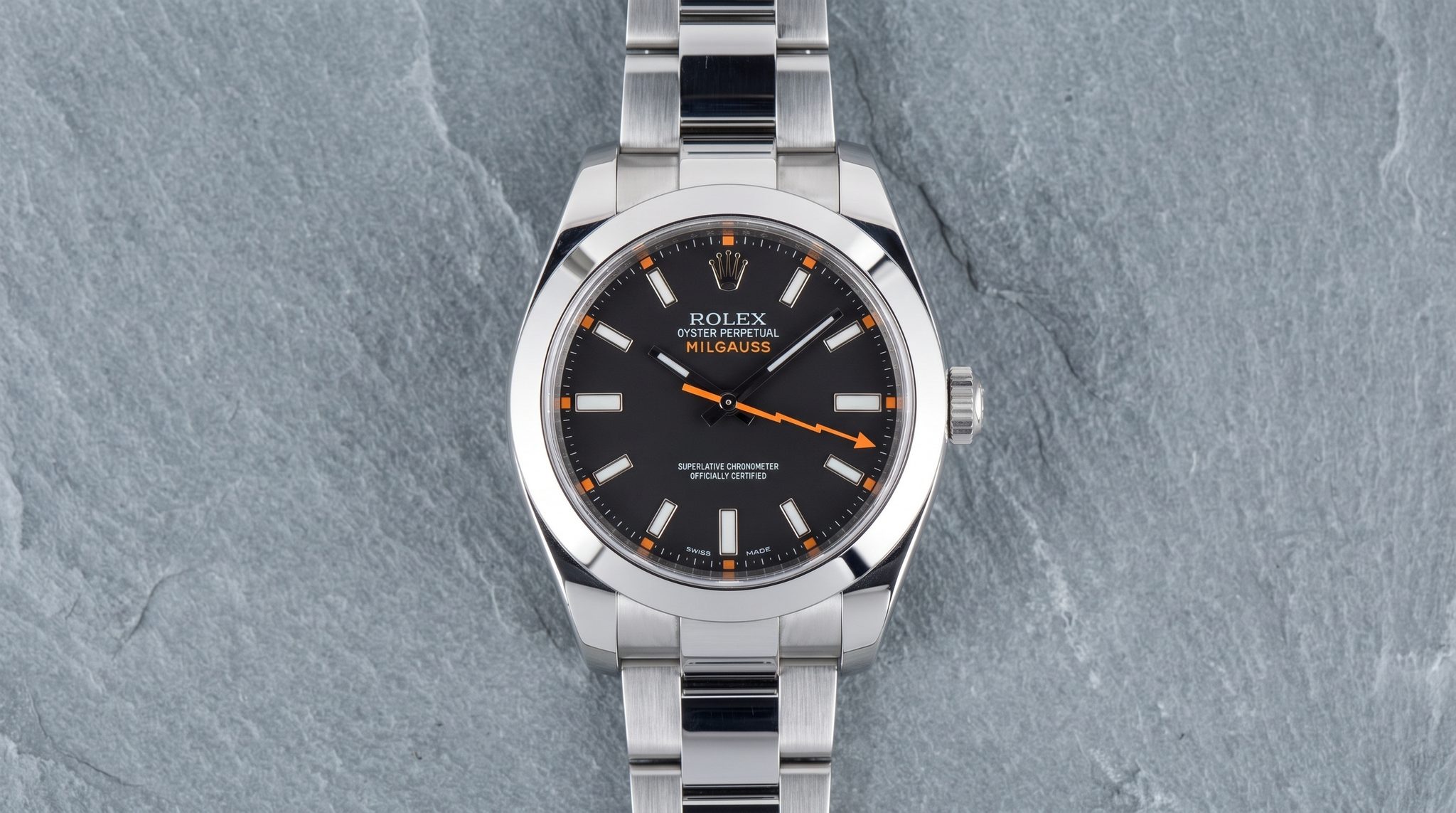
Ref. 116400 is the revival-era Milgauss in its least theatrical form: a modern anti-magnetic Milgauss without the green crystal that later became the line’s signature. On the wrist it is defined by what is missing, the absence of any tint at the crystal edge, even though it still carries the lightning-bolt seconds hand that reconnects the revival to the earliest Milgauss design language. This branch ends not with a clean handover but with a quiet contraction. Sources describe a dial-by-dial phase-out across the early-to-mid 2010s, converging around approximately 2016 for the last clear-crystal examples. The generation gives way because Rolex effectively concentrates the modern Milgauss identity into the GV variant, leaving the clear-crystal watch as the shorter-lived sibling.
Modern revival, green crystal
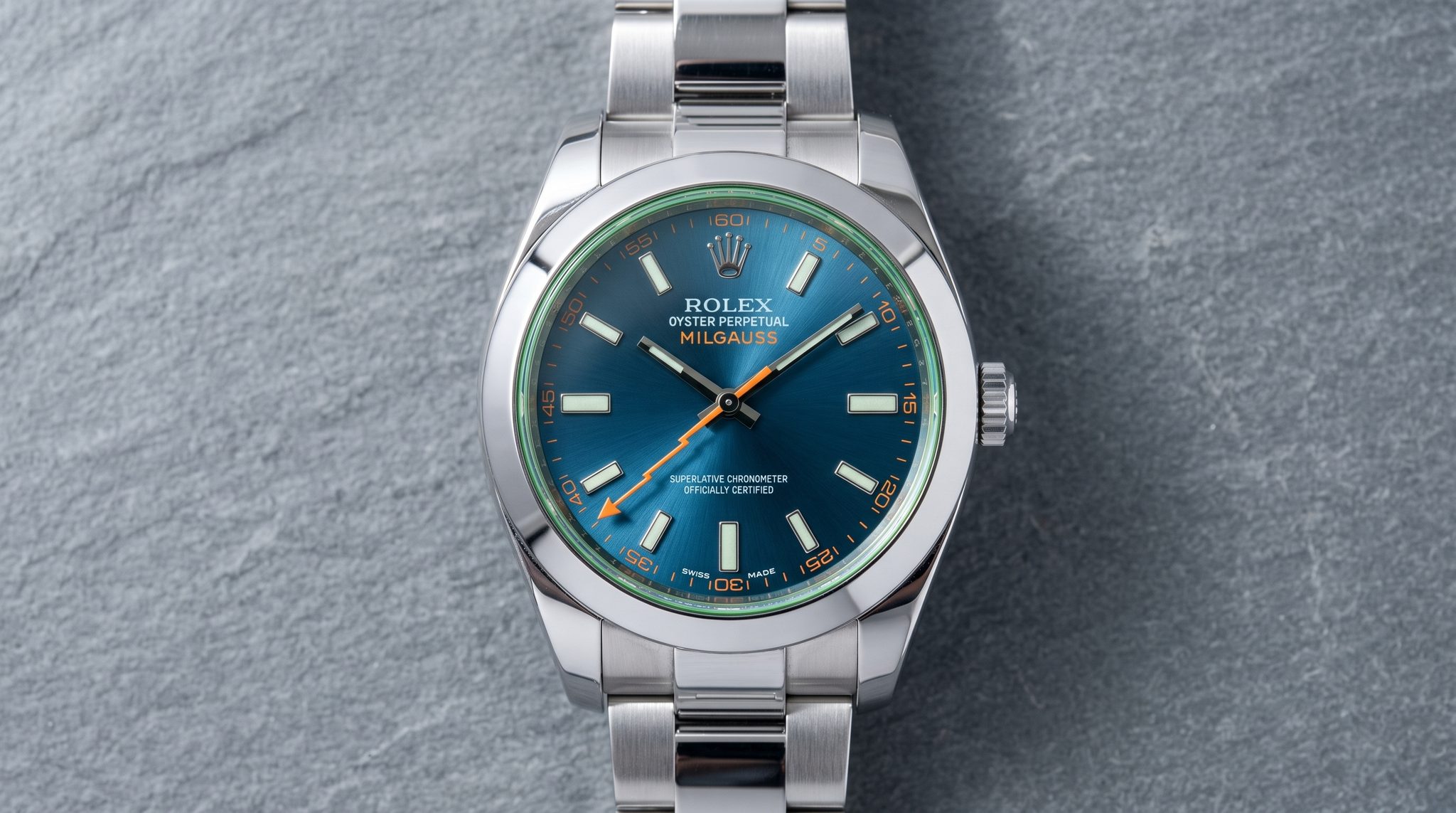
Ref. 116400GV turns the Milgauss into a reference you can identify by a single object: the green-tinted sapphire crystal. Viewed obliquely, the crystal edge carries a green cast that no other serial-production Rolex uses in the same way, and that decision becomes the anchor for the entire late Milgauss era. The rest of the watch remains stable in concept and layout, so the collector’s cues shift to what appears beneath that crystal, particularly the black-dial “Anniversary” execution and the later Z‑Blue dial introduced in 2014. This era ends for the simplest reason in the record: Rolex discontinued the Milgauss in 2023 without a direct successor, leaving the GV as the final, most distinctive statement of the modern return.
Which Milgauss to buy
For daily wear, the most straightforward choice is 116400GV, because it spans the full modern run to 2023 and is easiest to classify at a glance. The GV crystal is also a quick authenticity and configuration check: if the watch lacks that green edge tint, it is not the GV branch.
For a first vintage Rolex Milgauss, 1019 is the historically coherent entry. It represents the line’s longest, most stable vintage chapter, and it rewards careful dial study without forcing a buyer into the extreme rarity dynamics of the earliest Milgauss era.
For the reference-collector who wants the modern story with the sharpest “Milgauss vs everything else” differentiation, 116400GV is again the target, specifically because the crystal itself is unique to the line and defines the watch’s identity.
The one that rewards patience is 116400. It is the modern Milgauss that quietly disappeared first, phased out by approximately the mid-2010s, so a correctly configured clear-crystal example is less common than the 2007–2023 umbrella narrative suggests.
What to check on any Milgauss
Buying across the Rolex Milgauss family is unusually configuration-driven. The anti-magnetic concept is consistent, but service replacement parts and component mixing can change the very features that distinguish one reference from another, especially dials, hands, and crystals. The family is also a known target for both vintage “franken” assembly and modern lookalike conversions built around the GV aesthetic.
Common questions about the Milgauss
The Rolex Milgauss was built as an anti-magnetic professional watch for scientists, engineers, and others working around strong electromagnetic fields. It was designed to keep accurate time where ordinary mechanical watches could be disrupted, and it is defined by a 1,000-gauss rating and shielding-based anti-magnetism.
- What’s The Legacy Of The Rolex Milgauss?phillips.com
- The Past, Present, And Future Of The Rolex Milgausshodinkee.com
- History Rolex Milgauss Collection In-Depth Reviewmonochrome-watches.com
Show 7 more
- Rolex Milgauss History and Guidebobswatches.com
- Rolex Milgauss 116400 Ultimate Guidebobswatches.com
- Ultimate Guide to the Rolex Milgaussswisswatchexpo.com
- Why the Rolex Milgauss Stays a Cult Referencetheluxuryplaybook.com
- Rolex servicing procedurerolex.com
- Rolex Milgauss history and curiositiesferrogioielli.com
- Rolex Milgaussen.wikipedia.org