

Rolex Milgauss 1019
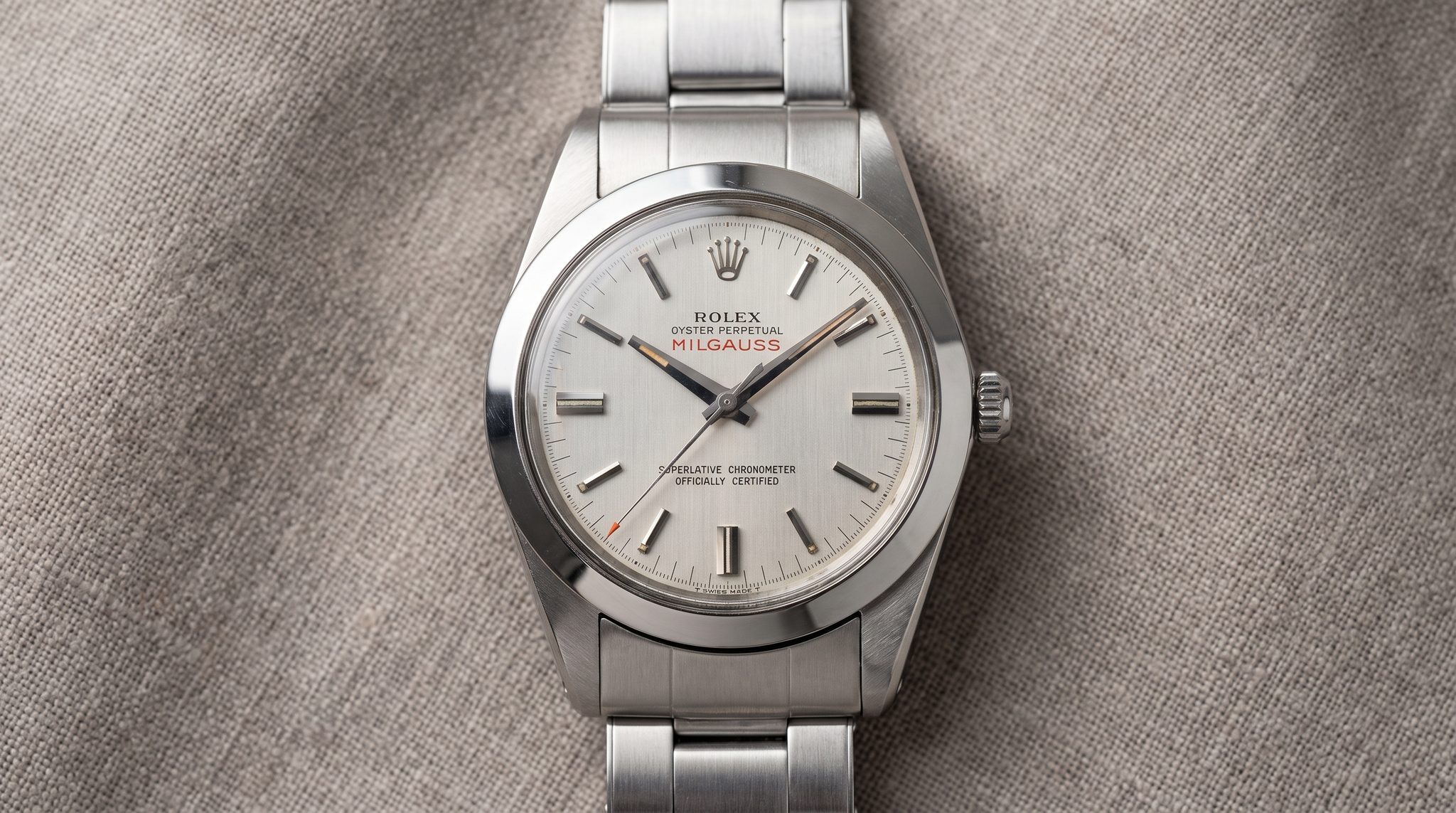
The Rolex Milgauss 1019 is the long-running, deliberately restrained Milgauss, a 1,000-gauss tool watch that kept its science brief while its dial details did the talking.
- Production
- c. 1960–c. 1988/89
- Case
- Stainless steel
- Diameter
- 38mm
- Thickness
- ~12mm
- Lug width
- 20mm
- Bezel
- Smooth, fixed
- Crystal
- Plexiglass
- Dial
- Silver or black; CERN no-lume
- Lume
- Tritium or none
- Movement
- Cal. 1580 (auto)
The Rolex Milgauss 1019 is the proof that Rolex could build a 1,000-gauss instrument and make it look almost anonymous on the wrist, a smooth-bezel Oyster whose most consequential clues live on the dial, not the case. It is documented in Rolex literature by August 1960, and it stayed in production into the late 1980s, a span most often summarized as a 28-year run to 1988.
That longevity is the reference’s collecting logic. The 1019 is steel-only and movement-stable, with every sourced account placing the watch on Rolex caliber 1580 throughout, so the hunt is not about chasing case generations or caliber swaps. Instead, it is about reading what Rolex chose to print (and what it chose to omit): brushed silver versus matte black, tritium versus the rare non-luminous CERN execution, and smaller running changes in hands and track markings whose exact cutoffs are not factory-published.
Technically, the watch remains a Milgauss in purpose as well as name. The line was designed to resist magnetism up to 1,000 gauss, and the 1019 continues that anti-magnetic mission with the familiar Milgauss architecture of shielding around the movement. Inside, the caliber 1580 is described with a frequency of 19,800 vph and a 48-hour power reserve, and it is a straightforward, time-only three-hand layout without a date.
What makes the Milgauss 1019 singular in the Rolex catalog is how completely it recasts the Milgauss idea. Compared with the earlier ref. 6541, which wore its role more loudly, the 1019 shifts to a cleaner, more traditional Rolex presentation while keeping the same reason for existing. The result is a scientific watch that has to be identified by observation and evidence, a reference whose best examples look coherent because they were assembled by time, not assembled later.
“A 1,000-gauss Rolex that refuses to look like one, the Milgauss 1019 turns decades of production into a dial-driven detective story.”
1019 across c. 1960–c. 1988/89
Ref. 1019 enters the record around 1960, with an unusually firm anchor point for a vintage Rolex sports reference: it is traceable in Rolex literature by August of that year. From the start it is presented as the second Milgauss, arriving immediately after the ref. 6541 and adopting a calmer exterior vocabulary, a smooth bezel and a cleaner dial arrangement, while remaining built for environments where magnetism is the enemy.
The long middle of the run is defined less by obvious external redesign and more by the fact that the watch stays itself. Sources consistently keep the reference on caliber 1580, a time-only automatic movement specified at 19,800 vph with a 48-hour power reserve and described as exclusive to the 1019. That stability shifts attention outward: dial color, luminous specification, and the smaller visual tells that collectors use to separate earlier from later execution. Those tells exist, but Rolex did not publish factory cutoffs for them, so precise year-by-year boundaries are a reconstruction from surviving watches and auction cataloguing rather than a closed ledger.
Discontinuation is the one place where the otherwise long, clean arc becomes slightly blurred. Several specialist histories end the reference in 1988 and describe a 28-year production run; at least one detailed collector review argues that the last manufacturing year was 1989, using late paperwork and sale timing as supporting evidence. The reason for the end, beyond a general shift toward more popular models, is not documented in the open record.
The zoomed-out view is that the Milgauss 1019 spent nearly three decades being a niche scientific tool inside Rolex’s catalogue, and its collecting appeal today comes from that tension. It is a functional anti-magnetic watch that looks intentionally ordinary, which is why a correct 1019 is read not by a headline feature, but by a chorus of small, mutually consistent details.
- c. 1960IntroducedSmooth bezel, straight seconds
- 1960DocumentedRolex literature, Aug 1960
- 1960 – 1988Cal. 1580Movement signed “1580”
- c. 1988DiscontinuedLate papers, late-1980s examples
- c. 1989Last examplesVery late sales/papers
1019 against its neighbours
The Milgauss 1019 makes the most sense when framed by the watch it replaced and the watch that revived the name. The ref. 6541 is the overt, early Milgauss with a more instrument-like personality; the modern ref. 116400 returns to the anti-magnetic theme with a larger case and contemporary construction. Between them, the 1019 is the long, quiet middle chapter, defined by its smooth-bezel restraint and its dial-led variation.
6541 Predecessor 1956–1960 | This reference 1019 Rolex · focal c. 1960–c. 1988/89 | |||
|---|---|---|---|---|
| Production | 1956–1960 | c. 1960–c. 1988/89 | 2007–c. 2016 | 2007–2023 |
| Case | Stainless steel | Stainless steel | Stainless steel | Stainless steel |
| Diameter | – | 38mm | 40mm | 40mm |
| Bezel | Rotating (external) | Smooth, fixed | Smooth, fixed | Smooth, fixed |
| Crystal | – | Plexiglass | Sapphire | Sapphire (green-tint) |
| Dial | More overt tool styling | Silver or black; CERN no-lume | Modern Milgauss dials | Modern Milgauss dials |
| Movement | Cal. 1066M | Cal. 1580 (auto) | Cal. 3131 | Cal. 3131 |
Seven dial generations across the run
The archetypal Milgauss 1019 is the vertically brushed silver dial: in raking light it reads like fine grain, with applied baton markers and a clean, scientific calm. Many examples pair that restraint with a single flash of color, the red “MILGAUSS” text above 6 o’clock, which is repeatedly described as a typical configuration for silver dials. On original tritium examples, the luminous plots and hands age away from bright white toward warmer tones, and that aging, even and undisturbed, is part of what makes a silver-dial 1019 feel period-correct rather than rebuilt.
This silver tritium dial appears throughout the reference’s long run, and sources do not provide factory-documented cutoff years for minor print or font changes. As a result, finer subdivision is largely based on watch-by-watch observation and auction cataloguing rather than a single authoritative production table.
What to check before buying a 1019
Buying a Milgauss 1019 is less about chasing the right case and more about getting the right face. The reference is consistently documented with caliber 1580 and a stable steel format, so most expensive mistakes happen at the dial, either through replacement, refinishing, or mismatched parts assembled to resemble a rarer variant.
Rolex Milgauss 1019 for sale
Indicative market value from recent dealer, auction, and Grey Market sales: median ≈ $12,500, with a typical $11,000–$26,000 range across 11 comparable sales (updated this week).
Each point is a recent dealer or auction sale, banded to an indicative figure. The range shown is not a valuation.
Adjacent in the Milgauss family
Common questions about the 1019
The Milgauss 1019 is generally dated from around 1960 into the late 1980s. Many specialist histories summarize it as 1960–1988, while at least one detailed collector review argues that the last year of production was 1989, so late-1980s end dates are best treated as approximate.
- What's The Legacy Of The Rolex Milgauss?phillips.com
- In-Depth: The Complete History of the Rolex Milgaussmonochrome-watches.com
- 1969 Rolex Milgauss Ref. 1019shop.hodinkee.com
Show 7 more
- Rolex Milgauss 1019 Review - WatchProSitewatchprosite.com
- Rolex Milgauss 1019 Review: Hands-On, Specs & Valuewatchguys.com
- Rolex 1019 - BobsWatches.combobswatches.com
- Rolex Milgauss Collector's Guide - Luxury Bazaarluxurybazaar.com
- The Rolex Milgauss 1019: Why a 28-Year Commercial Failure...swisswatchexpo.com
- Rolex Milgauss History and Guidebobswatches.com
- Rolex Milgauss 1019 | Ref. 1019 Watches on Chrono24chrono24.com