

Omega Speedmaster 105.003
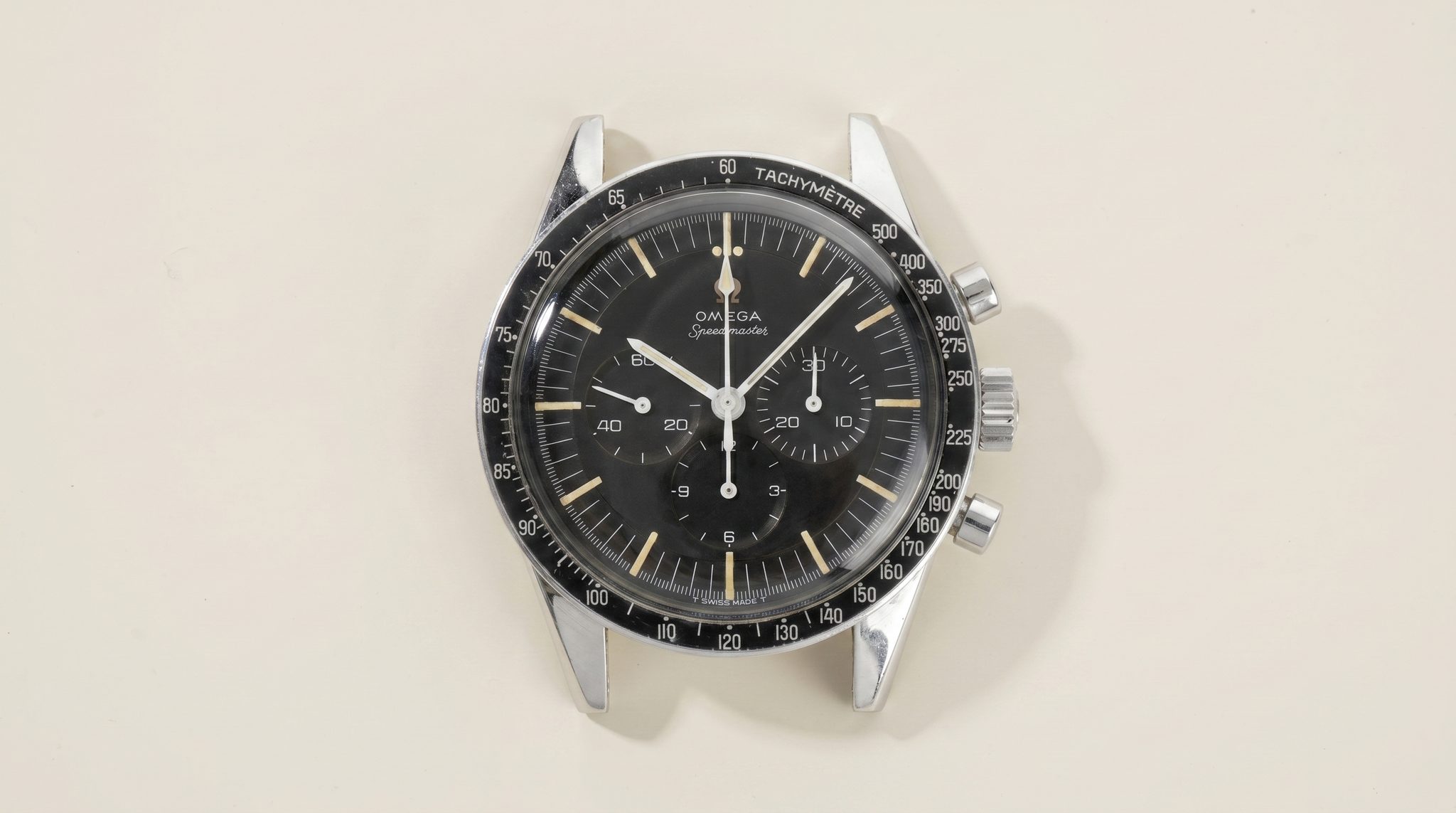
The Omega Speedmaster 105.003 is the last straight-lug, no-guard Speedmaster, yet it is the one whose -63 caseback is confirmed as Ed White’s Gemini IV EVA watch.
- Production
- c. 1963/64–1969
- Case
- Stainless steel
- Diameter
- 38 mm
- Lug width
- 19 mm
- Thickness
- 13.5 mm
- Bezel
- Tachymeter, BASE 500
- Bezel type
- DO90
- Crystal
- Hesalite (acrylic)
- Dial
- Stepped, applied logo
- Lume
- Tritium (T…T)
- Movement
- Cal. 321
- Crown guards
- None
The Omega Speedmaster 105.003 is the straight-lug Speedmaster that reached space without ever becoming a “Professional.” The most repeatable fact is also the one that fixes the watch in history: Omega has confirmed that Ed White’s Gemini IV EVA Speedmasters were reference 105.003-63.
That single archival anchor is why the 105.003 sits at a peculiar hinge point in the line. It comes after the transitional 105.002 and directly before the first asymmetrical, crown-guard “Professional” case beginning with the 105.012, but it keeps the earlier, symmetrical straight-lug shell. In the hand, that means a compact, clean-edged chronograph case with no crown guards, paired with the utilitarian layout that later Speedmasters largely keep: a stepped, applied-logo dial without “Professional,” white baton hands, and the characteristic BASE 500 tachymeter bezel with dot over 90.
Its production story is also part of its identity. Specialist references place active manufacture in the mid-1960s, while also documenting factory deliveries extending as late as 1969. The result is a reference whose “years” are best understood as two overlapping realities, caseback suffixes that read -63, -64, -65, and watches that could still be leaving Omega years after the case design had already moved on.
“The 105.003 is the Speedmaster that kept its straight lugs to the end, and still became the space-era configuration people picture.”
105.003 across c. 1963/64–1969
In collector references, the 105.003 is both a last chapter and a preview. It follows the 105.002, a transitional straight-lug Speedmaster that can look deceptively similar in late baton-hand form, and it is followed in the main lineage by the 105.012, where the case becomes asymmetrical and gains crown guards. Public sources do not document why these generations overlap in real time, but the overlap is visible in the way the 105.003’s mid-1960s caseback suffixes (-63, -64, -65) coexist with documented factory deliveries that extend to 1969.
What does not shift across that span is the 105.003’s defining look. It keeps the symmetrical straight-lug case with no crown guards and pairs it with a stepped, applied-logo dial that omits “Professional.” The dial is also unusually specific in its small print: correct examples are tritium-marked with “T SWISS MADE T” and the Ts sit close to the words, a spacing detail that becomes a practical check against later service dials.
One historical detail then turns the reference from merely transitional to genuinely fixed in the narrative: Omega has confirmed that Ed White’s Gemini IV EVA Speedmasters were 105.003-63. That makes the 105.003 unusual among famous tool watches, because the celebrated association points to a particular stamped sub-reference rather than a broad era.
Taken as a whole, the 105.003 shows how quickly the Speedmaster’s identity crystallized. Within a handful of years, Omega moved from straight lugs to crown guards and from “Speedmaster” to “Speedmaster Professional,” but the legible baton-hand layout and the caliber 321 chronograph architecture remained familiar enough that watches assembled and delivered later can still read like they belong to the earlier case design.
- c. 1963/1964Reference appearsCaseback stamped 105.003-63/-64
- c. 1963/1964T-marked dialClose-spaced Ts at 6
- 1965Gemini IV EVA105.003-63 sub-reference
- c. 1964 – 1966Sub-refs evolveInside caseback suffix
- 1964Professional caseCrown guards; “Professional” appears
- 1969Late deliveries1969-dated delivered examples
105.003 against its neighbours
The 105.003 makes the most sense when bracketed by its near-twin predecessor and its first crown-guard successor. The 105.002 explains why small hardware details matter on a straight-lug Speedmaster, while the 105.012 shows how abruptly the line’s case and dial language shifts once “Professional” arrives.
This reference 105.003 Omega · focal c. 1963/64–1969 | ||||
|---|---|---|---|---|
| Production | c. 1962–1964 | c. 1963/64–1969 | c. 1964–1967 | c. 1967–1969 |
| Diameter | – | 38 mm | 42 mm | 42 mm |
| Lug width | 19 mm | 19 mm | 20 mm | 20 mm |
| Movement | Cal. 321 | Cal. 321 | Cal. 321 | Cal. 321 |
| Crown guards | None | None | Yes | Yes |
| Bezel type | DON | DO90 | DON tachymeter | DON tachymeter |
| Dial | No “Professional” | Stepped, applied logo | “Professional” text | “Professional” text |
| Lume | – | Tritium (T…T) | Tritium | Tritium |
What to check before buying a 105.003
A Speedmaster 105.003 review eventually becomes a lesson in restraint: the reference has a famously consistent baseline specification, so value and legitimacy rise or fall on originality and condition, not on chasing a long list of “marks.” The traps are predictable, dials and bezels swapped during service, cases polished until the straight-lug geometry loses its edges, and watches assembled from valuable donor parts.
Because the 105.003 is defined as much by what it is not, no crown guards, no “Professional” text, no later dial layouts, the safest purchases are those that look coherent at a glance and still reward close inspection. The best examples feel like they were worn and then left alone, with the stepped dial, tritium plots, correct DO90 bezel, and crisp caseback engraving telling the same mid-1960s story.
In the market, the Speedmaster 105.003 value range is unusually wide. Specialist tracking includes watches bought in very poor condition at USD 4,500 and estimates “excellent” examples around USD 22,000–28,000, while broader market commentary places typical examples roughly in the low five figures and mint, boxed examples around USD 30,000–36,000 in the 2023–2024 period. That spread is the point: the reference is common enough to find, but genuinely convincing, attractive examples are not.
Omega Speedmaster 105.003 for sale
Indicative market value from recent dealer, auction, and Grey Market sales: median ≈ $13,000, with a typical $9,900–$16,750 range across 24 comparable sales (updated this week).
Each point is a recent dealer or auction sale, banded to an indicative figure. The range shown is not a valuation.
Adjacent in the Speedmaster family
Common questions about the 105.003
Most collector references summarize the Omega Speedmaster 105.003 as 1963–1969, with nuance. Specialist guidance places active production in the mid-1960s, while also documenting factory deliveries as late as 1969, which is why late delivered examples exist even though casebacks are stamped -63, -64, and -65.
- 105.003 (Speedmaster101)speedmaster101.com
- Stainless steel OMEGA Speedmaster ref. 105.003 chronograph wristwatch made 1969 (example and reference traits)somlo.com
- 1960s Omega Speedmaster Reference 105.003 (Hodinkee Shop listing, -64 rarity statement)shop.hodinkee.com
Show 7 more
- The Omega Speedmaster: A Complete Collector's Guide (Sotheby’s)sothebys.com
- Omega Speedmaster Ed White 105.003 (“The Gamble”) (Bazamu)bazamu.com
- Omega Speedmaster 105.003: The Last of its Kind (WahaWatches)wahawatches.com
- The Speedmaster ‘Ed White’ 105.003 (Chrono24 Magazine)chrono24.com
- A Long Hunt For A Speedmaster ‘Ed White’ Comes To An End (Fratello)fratellowatches.com
- 105.003 numbers made each year? (Omega Forums thread)omegaforums.net
- Omega Speedmaster 105.003: Birth Year Acquisition (WatchProSite)watchprosite.com