

Omega Speedmaster 105.012
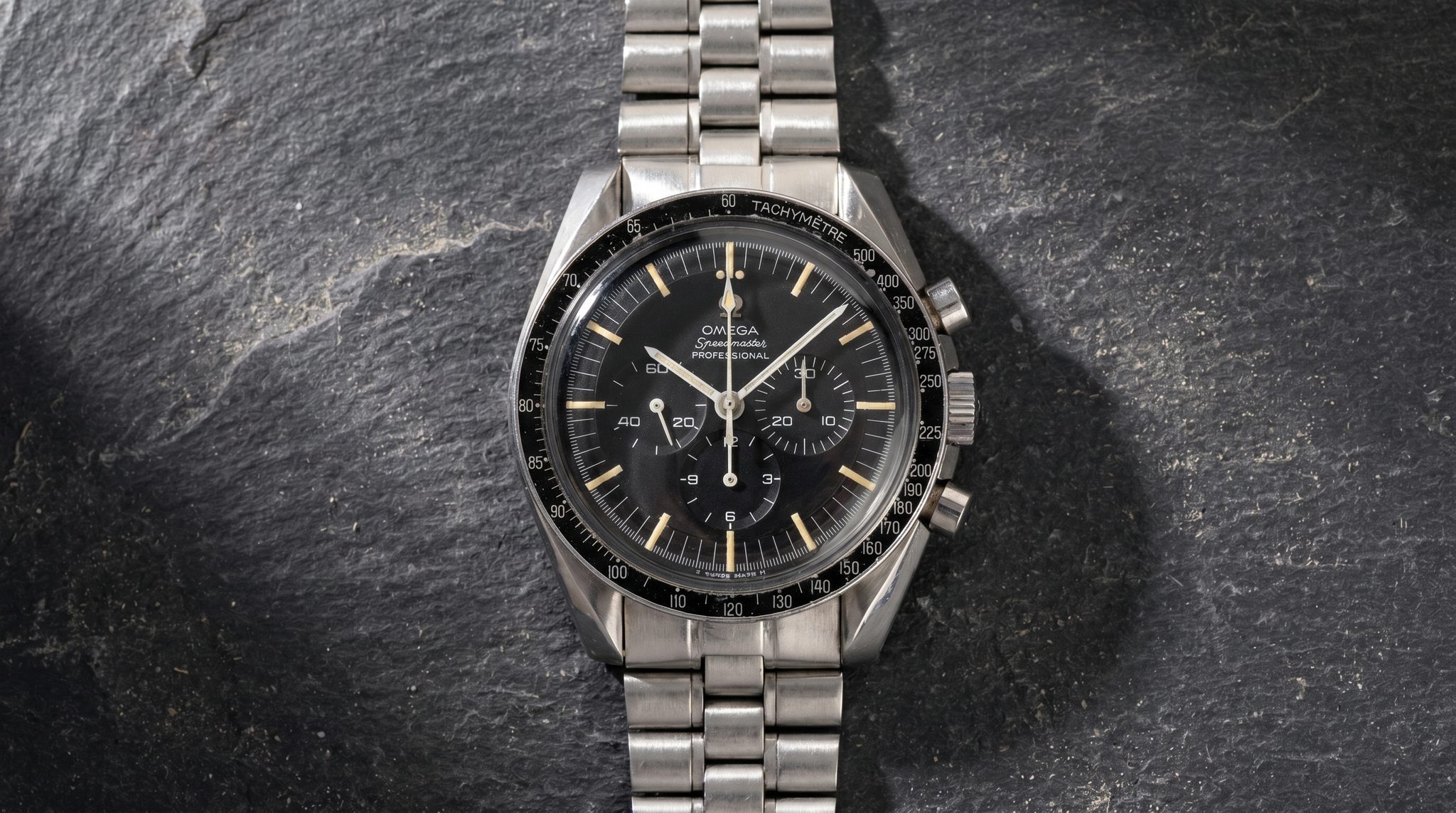
The Omega Speedmaster 105.012 is the turning point that made the Moonwatch silhouette official: the first 42 mm, crown-guard “Professional” Speedmaster built around caliber 321.
- Production
- 1964–c. 1967
- Case
- Stainless steel
- Diameter
- 42 mm
- Lug width
- 20 mm
- Bezel
- DON tachymeter
- Crystal
- Acrylic (Hesalite)
- Dial
- Step, applied logo
- Lume
- Tritium
- Movement
- Cal. 321
- Chronograph
- Manual-wind, 2-pusher
- Pushers
- 5 mm × 3 mm
The Omega Speedmaster 105.012 is the reference where the Speedmaster stops looking like a refined 1960s chronograph and becomes the template for the Moonwatch. The proof is physical and immediate: it is the first Speedmaster in the 42 mm asymmetrical case with twisted lyre lugs and crown guards, a shape that still reads “Speedmaster Professional” from across a room.
That single case redesign matters because it arrives without changing what enthusiasts came for in the first place, the caliber 321 column-wheel chronograph. In other words, Omega wrapped the revered 321 in a new, more protective body and, at the same time, introduced the “Professional” line on the dial. From there the 105.012 becomes a short, information-dense chapter, introduced in 1964 and produced until about 1967, with sub-references (-63, -64, -65, -66) and even different case makers (HF and, later, CB) that leave visible fingerprints on surviving watches.
Collectors care about the 105.012 not because it is hard to describe, but because it is unusually easy to read once you know what to look for. A caseback stamp, the presence or absence of the tritium “T” marks at 6 o’clock, and the geometry of the lugs can each anchor the watch to a specific part of the run. The result is a reference whose history lives on the surface: a Moonwatch silhouette being finalized in real time, one crisp facet and one line of dial text at a time.
“The 105.012 is the Moonwatch shape before it was a slogan: the first 42 mm, crown-guard Speedmaster Professional, still powered by caliber 321.”
105.012 across 1964–c. 1967
The Speedmaster 105.012 sits in the narrow corridor between the straight-lug 105.003 and the later 145.012, and its production years are often summarized as 1964 to 1967. Specialists disagree on the precise boundaries by a few months because they may be describing different things, introduction versus factory output versus delivery, and because the reference is subdivided into stamped suffixes (-63, -64, -65, -66) that do not map neatly onto calendar years.
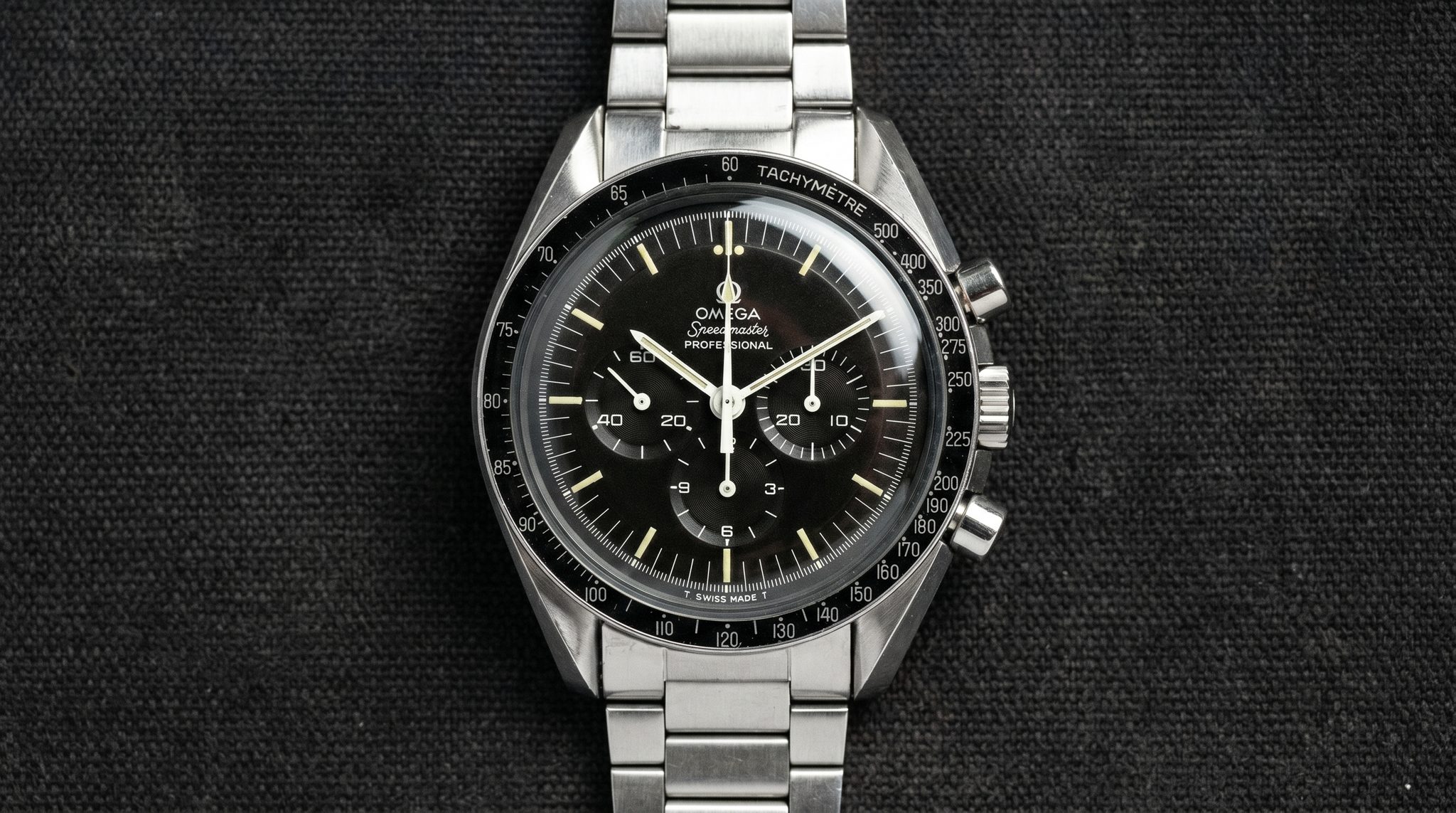
What is firmly visible on the watches themselves is the sequence of decisions Omega locked in quickly. First comes the new asymmetrical 42 mm case with crown and pusher guards and the “Professional” line on the dial, while the movement remains the caliber 321. Early 105.012-63 examples pair that new case with a dial that lacks the tritium “T” marks at 6 o’clock; soon after, 105.012-64 and later suffixes carry the familiar “T SWISS MADE T” signature. The reason for the exact cutoff is not documented for this reference, so the transition is dated by surviving watches rather than a factory memo.
By the time the common 105.012-66 appears, Omega is sourcing cases from two suppliers, and the reference becomes a lesson in how manufacturing shows up as design. HF cases keep a smoothly curved lug-top profile, while CB cases introduce a flat, polished facet along the top of each lug that creates a sharp border you can feel with a fingertip. Zooming out, the 105.012 compresses an era of “settling” into only a few years: the Moonwatch look that later seems inevitable was still being negotiated through stamped suffixes, dial markings, and case geometry before it stabilized in the references that followed.
- 1964IntroducedCrown guards, “Professional” dial
- 1964-63 batchNo “T” at 6 o’clock
- 1964-64 onward“T SWISS MADE T” text
- 1966-66 casesCB lug-top facet vs HF curve
- c. 1967ReplacedLater caseback stamped 145.012
105.012 against its neighbours
The 105.012 makes the most sense when framed by the two references that bracket it: the 105.003 that came before, and the 145.012 that followed. The first shows what Omega changed, the move from straight lugs and no guards to the asymmetrical “Professional” case, and the second shows what stayed constant, the 42 mm crown-guard silhouette and caliber 321, even as details like pushers and case construction evolved.
This reference 105.012 Omega · focal 1964–c. 1967 | BA 145.022-69 Nearest sibling From 1969 | |||
|---|---|---|---|---|
| Production | c. 1963/64–1969 | 1964–c. 1967 | c. 1967–1969 | From 1969 |
| Case | Stainless steel | Stainless steel | Stainless steel | 18k yellow gold |
| Diameter | ~39 mm | 42 mm | 42 mm | 42 mm |
| Lug width | 19 mm | 20 mm | 20 mm | 20 mm |
| Bezel | DO90 | DON tachymeter | DON tachymeter | Burgundy tachymeter |
| Crystal | Hesalite (acrylic) | Acrylic (Hesalite) | Hesalite (acrylic) | Hesalite (acrylic) |
| Dial | Step, applied logo | Step, applied logo | Step, applied logo | Gold, onyx markers |
| Lume | Tritium | Tritium | Tritium | None |
| Movement | Cal. 321 | Cal. 321 | Cal. 321 | Cal. 861 |
| Chronograph | Manual-wind, 2-pusher | Manual-wind, 2-pusher | Manual-wind, 2-pusher | Manual-wind, 2-pusher |
What to check before buying a 105.012
Buying a Speedmaster 105.012 is less about chasing a single headline trait than making sure the traits agree with each other. The reference is defined by a short production run and by factories that clearly mixed overlapping suffixes and suppliers, which is why incorrect combinations often look “close enough” until a detail gives the game away.
Start with what the watch itself states: the inside caseback suffix (-63, -64, -65, -66) and any HF or CB stamp. Then read the dial at six o’clock. A -63 should present the early non-T “SWISS MADE” signature, while -64, -65, and -66 are expected to show “T SWISS MADE T”. The 105.012 should also wear a pre-1970 DON tachymeter bezel, and originality here is not academic, correct DON inserts can materially change value.
Condition has a reference-specific penalty. The asymmetrical case is all line and edge, and on the 105.012-66 CB, a polished case can literally erase the feature that makes it a CB in the first place, the crisp lug-top facet. In the end, a good 105.012 is a watch that looks assembled by its own decade: tritium that has aged naturally, a dial and bezel that belong together, and case geometry that still tells you which maker cut the steel.
For many owners, that is the appeal. The 105.012 wears like the prototype of every later “Professional” Speedmaster, but it still offers the period tactile experience of the caliber 321 era, a hesalite crystal, and 1960s printing and lume that look better with honest age than they do when made to look new.
Omega Speedmaster 105.012 for sale
Indicative market value from recent dealer, auction, and Grey Market sales: median ≈ $7,500, with a typical $5,100–$10,000 range across 11 comparable sales (updated this week).
Each point is a recent dealer or auction sale, banded to an indicative figure. The range shown is not a valuation.
Adjacent in the Speedmaster family
Common questions about the 105.012
The Speedmaster 105.012 was introduced in 1964 and produced until about 1967, with the precise boundaries depending on whether a source is discussing introduction, factory production, or delivery dates, and on which sub-reference (-63, -64, -65, -66) is being discussed.
- Omega Speedmaster ST105.012 - Revolution Watchrevolutionwatch.com
- 105.012 - Speedmaster101speedmaster101.com
- 1966 Omega Speedmaster CB Case Ref 105.012cwwatchshop.com
Show 7 more
- 1965 OMEGA Speedmaster Professional (Ref. 105.012) CAL. 321 (smooth sub-dials)craftandtailored.com
- 105.012-65 Omega Speedmaster - Hairspringhairspring.com
- 1966 Omega Speedmaster Professional Ref. 105.012-66 'CB Case' (Hodinkee Shop)hodinkee.com
- A deep dive into the Omega Speedmaster Professional 105.012-65chronoholic.com
- The Omega Speedmaster history | Time and Watchestimeandwatches.com
- Omega Speedmaster 105.012 | Ref. 105.012 Watches on Chrono24chrono24.com
- 【F】 Fratello's Guide To Omega Speedmaster Watchesfratellowatches.com