

Omega Speedmaster CK2915
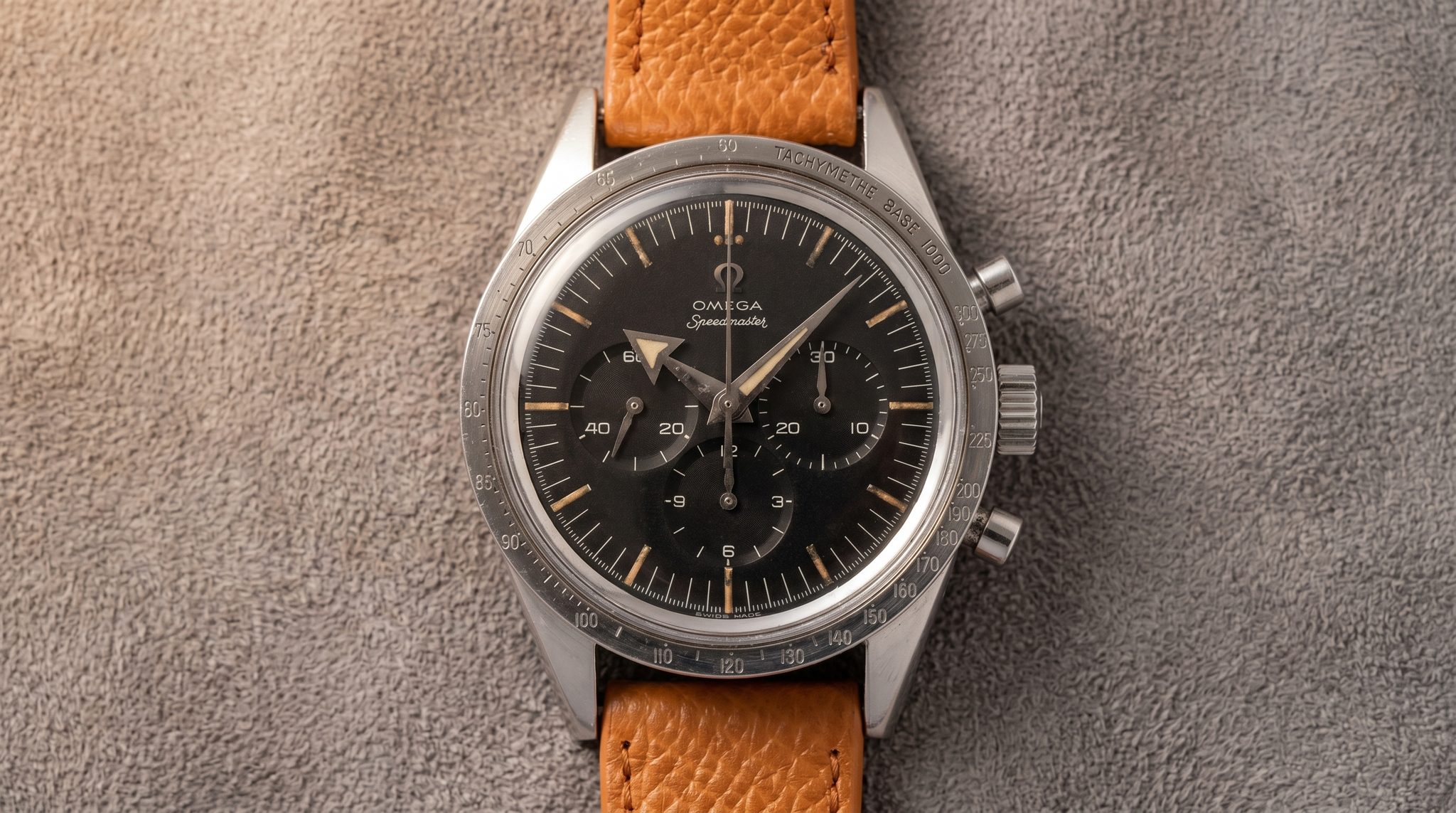
The Omega Speedmaster CK2915 is the founding Speedmaster, a 1957–1959 racing chronograph whose short run and overlapping original executions make originality a matter of visible, part-by-part evidence.
- Production
- 1957–1959
- Case
- Stainless steel
- Diameter
- ~38–38.5 mm
- Lugs
- Straight lugs
- Bezel
- Engraved steel tachy
- Crystal
- Hesalite (acrylic)
- Dial
- Black, applied logo
- Movement
- Cal. 321
- Chronometer
- No
- Functions
- 12h chronograph
The Omega Speedmaster CK2915 is a watch whose surviving examples teach a hard lesson: the “first Speedmaster” is not a single frozen template, but a short 1957–1959 production run where hands, bezel execution, and small dial details can legitimately diverge, and where later parts swapping can erase the evidence. Its most repeatable visual signature is also its most contested one, the engraved steel tachymeter bezel marked “BASE 1000,” a component described as rare, fragile, and frequently replaced.
CK2915 launched in 1957 as Omega’s purpose-built racing chronograph within the brand’s broader professional push that also produced the Seamaster 300 CK2913 and Railmaster CK2914. Inside is the manual-wind Cal. 321, a Lemania 27 CHRO C12 family movement with column-wheel control, paired with the then-novel decision to put the tachymeter scale on the bezel rather than printing it on the dial.
Collectors organize CK2915 into three sub-references, CK2915-1, -2, and -3, but the most important caution is that many of the traits people look for, hand style and bezel execution in particular, are documented as independent variables rather than a single synchronized “early vs late” makeover. That independence is why the CK2915 rewards careful, component-by-component evaluation, especially at a price level where incorrect bezels, service hands, redials, and even newly manufactured cases are documented risks.
“CK2915 is the first Speedmaster, but it is not one look: in 1957–1959, hands and bezel executions overlap, so the watch has to be read by parts, not by nickname.”
CK2915 across 1957–1959
CK2915 begins in 1957 as Omega’s new racing chronograph, built around the manual-wind Cal. 321, a column-wheel movement in the Lemania 27 CHRO C12 family. The exterior decision that sets the tone for the line is visual and immediate: an external tachymeter scale engraved into a steel bezel, rather than a tachymeter printed on the dial. Period dials also show early typography cues that specialists use for confirmation, including the oval “O” in OMEGA and the first-generation Speedmaster script.
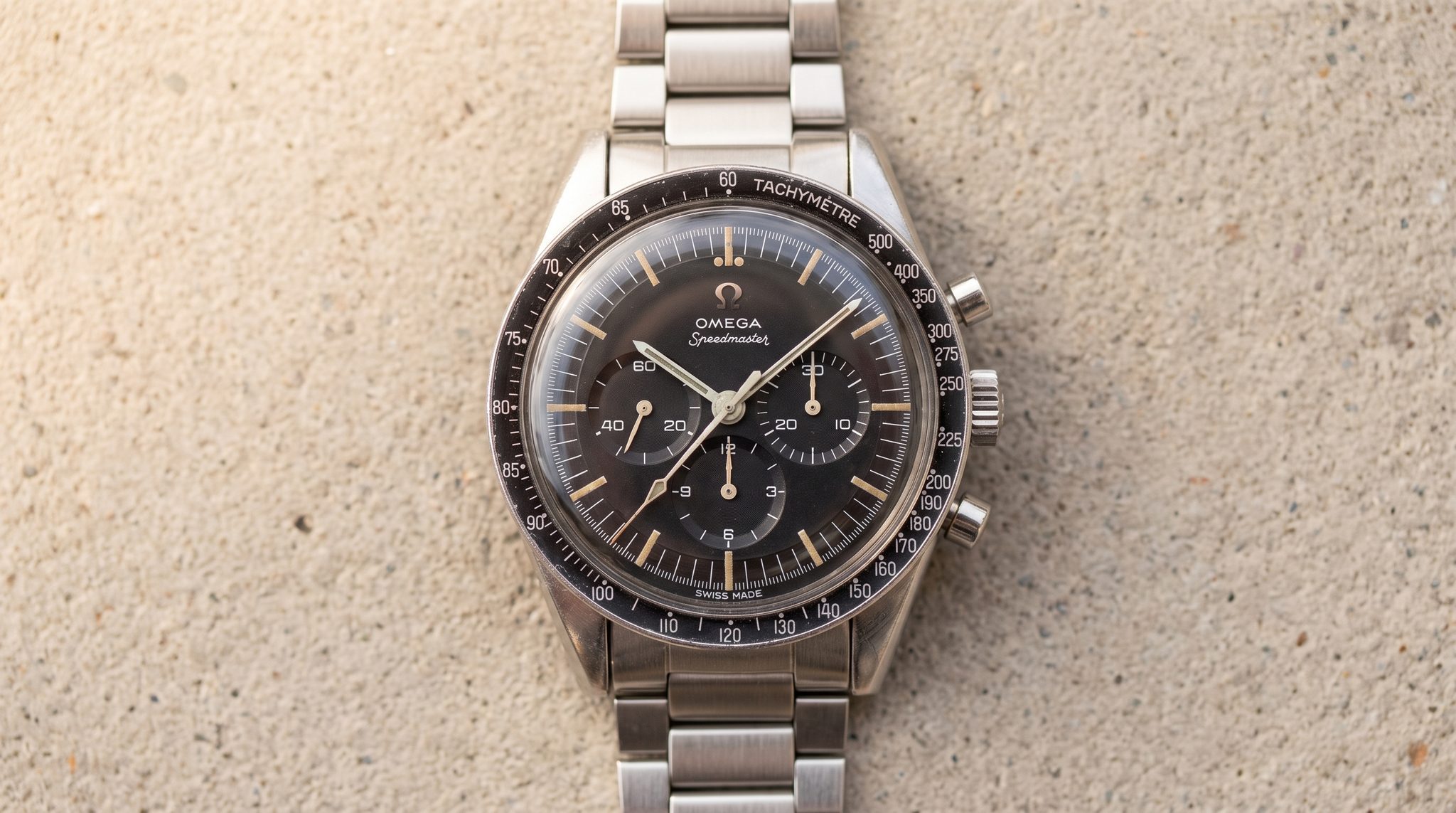
Within the short 1957–1959 run, collectors separate CK2915 into -1, -2, and -3, but the more instructive story is that CK2915 does not behave like a modern reference with one fixed bill of materials. The supplied record supports that CK2915-3 can appear with broad-arrow hands or with alpha hands, and that it can be found either with the engraved steel bezel or, on some transitional examples, with a black aluminum tachymeter bezel associated with parts intended for the follow-on CK2998. The exact factory cutoffs for these execution choices are not documented, and specialist writing treats some of the micro-subtypes as difficult to pin down.
The zoomed-out implication is that the “first Speedmaster” look was still being settled in real time. That is why, today, CK2915 collecting is less about memorizing a single correct picture and more about recognizing whether dial, hands, bezel, case, and movement form a coherent 1957–1959 whole, or whether later service and rebuilding have replaced the very features that make the reference historically legible.
- 1957LaunchEngraved steel tachy bezel
- 1957CK2915-1Caseback edge “Speedmaster”
- 1958CK2915-2Sub-ref stamped inside back
- c. 1958 – 1959CK2915-3May show alpha hands
- 1959CK2998 followsBlack aluminum tachy bezel
CK2915 against its neighbours
CK2915 is best understood by bracketing it with what comes immediately after, and with the two tool-watch siblings it launched beside. CK2998 shows how quickly the Speedmaster’s external language moved toward the black aluminum bezel and alpha-hand configuration, while the 1957 CK2913 and CK2914 underscore that CK2915 was conceived as part of a broader professional tool family, not as an isolated one-off.
CK2913 1957 sibling from 1957 | CK2914 1957 sibling from 1957 | This reference CK2915 Omega · focal 1957–1959 | ||
|---|---|---|---|---|
| Production | from 1957 | from 1957 | 1957–1959 | 1959–c. 1962/63 |
| Diameter | 39 mm | 38 mm | ~38–38.5 mm | ~39.7 mm |
| Case | Stainless steel | Stainless steel | Stainless steel | Stainless steel |
| Bezel | Rotating dive bezel | Plain metal bezel | Engraved steel tachy | Black aluminum tachy |
| Movement | Cal. 501 | Cal. 284 | Cal. 321 | Cal. 321 |
| Functions | Time-only | Time-only | 12h chronograph | 12h chronograph |
| Lugs | Straight lugs | Straight lugs | Straight lugs | Straight lugs |
| Water res. | 200 m | – | – | – |
| Dial | Diver layout | Engineer layout | Black, applied logo | Black, evolved print |
| Crystal | Hesalite (acrylic) | Hesalite (acrylic) | Hesalite (acrylic) | Hesalite (acrylic) |
Three dial generations across the run
CK2915-1 is the opening chapter of the Speedmaster story, and it sits at the top of the reference’s internal hierarchy largely for that reason. The supplied material treats it as the earliest sub-reference and regularly frames it as the most desirable, with an often-quoted production estimate of roughly 300–500 pieces that is presented as an estimate rather than an official figure. Visually, the safest way to describe what defines a CK2915-1 from the provided record is not a single dial or hand trait, but a period-correct whole: the early dial typography (including the oval “O”), the straight-lug steel case, and the correct family of early components.
What makes CK2915-1 difficult in practice is that some of the parts collectors prize most, particularly the engraved steel “BASE 1000” bezel and the broad-arrow handset associated with the early look, are also the parts most likely to have been changed during decades of servicing. The reference’s status means that “too perfect” examples deserve as much scrutiny as worn ones, because newly manufactured cases and rebuilt components are documented concerns at this level.
What to check before buying a CK2915
Buying a CK2915 is largely an exercise in proving that a very small set of early components has survived intact. The sources explicitly flag the usual high-end vintage hazards, service dials and hands, swapped bezels, heavy polishing, and movement or case substitutions, but they also add a CK2915-specific concern: newly manufactured cases and reworked assemblies have appeared, drawn by the money involved.
The bezel and hands deserve special attention because they sit at the center of both history and value. The engraved steel “BASE 1000” tachymeter bezel is described as rare, fragile, and frequently replaced, and the broad-arrow set is the visual shorthand for the earliest Speedmaster configuration. At the same time, late CK2915-3 watches complicate simplistic rules by legitimately appearing with alpha hands and, on some examples, a black aluminum tachymeter bezel associated with CK2998-era parts. The safest reading is not “must be steel and broad arrow,” but “must make sense together.”
The most satisfying CK2915 ownership experience tends to come from accepting what the reference is in the real world: a 1957–1959 tool chronograph that often shows honest wear, and where an even, original dial patina and correct, timeworn metal parts can be more convincing, and ultimately more valuable, than a cosmetically perfect watch rebuilt into an unearned version of history.
Omega Speedmaster CK2915 for sale
Auctions on Grey Market run on seven-day cycles, every watch verified before it sells. Browse what's live now, or consign your CK2915.
Adjacent in the Speedmaster family
Common questions about the CK2915
CK2915 production is documented as 1957–1959, with collectors dividing the reference into CK2915-1, CK2915-2, and CK2915-3 within that window.
- Grail Worthy: The Omega Speedmaster Ref. 2915-1 - Analog:Shiftanalogshift.com
- Omega Speedmaster History Part 1 - the early pre-moonsmonochrome-watches.com
- Omega Speedmaster CK2915 - Corrado Mattarellicorradomattarelli.com
Show 7 more
- 1958 Speedmaster sells for world record | OMEGAomegawatches.com
- Vintage Watch: Seamaster Speedmaster CK 2915 | OMEGAomegawatches.com
- Owner Review: Omega Speedmaster CK2915-3 - FIFTH WRISTfifthwrist.com
- 【F】 Fratello's Guide To Omega Speedmaster Watchesfratellowatches.com
- Omega Speedmaster CK 2915 – The First Speedy - WahaWatcheswahawatches.com
- 2915 - Speedmaster101speedmaster101.com
- Omega The Geneva Watch Auction: XIVphillips.com