

Omega Speedmaster 145.022
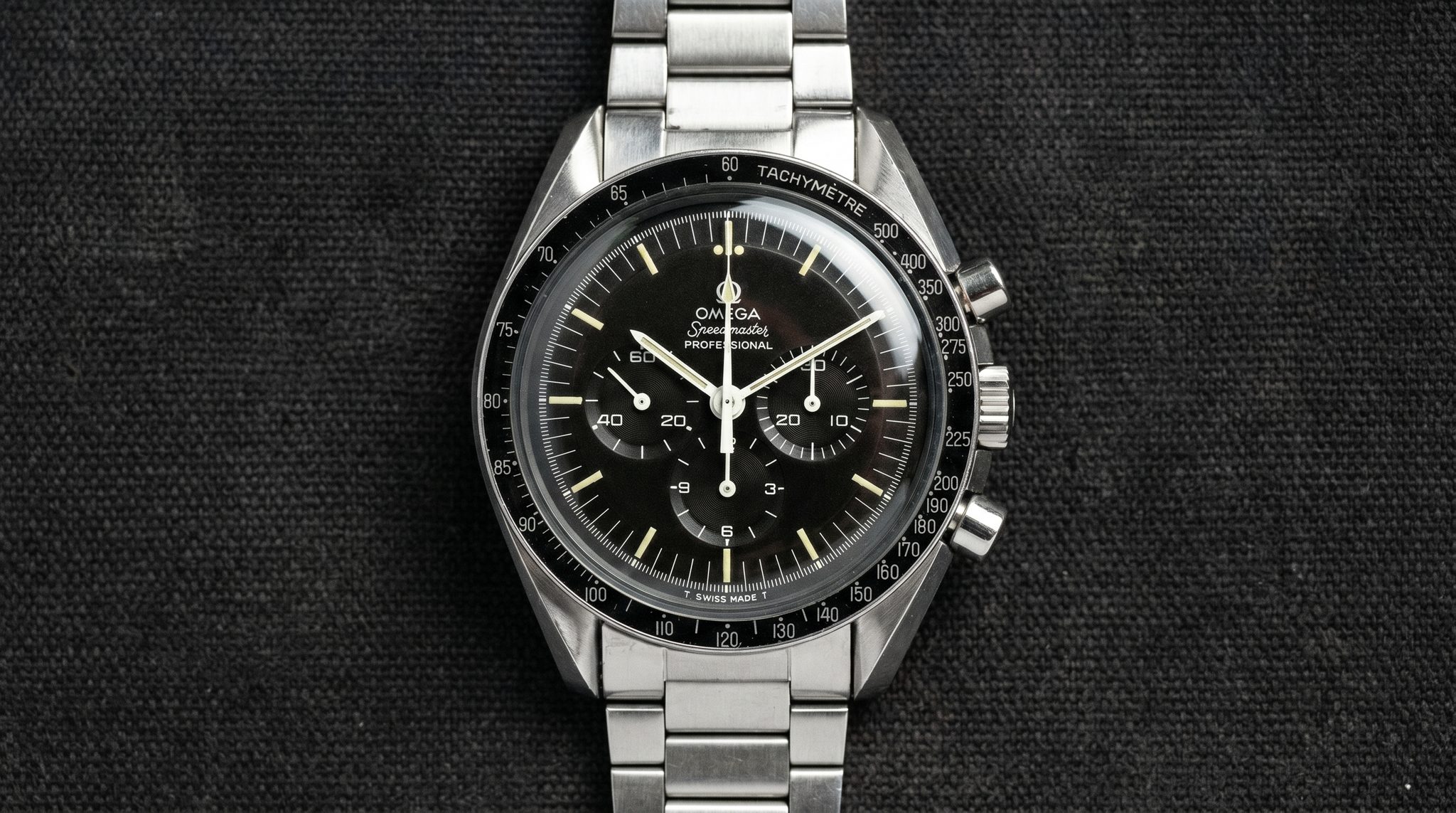
The Omega Speedmaster 145.022 is the Moonwatch that traded the hand-built Cal. 321 for the tougher, easier-to-service Cal. 861, then ran for two decades, long enough that its small dial, bezel, and caseback changes became a readable timeline.
- Production
- 1968–c. 1988
- Case
- Stainless steel
- Diameter
- 42 mm
- Lug to lug
- 48 mm
- Thickness
- 14 mm
- Lug width
- 20 mm
- Crystal
- Hesalite
- Bezel
- Tachymeter (aluminum)
- Water res.
- 3 ATM
- Movement
- Cal. 861
- Winding
- Manual
- Lume
- Tritium
The Omega Speedmaster 145.022 is the reference that made the Speedmaster Professional sustainable: it replaced the celebrated Cal. 321 with the tougher, more service-friendly Cal. 861, then stayed in production for roughly two decades, long enough that tiny external changes became a readable timeline on the wrist. The quickest way to feel that history is to handle an early example where the dot sits directly above “90” on the tachymeter bezel, a small printing detail that now signals the earliest years of 145.022 production.
As a watch, the 145.022 looks like the template for the hesalite “Moonwatch” that followed, with the 42 mm twisted-lug case, external tachymeter bezel, and the familiar tri-compax layout. As a collecting object, it rewards precision: its dial construction (applied or printed logo, step or flat), bezel type (DON, 220, DNN), and caseback engraving (pre-Moon through multiple Moon-text formats) each changed on their own timetable. Those independent axes are why a correct 145.022 can look quietly inevitable, while a parts-swapped one can look convincing until you know what to notice.
“A 145.022 is the Moonwatch that stayed the same where it mattered, then changed just enough everywhere else to leave a datable trail.”
145.022 across 1968–c. 1988
What makes the 145.022 unusually legible, decades later, is that Omega did not reinvent the Speedmaster Professional every few years. The company kept the case silhouette and the basic hesalite, tachymeter-bezel package steady, while altering components for reasons that are only partly documented in public. The major documented mechanical reason is clear: the move from the Cal. 321 to the Cal. 861 brought a cam-and-shuttle chronograph system that writers consistently describe as simpler to service and robust, and it runs at 21,600 bph rather than the earlier 18,000 bph.
From there, the visible story becomes a matter of overlapping manufacturing eras. The earliest 145.022-68 is a true bridge: it houses the 861 but can present with an applied metal Ω logo and a stepped dial that catches light at the edge of the minute track, often paired with the early dot-over-90 bezel and a pre-Moon caseback that says “Speedmaster” around the seahorse and nothing more. Shortly after, the 145.022-69 normalizes the printed-logo dial, but it does not normalize everything else. Within -69 alone, collectors document multiple caseback styles as Omega phases in Moon-text formats, and the bezel story runs on a separate rail, including the brief, famous “220” printing error.
By the mid-1970s, the watch settles into what most people picture when they imagine a vintage 861 Speedmaster: a flat tritium dial, a dot-next-to-90 bezel, and a medallion-style Moonwatch caseback. That is the zoomed-out lesson of the 145.022: a reference often treated as a single, stable object was still being worked out in public, and the evidence is all on the outside, if the parts remain honest to one another.
The late 145.022 period becomes fuzzier in naming rather than in form. Enthusiast charts show the same basic watch appearing under ST 145.0022 in the 1980s and then 3590.50 later, so the end of “145.022” is best understood as a gradual recoding rather than a clean model change.
- 1968Reference begins145.022-68 ST inside back
- 1969Printed logoΩ logo printed, not applied
- 1970Bezel shiftDot moves off top of “90”
- 1971Moon text eraNASA/Moon wording on back
- c. 1971/72Dial flattensNo step at minute track
- c. 1978Medallion standardRaised Seahorse medallion
- c. 1988Reference ends145.0022 or 3590.50 stamping
145.022 against its neighbours
The 145.022 sits at the hinge of the Speedmaster Professional story: the 145.012 is the last of the Cal. 321 generation that the 145.022 visually echoes in its earliest “transitional” form, while ST 145.0022 / 3590.50 is essentially the continuation of the same Cal. 861 Moonwatch under new reference coding. Together, they frame why 145.022 collecting is so focused on external tells rather than a changing underlying watch.
This reference 145.022 Omega · focal 1968–c. 1988 | 145.0022 Successor (recoded) c. 1983–1988 | 3590.50 Successor (catalog) c. 1988–1990 | ||
|---|---|---|---|---|
| Production | c. 1967–1969 | 1968–c. 1988 | c. 1983–1988 | c. 1988–1990 |
| Case | Stainless steel | Stainless steel | Stainless steel | Stainless steel |
| Diameter | 42 mm | 42 mm | 42 mm | 42 mm |
| Crystal | Hesalite | Hesalite | Hesalite | Hesalite |
| Bezel | Tachymeter (aluminum) | Tachymeter (aluminum) | Tachymeter (aluminum) | Tachymeter (aluminum) |
| Movement | Cal. 321 | Cal. 861 | Cal. 861 | Cal. 861 |
| Winding | Manual | Manual | Manual | Manual |
| Lume | Tritium | Tritium | Tritium | Tritium |
| Water res. | – | 3 ATM | – | – |
Five dial generations across the run
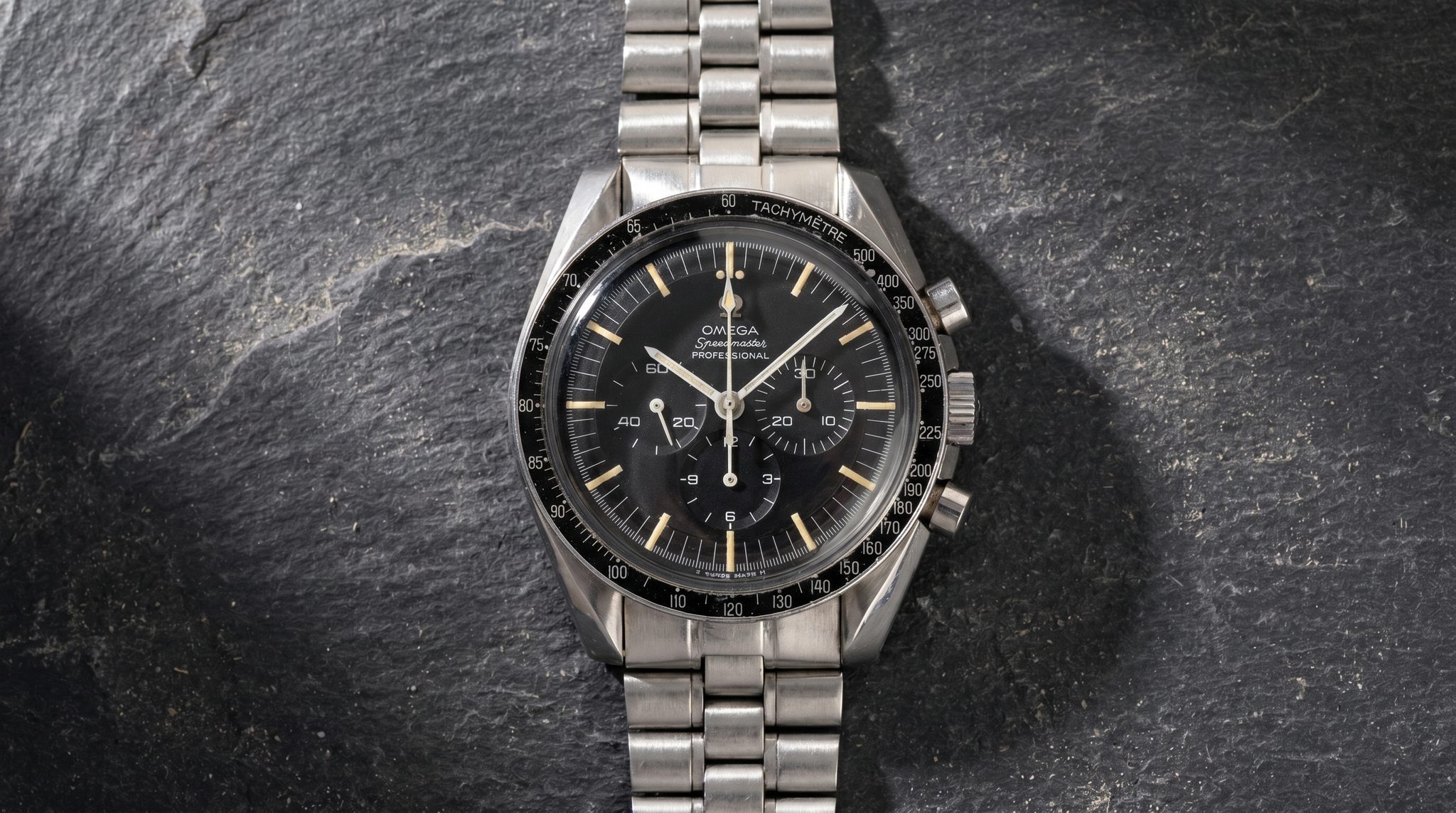
This is the 145.022 that looks back at the Cal. 321 era while turning the page mechanically. The applied metal Ω at 12 o’clock reads like jewelry compared with later printed dials, and the step at the minute track creates a clear change in plane that you can catch when the watch tilts. Hodinkee notes that on this early execution the lume plots reach all the way to the base of the minute track, a small graphic choice that makes the dial feel denser and more “pre-Professional” in character. The defining point is the combination: Cal. 861 inside, applied-logo step dial on the front, typically paired with early-period bezel and caseback traits that may also be found separately on early -69 watches.
What to check before buying a 145.022
Most “Speedmaster 145.022 for sale” listings are not really selling a single, fixed configuration, they are selling a 42 mm Moonwatch head whose most valuable parts are also the easiest to swap. The reference is famous precisely because it ran long enough to create many correct combinations, and that flexibility is what makes careless or intentional mixing hard to spot at a glance.
The safest way to buy is to treat dial, bezel, and caseback as separate questions, then ask whether the answers belong together for the claimed dash-reference. A DON or “220” bezel can be worth real money on its own, which is why those bezels so often migrate onto later watches. Likewise, a pre-Moon or straight-writing caseback can be fitted to a different period head in minutes. Even bracelets, while less defining, can add value when period-correct (1039 and 1171 are commonly cited) and are frequently changed.
Living with a good 145.022 is straightforward in the way the best tool chronographs are: hesalite softens reflections, the 42 mm case wears in the familiar Speedmaster way, and the Cal. 861 is routinely described as tough and service-friendly. The appeal is that it offers a genuinely vintage Moonwatch experience without demanding the fragility, scarcity, or pricing of the Cal. 321 era, provided the watch is allowed to be what it is: a long-lived standard whose details matter.
Omega Speedmaster 145.022 for sale
Indicative market value from recent dealer, auction, and Grey Market sales: median ≈ $4,500, with a typical $3,900–$6,300 range across 114 comparable sales (updated this week).
Each point is a recent dealer or auction sale, banded to an indicative figure. The range shown is not a valuation.
Adjacent in the Speedmaster family
Common questions about the 145.022
Specialist references consistently place Omega Speedmaster 145.022 production from 1968 to around 1988, after which the same basic Cal. 861 Moonwatch continues under ST 145.0022 and then 3590.50 reference coding.
- Omega Speedmaster 145.022: The Evolutionary Moonwatch Workhorsecrownvintage.com.au
- The Case For Collecting The Classics With The 1978 Omega Speedmaster Professional Ref. 145.022ablogtowatch.com
- 1969 Omega Speedmaster Professional Ref. 145.022-69 (Hodinkee Shop listing)shop.hodinkee.com
Show 7 more
- Spotlight on the Transitional Omega Speedmaster 145.022-68grayandsons.com
- Omega Speedmaster Professional 145.022 reference details and dimensionschrono24.com
- Finding year of production for 145.022 Speedy (discussion of ST 145.0022 and 3590.50 coding)omegaforums.net
- The Omega 145.022 Speedmaster Racing (145.022-69 Racing dial)bulangandsons.com
- Omega's Living Legend: Speedmaster 145.0022 (tropical/chocolate discussion context)bobswatches.com
- 145.022 update (collector-facing reference overview)speedmaster101.com
- Vintage Omega Speedmaster 145.022-69 “Straight Writing” (video overview)youtube.com