

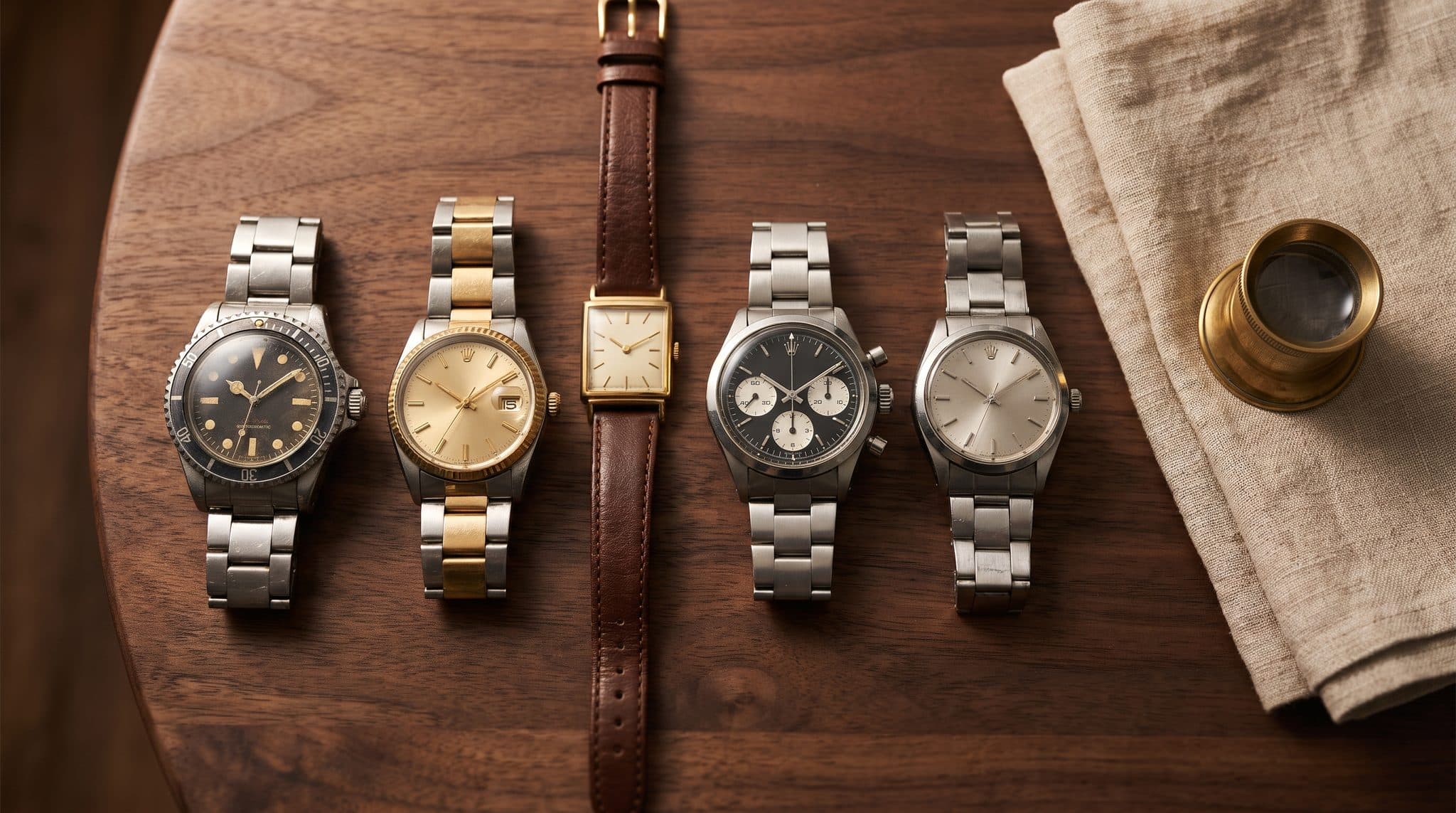
Short answer: buy from the venue that checks the watch before you pay for it, or that holds your money until you have the watch in hand. For a first vintage purchase that means an auction house, a specialist dealer, or a platform that authenticates (Bezel, eBay's program above its price floor, or a Grey Market auction). Chrono24 and the forums have the widest selection and often the best prices, and they ask the most of you in return: you do the checking, and your protection is whatever you paid with.
Start With What You Are Buying
The right venue depends on the watch. A five-digit Rolex Submariner or an Omega Speedmaster from the 1990s is a commodity in the best sense: thousands exist, the market price is well known, and the main risk is a service dial or a replaced bezel going undisclosed. Those are safe to buy almost anywhere that checks them. A gilt-dial 5513, a Paul Newman Daytona, or anything whose value sits in an original dial is a different purchase: condition and originality are the whole price, and you want the venue with the deepest expertise and the clearest recourse. Read the reference guides for what should be original on the watch you are after before you look at a single listing.
Auction Houses
Phillips, Christie's, Sotheby's, Bonhams, Antiquorum and the regional houses sell vintage watches in catalogued sales a few times a year, with the important pieces photographed, described and, at the top end, researched by specialists who know the references cold.
Good at: the rarest watches, provenance, and a description you can hold the house to. A catalogue note that says "original dial" from a major house is worth a great deal.
Bad at: cost and pace. The buyer's premium is the highest of any venue, the sale happens on the house's calendar, and most lots carry a reserve, so the pre-sale estimate is close to what you will pay. Condition reports are honest but brief, and you are expected to view the watch in person or send someone who can.
Protection: the house's guarantee of authenticity, usually for a fixed period after the sale, and its specialists' reputation. Returns otherwise are rare.
Specialist Dealers
The vintage dealers, from the famous names to the one-person operations that do most of their business on Instagram, buy watches, service them, and sell them with a warranty and a price that reflects both.
Good at: curation, condition, and relationship. A good dealer has already rejected the watches you should not buy, will tell you what has been replaced, and will take the watch back if they are wrong. For a buyer who wants one correct watch without becoming an expert first, this is the shortest path.
Bad at: price. A dealer's margin is the price of their curation, and it is real: the same watch on the forums or at a quiet auction can be a fifth cheaper. "Dealer" also covers a wide range; a shop that moves modern steel sports watches is not the place to buy a 1960s chronograph.
Protection: the dealer's own return policy and warranty, and their name. Check both before you pay, and pay by a method you could dispute.
Chrono24
The largest marketplace, with listings from thousands of dealers and private sellers in dozens of countries. Chrono24 does not own, inspect or price the watches; it hosts the listings and runs the checkout.
Good at: selection and price discovery. If a reference exists, it is listed on Chrono24 somewhere, and the spread of asking prices tells you what the market thinks in an afternoon.
Bad at: checking the watch. Unless a listing is Chrono24 Certified, nobody inspects it before it ships, and import duties and shipping on a cross-border purchase can add a lot to the sticker. Private-seller purchases carry no right of return.
Protection: pay through the platform's checkout and your money is held for an inspection window after delivery; pay a seller directly and you have none. The full picture, including the dealer-versus-private difference, is in is Chrono24 legit.
eBay
Still where a surprising number of vintage watches change hands, and better than its reputation since eBay began routing watches above a price floor through a third-party authentication center before they reach the buyer.
Good at: price, and the odd find. Estate watches, watches sold by people who do not know what they have, and the occasional watch listed under the wrong name all turn up here. The authentication program catches outright fakes.
Bad at: condition and originality. The authentication center confirms the watch is genuine; it does not grade a service dial, a relumed set of hands or an over-polished case against the listing. Below the price floor there is no inspection at all.
Protection: eBay's money-back guarantee for not-as-described and not-received claims, handled through eBay's resolution process.
Curated Platforms
Bezel, and the handful of platforms built on the same idea: a marketplace where every watch passes through the platform's own authentication before delivery, with a concierge to settle problems.
Good at: taking the inspection off your plate without a dealer's margin. Sellers are vetted, watches are checked in hand, and the buyer fee is well below an auction house premium.
Bad at: depth in the vintage end. The inventory leans modern and neo-vintage, prices are negotiated rather than discovered, and the authentication is the platform's own team rather than an independent one.
Protection: the platform's guarantee that the watch is genuine and as described, with the sale unwound if not.
Forums and r/watchexchange
The collector communities: r/watchexchange, the big forums, and the WhatsApp and Instagram groups that grew out of them. Members sell to members, with timestamps, trade histories and public questions.
Good at: price and knowledge. There is no margin, the sellers are often the most knowledgeable people in the hobby, and a question asked on a post gets an honest answer in public.
Bad at: payment. The deal settles directly between two people, and the protection is whatever your payment method offers. Scams are rare but real, and the recourse when one happens is thin.
Protection: the seller's reputation, the community's rules, and a payment method with a dispute process. Never pay as a gift, never wire a stranger.
Estate Sales, Pawn Shops and Local Jewelers
The venues where watches are found rather than shopped for. Prices can be far below market because nobody involved knows the market; they can also be far above it for the same reason.
Good at: the find, and the chance to hold the watch before you buy it.
Bad at: everything else. No authentication, no return, no description you can rely on. Bring a loupe, know the reference, and assume the watch has been serviced with whatever parts were on hand.
Where Grey Market Fits
We built Grey Market to combine the venues that check the watch with the venues that let the market set the price. Auctions run for seven days with no reserve, every lot is opened and checked in hand by an independent verifier before it ships, your payment is held until you have had the watch for 24 hours, and the seller is paid only after that. The Exchange is the forum model with the payment problem solved: ID-verified members list at a fixed price, questions are asked in public, your payment is held by Grey Market until delivery, and you can add the same verification at checkout. Both lanes are collected on the brand pages, starting with Rolex for sale.
What we are not: the biggest selection. About one submission in ten is accepted, so on any given week there are a few dozen watches here, not tens of thousands. If you want a specific reference tomorrow, Chrono24 will have it; if you want the next one that comes through checked, sealed and priced by the room, leave an alert on the reference page and we will email you when it lists.
Questions People Ask
Where is the safest place to buy a vintage watch? Anywhere the watch is checked by someone other than the seller before you pay, and your money is held until you have it: a reputable auction house, a specialist dealer with a return policy, or a platform that authenticates and holds payment. The cheapest venues are the ones that ask you to do the checking.
Is it safe to buy a vintage watch online? Yes, if you pay through a platform that holds the money, buy from a seller with a track record, and inspect the watch the day it arrives. The risks online are the same as in person; the difference is that you cannot hold the watch first, so the venue's protection has to stand in for your hands.
Should I buy from a dealer or at auction? A dealer when you want one correct watch and would rather pay for someone else's expertise; an auction when you know the reference well enough to read a condition report and want the price set by the room. The reference guides on this site exist to get you from the first group to the second.
How do I know a vintage watch is original? Compare the dial, hands, bezel insert, caseback and serial against the reference's production record (each reference guide lists what changed and when), and ask the seller directly what has been replaced. A verification report from an independent party answers the question for you; a listing's silence does not.
What should a first vintage watch be? Something made in numbers, with a known market and a service network: a five-digit Rolex, a Speedmaster, a Seamaster, a steel Datejust. Learn on a watch whose price is well known before you buy one whose price is the dial. How to buy a vintage Rolex walks through the first of those.
Reference guides
Deep dives on the references discussed in this story:
- Rolex Submariner 5513 (1962–1989)