

Cartier Santos Carrée 2961

The Santos Carrée 2961 is Cartier’s long-running two-tone automatic date Santos whose identity stays constant while collectability concentrates in dial execution and bracelet originality.
- Production
- early 1980s–late 1990s
- Case
- Steel, YG bezel
- Size
- 29 × 41 mm
- Thickness
- ~8.0–8.6 mm
- Bracelet
- Integrated two-tone
- Crystal
- Sapphire
- Water res.
- ~3 ATM
- Dial
- Roman, date at 3
- Movement
- Cartier cal. 077
- Winding
- Automatic
- Complication
- Date
- Lug width
- 18 mm
The Cartier Santos Carrée 2961 is the two-tone Santos that proves how a watch can be stable in design yet volatile in value. One reference can look almost unchanged on paper for decades, but the market treats it very differently once the dial turns oxblood, the lacquer starts to craze into a “spider” pattern, or the integrated bracelet has been softened by polishing and wear.
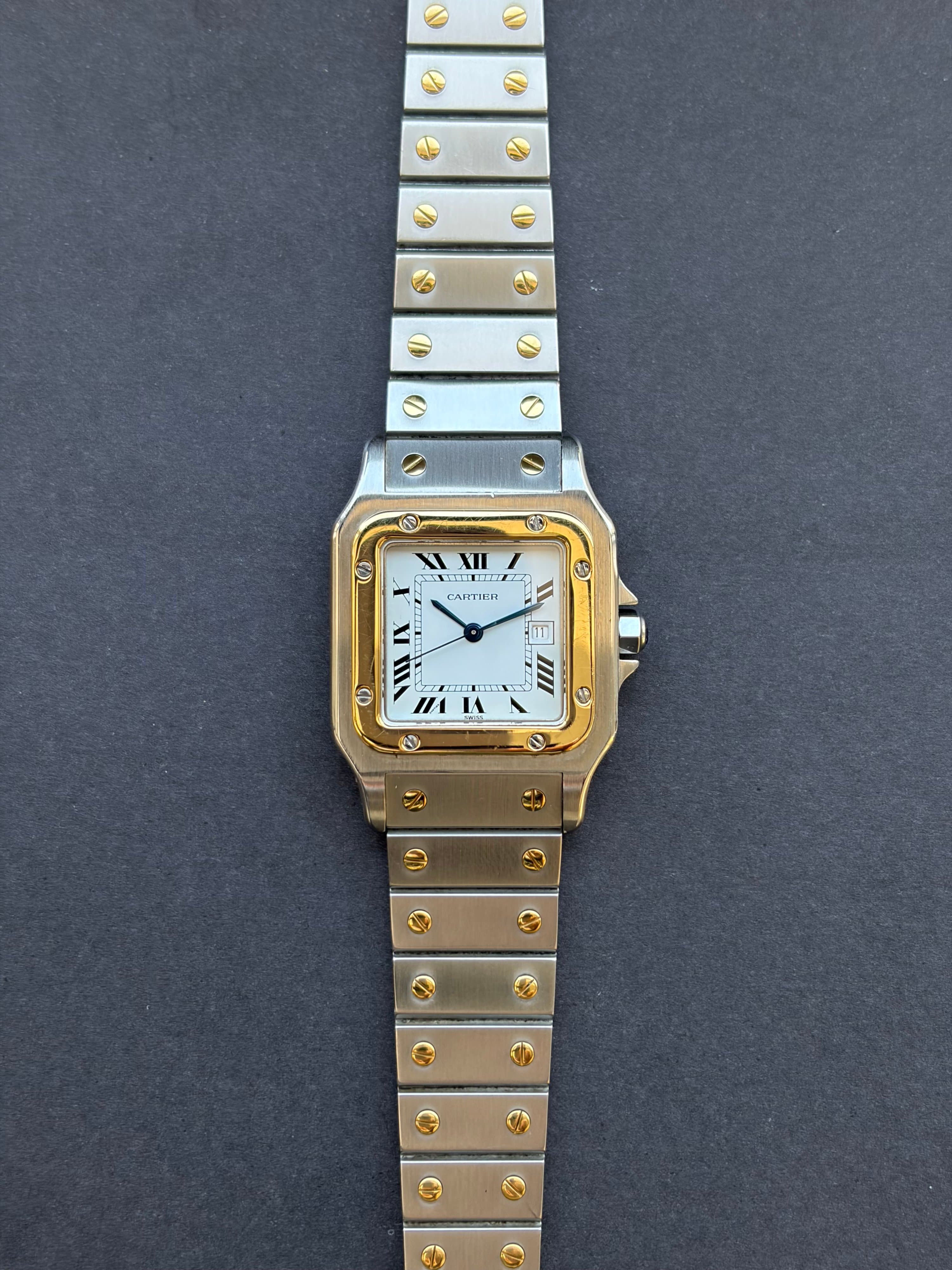
Ref. 2961 is the medium, automatic, date Santos Carrée in stainless steel with an 18k yellow-gold bezel and the signature exposed screw-head look carried through the bracelet links. Examples are documented across the early 1980s and deep into the 1990s, including a full-set watch sold new in Paris in 1999, so the reference reads as mainstream production rather than a short, neatly bounded run. Within that long span, the fundamentals stay recognizable: a square 29 mm case, sapphire crystal, Roman numerals, blued sword hands, and a date window at 3 o’clock.
Mechanically, listings most often describe Cartier caliber 077 with automatic winding and a quick-set date. Separate listings also identify ETA 2671 as the underlying base for a 2961, but Cartier does not publish a reference-level technical sheet in the material at hand that confirms the mapping as a factory statement. For collectors, that uncertainty matters less than the tangible things you can see and feel, because originality on a Carrée is read from surfaces and details: the crispness of the case edges, the alignment and condition of screw heads, and whether the dial’s color and aging look like they belong to the rest of the watch.
“With the Santos Carrée 2961, the reference stays the same, but the dial and the bracelet decide the watch you are actually buying.”
2961 across early 1980s–late 1990s
The record for ref. 2961 is built from surviving watches rather than a single authoritative Cartier start-and-stop statement, so the safest way to understand its life is through dated examples. Market listings and dealer descriptions place 2961 watches in the early 1980s (with individual pieces listed as 1980, 1983, and 1984), and then again through the 1990s (with pieces listed as 1990 and 1995). A full-set example dated March 1987 shows the reference firmly established by the mid-1980s, while a separate full-set watch sold in Paris in 1999 demonstrates that the reference could still be retailed at the end of the decade, whether produced that year or remaining in stock.
Across those decades, most listings describe the same core physical profile, roughly 29 mm wide with an approximately 40–41 mm footprint, and a slim 8.0–8.6 mm thickness depending on how it is measured. What changes, and what creates the real separation in collector interest, is not a formally documented sequence of “Mark” dials. It is the quieter divergence of execution: a classic white or silver Roman dial that reads crisp and graphic, versus darker lacquer dials that shift the personality of the watch and can develop spiderweb-like crazing visible only at an angle under strong light. Bracelet execution and condition form the other axis, with some late-production examples described as having a “mk3” bracelet and newer-style buckle, although Cartier did not publish these bracelet “marks” in the sources available.
Seen as a whole, the 2961 is a reminder that a reference can be visually consistent and still become sharply segmented in practice, because the case architecture and automatic date layout stay familiar while value concentrates in what the eye catches first (white versus burgundy/oxblood) and what the hand notices next (a crisp, correct integrated bracelet versus one compromised by wear or replacement).
- early 1980sIn circulationListings dated 1980, 1983, 1984
- c. 1987Full-set datedPaper date: March 1987
- c. 1990Colored dialsBurgundy dial, gilt “Cartier” text
- 1992Service docsRepair guarantee dated 1992
- 1995Still listedListings dated 1995
- 1999Sold newPapers show sale in 1999
2961 against its neighbours
Ref. 2961 is most easily framed against the same watch in different execution: the common white-dial two-tone Carrée that defines the baseline look, and the less common colored or “spider” dials that can trade on rarity and patina. The important point is that these are not separate mechanical generations; they are the same reference expressed through dial and bracelet details.
This reference 2961 Cartier · focal early 1980s–late 1990s | ||
|---|---|---|
| Production | – | early 1980s–late 1990s |
| Case | Steel | Steel, YG bezel |
| Size | – | 29 × 41 mm |
| Thickness | – | ~8.0–8.6 mm |
| Bracelet | – | Integrated two-tone |
| Crystal | – | Sapphire |
| Water res. | – | ~3 ATM |
| Dial | – | Roman, date at 3 |
| Movement | – | Cartier cal. 077 |
| Winding | Automatic | Automatic |
| Complication | – | Date |
| Lug width | – | 18 mm |
Five dial generations across the run
This is the Santos Carrée 2961 most people picture: a light dial (described as white or silver) printed with black Roman numerals and a chemin-de-fer minutes track, with the date window neatly cut at 3 o’clock. In person it reads like graphic design on enamel, especially against the jewelry-like contrast of steel and yellow gold. The identifying experience is simple and immediate: blued sword hands that flash blue at some angles, and a dial that stays high-contrast even as the case picks up wear.
Because this dial appears on examples dated from the 1980s into the 1990s, it functions as the continuous baseline execution rather than a narrowly bounded “early” mark. The collector task is less about proving the dial is from a particular year, and more about judging whether it is original to the watch and coherent with the rest of it, especially the sharpness of the case edges and the integrity of the integrated bracelet.
What to check before buying a 2961
Buying a Santos Carrée 2961 is less about hunting a single “correct year” and more about avoiding the ways a long-running, highly wearable design gets altered. The biggest financial swings come from the visible elements: dials that have been refinished or swapped, and integrated bracelets that have been replaced, stretched, or polished until the geometry looks melted.
The safest purchases are the ones that look assembled by time, not assembled later: a dial whose aging matches the case, a case that still shows crisp transitions between finishes, and screws that look consistent rather than like a handful of mismatched replacements. Documentation helps, but on a Carrée the surfaces tell the story first.
Cartier Santos Carrée 2961 for sale
One 2961 is taking bids on Grey Market right now, verified before it goes live.
Each point is a recent dealer or auction sale, banded to an indicative figure. The range shown is not a valuation.
Adjacent in the Santos Carrée family

Common questions about the 2961
Cartier reference 2961 denotes a Santos Carrée in the medium 29 × 41 mm format with an automatic movement and date at 3 o’clock, typically in a two-tone steel and 18k yellow-gold configuration with an integrated screw-link bracelet and Roman-numeral dial.
- European Watch Company (55909) Cartier Santos Carrée 2961europeanwatch.com
- EveryWatch lot: Cartier Santos Carrée 2961, cal. 077 (Germany)everywatch.com
- EveryWatch listing: Cartier Santos Carrée 2961, caliber ETA 2671 (Netherlands)everywatch.com
Show 7 more
- Goldammer: Cartier Santos Carrée 2961 Two Tone 1990sgoldammer.me
- Veritas Watches: Cartier Santos Carrée 2961veritaswatches.ch
- Veritas Watches shop: full set sold in 1999 in Parisveritaswatches.ch
- Chrono24 reference page: Cartier ref. 2961chrono24.com
- Danny’s Vintage Watches: Cartier Santos 2961 white Roman dialdannysvintagewatches.com
- Cresus: Cartier Santos Carrée 2961 listingcresus.fr
- ORBIS Atelier: Santos Carrée 2961 circa 1990orbis.swiss