

Cartier Santos Carrée 2960
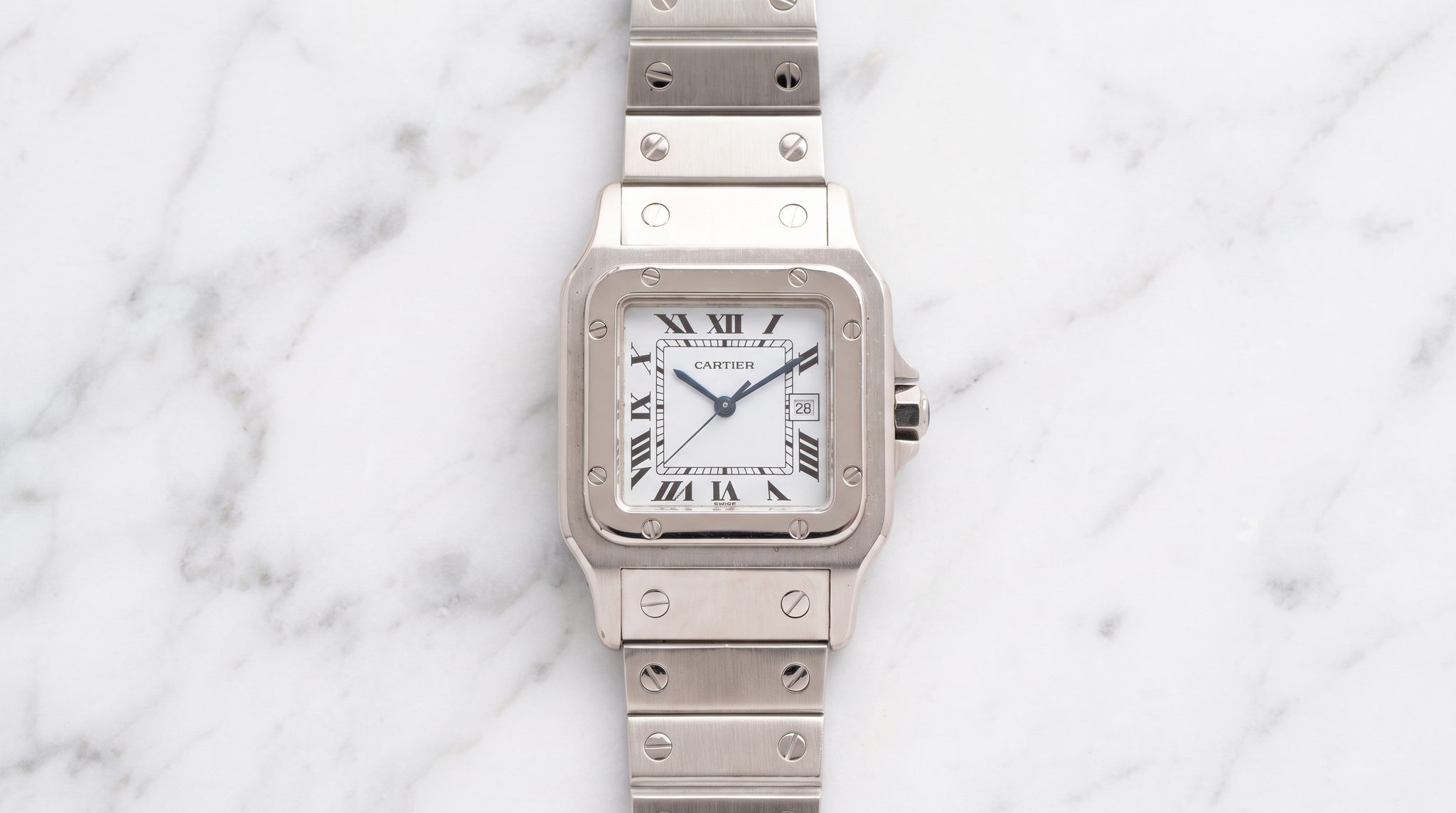
The Santos Carrée ref. 2960 is a single Cartier reference that survives as a family of executions: the same squared Carrée architecture appears in steel, gold and two-tone, with white, slate and burgundy dials overlapping in period rather than marching in a neat sequence.
- Production
- c. 1978–c. 1990s
- Case
- Steel or 18k gold
- Size
- ~29 × 41 mm
- Crystal
- Sapphire
- Bezel
- Screwed, square
- Water res.
- 3 ATM / 25–30 m
- Movement
- Cal. 2671 (also 077)
- Winding
- Automatic
- Date
- Yes
- Power res.
- 39 h
- Jewels
- 17
The Santos Carrée ref. 2960 is the reference that shows how Cartier’s 1980s Santos could be both standardized and surprisingly variable at the same time: the same squared Carrée case is documented with a vertically brushed slate dial whose Cartier signature can fade until it is nearly invisible, and with a burgundy lacquer dial that can age into a cracked “spider” surface. That overlap, plus the way listings alternate between Cartier cal. 2671 and cal. 077 for the very same watch, is the reason ref. 2960 is collected as much with the eyes as with the reference number.
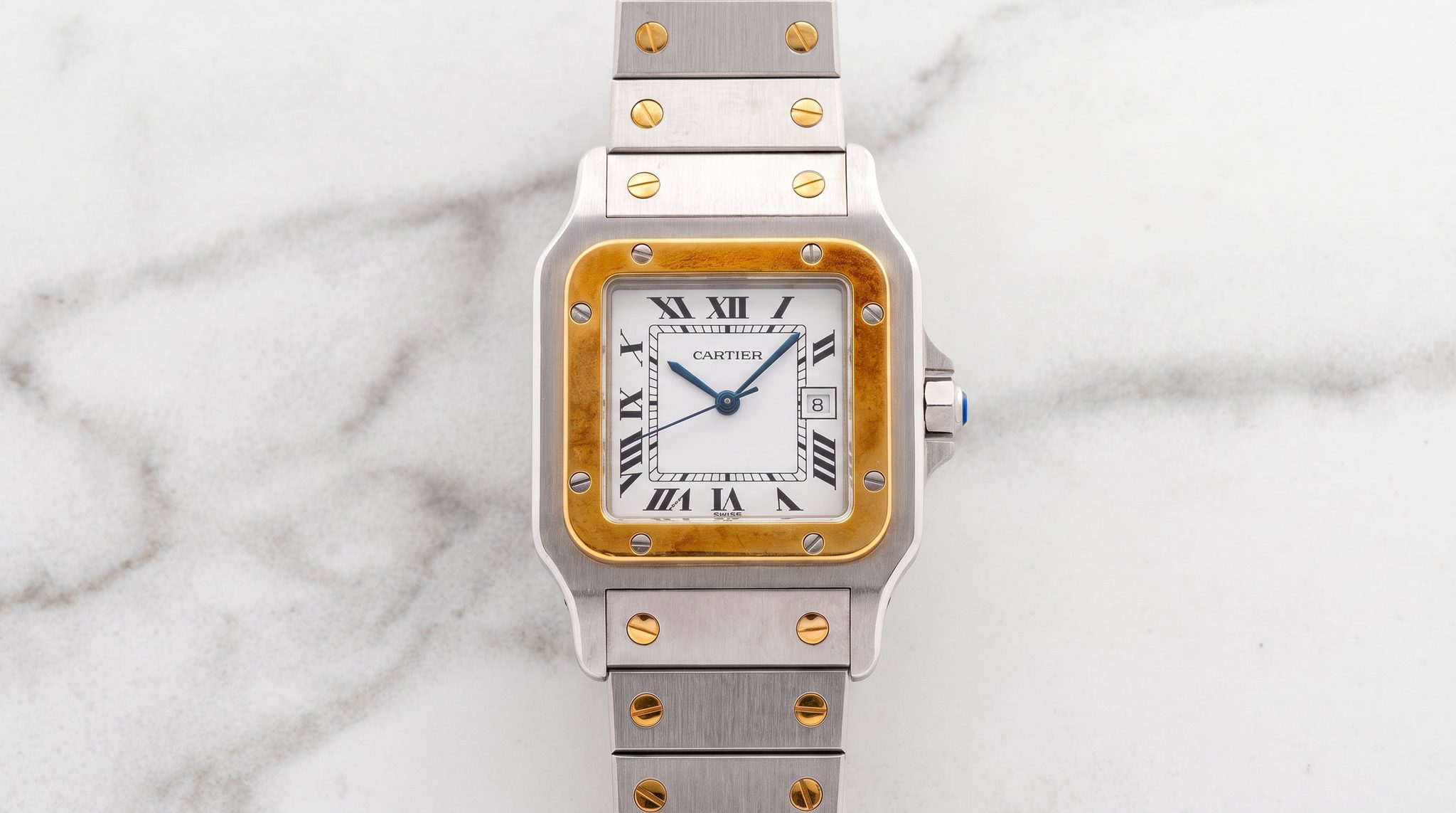
What is solidly documented is the core object. Ref. 2960 is a pre-Galbée Santos Carrée with an integrated bracelet, exposed bezel screws, sapphire crystal, and dress-level water resistance often quoted as 3 ATM (about 25–30 m). The most consistent size cited is about 29 × 41 mm, and the typical configuration is an automatic movement with a date. Beyond that baseline, surviving examples show the Carrée platform expressed across case metals and dial executions that run in parallel, not as tidy “Mark” generations.
That is also why “Santos Carrée 2960 production years” cannot be stated as a single clean factory interval from the public record. Archiva places the solid 18k yellow-gold 2960 around c. 1978–1990, while marketplace and dealer examples cluster in the late 1970s and 1980s and continue into the early 1990s, with occasional later year tags that read like approximations or mis-assignments rather than proof of continuous production into the 2000s. In practice, the ref. 2960 story is less about chasing one definitive start date and more about recognizing which execution is in hand.
“Ref. 2960 is one squared Santos Carrée platform with many legitimate faces, metals and dials that overlap in period rather than lining up as neat generations.”
2960 across c. 1978–c. 1990s
Ref. 2960 sits in the straight-edged Santos Carrée generation that predates the more curved Galbée shape. Archiva documents the solid 18k yellow-gold 2960 around c. 1978–1990, and steel Carrée automatics are clearly contemporaneous based on dated examples offered as c. 1979 and c. 1980. The underlying movement is consistently presented as an automatic date calibre, but the naming is not uniform in the secondary market: many listings call it Cartier cal. 2671, while at least one early steel watch is described as cal. 077, reinforcing that buyers often encounter the same mechanical idea under different Cartier designations.
Where the watch becomes truly identifiable is on the dial, because the Carrée platform seems to have carried several legitimate factory executions at once. The classic white Roman dial is the baseline, sometimes described as having “SWISS” at 6 on early examples, though there is not enough published, multi-source evidence to turn “SWISS” versus “SWISS MADE” into a dated Mark system. Alongside the white dial, specialist coverage treats two alternatives as standard-production options within the ref. 2960 era: a slate grey, vertically brushed dial whose Cartier signature at 12 can fade until it nearly disappears, and a burgundy lacquer dial whose surface can later craze into a spiderweb of cracks. Those are not different references and they are not reliably tied to strict year cutoffs. They are parallel expressions of the same watch.
One step back makes the reference easier to understand. The Santos Carrée 2960 reads less like a single frozen spec and more like a modular 1980s platform: the squared case and screw bezel stay constant while case metals, bracelets and dial executions move around them. That is why the most useful “dating” details tend to be visual and tactile, like the direction of brushing on a slate dial, the presence of lacquer cracks on burgundy, or the way a case’s flat planes and screw recesses have survived polishing, rather than any single headline year.
- c. 1978Carrée eraSquare Carrée case, screw bezel
- c. 1980Early automaticsSteel integrated bracelet, date
- c. 1980Cal. 077Movement described as “077”
- c. 1983 – 1986Alt dialsSlate brushing or burgundy lacquer
- c. 1985Godron loreSculpted “godron” links
- 1987Galbée risesMore curved case/bracelet
- c. 1992Late tagsGuarantee-year style dating
2960 against its neighbours
Ref. 2960 is best framed against the Santos that came before and after it in form, plus a dial-focused sibling reference. The manual-wind Carrée in precious metal shows how the same square case architecture can appear without the automatic date configuration, the Galbée generation is the later, more curved direction the line takes, and ref. 2961 demonstrates how closely related Carrée watches can diverge primarily through dial and metal choices.
This reference 2960 Cartier · focal c. 1978–c. 1990s | ||
|---|---|---|
| Production | c. 1978–c. 1990s | early 1980s–late 1990s |
| Case | Steel or 18k gold | Gold/steel |
| Size | ~29 × 41 mm | 40 × 32 mm |
| Crystal | Sapphire | Sapphire |
| Water res. | 3 ATM / 25–30 m | 3 ATM |
| Movement | Cal. 2671 (also 077) | Automatic |
| Winding | Automatic | Automatic |
| Date | Yes | – |
Four dial generations across the run
The default ref. 2960 dial is the classic Cartier Santos layout: an off-white field with black Roman numerals, a chemin-de-fer minute track and the Cartier signature at 12. On the wrist it reads crisp and architectural, matching the square bezel and its exposed screws. Some early examples are described in listings as having “SWISS” alone at 6, while others show “SWISS MADE.” The existence of both is well documented, but a reliable, dated cutover has not been published, so the text at 6 is best treated as a period detail to be weighed alongside other traits, not as a standalone guarantee of an exact year.
What to check before buying a 2960
A Santos Carrée 2960 review is ultimately a lesson in buying the watch that is actually in the photos, not the one implied by the reference alone. The market accepts steel, yellow gold and two-tone Carrée watches labeled 2960, and it also accepts multiple legitimate dial executions. That breadth is part of the charm, but it also creates the two main risks: reference-number ambiguity in listings and dial originality questions, especially when the dial is the value driver.
For the white Roman dial, condition is the story. The Carrée design depends on sharp planes, crisp bezel screw recesses and a bracelet that still feels architectural rather than rounded by polishing. For slate and burgundy, the dial itself becomes the inspection target. The slate dial should show its vertical grain, and a faded signature can be natural aging, not necessarily damage. Burgundy lacquer can craze into a spiderweb of cracks; that is patina, but it should look like lacquer aging rather than fresh paint. Both are expensive enough that conversions and refinishes are a practical concern.
A third decision is service. Listings sometimes highlight recent Cartier service, which can be valuable for reliability, but factory servicing can also mean replacement dials or hands if Cartier judged originals out of tolerance. For many buyers, ref. 2960 is at its best when it still looks assembled by time, with surfaces and dial aging that match, even if that means living with a watch that is more delicate and more historically specific than a modern Santos.
Cartier Santos Carrée 2960 for sale
Indicative market value from recent dealer, auction, and Grey Market sales: median ≈ $6,700, with a typical $5,200–$9,600 range across 37 comparable sales (updated this week).
Each point is a recent dealer or auction sale, banded to an indicative figure. The range shown is not a valuation.
Adjacent in the Santos Carrée family
Common questions about the 2960
Publicly available documentation does not provide a single, factory-verified production range for Cartier Santos Carrée ref. 2960. Archiva places the solid 18k yellow-gold 2960 around c. 1978–1990, while listings and dated examples show the reference in the late 1970s and 1980s and into the early 1990s. Occasional later year tags on marketplaces are best treated as approximations or mis-assignments rather than proof of 2000s production.
- Archiva Watch, Cartier Santos: history and referencesarchiva.watch
- Hairspring: 2960 Cartier Santos Carréehairspring.com
- Hairspring: Slate Dial 2960 Cartier Santos Carréehairspring.com
Show 7 more
- Hairspring: Black Dial 2960 Cartier Santos Carrée Or Massifhairspring.com
- Chrono24: Cartier ref. 2960 overview pagechrono24.com
- EveryWatch: Cartier Santos 2960 (example listing, steel)everywatch.com
- Loupe This: Cartier Santos Carrée Automatic 2960 Ghost Dial (auction listing)loupethis.com
- Loupe This: Cartier Santos Carrée Automatic 2960 Burgundy Dial (auction listing)loupethis.com
- Oliver & Clarke: Cartier Santos Carrée ref. 2960 (product listing)oliverandclarke.com
- Goldammer: Cartier Santos 2960 Carrée Deux Or Two Tone (1980s)goldammer.me