

Tudor Chronograph 79260
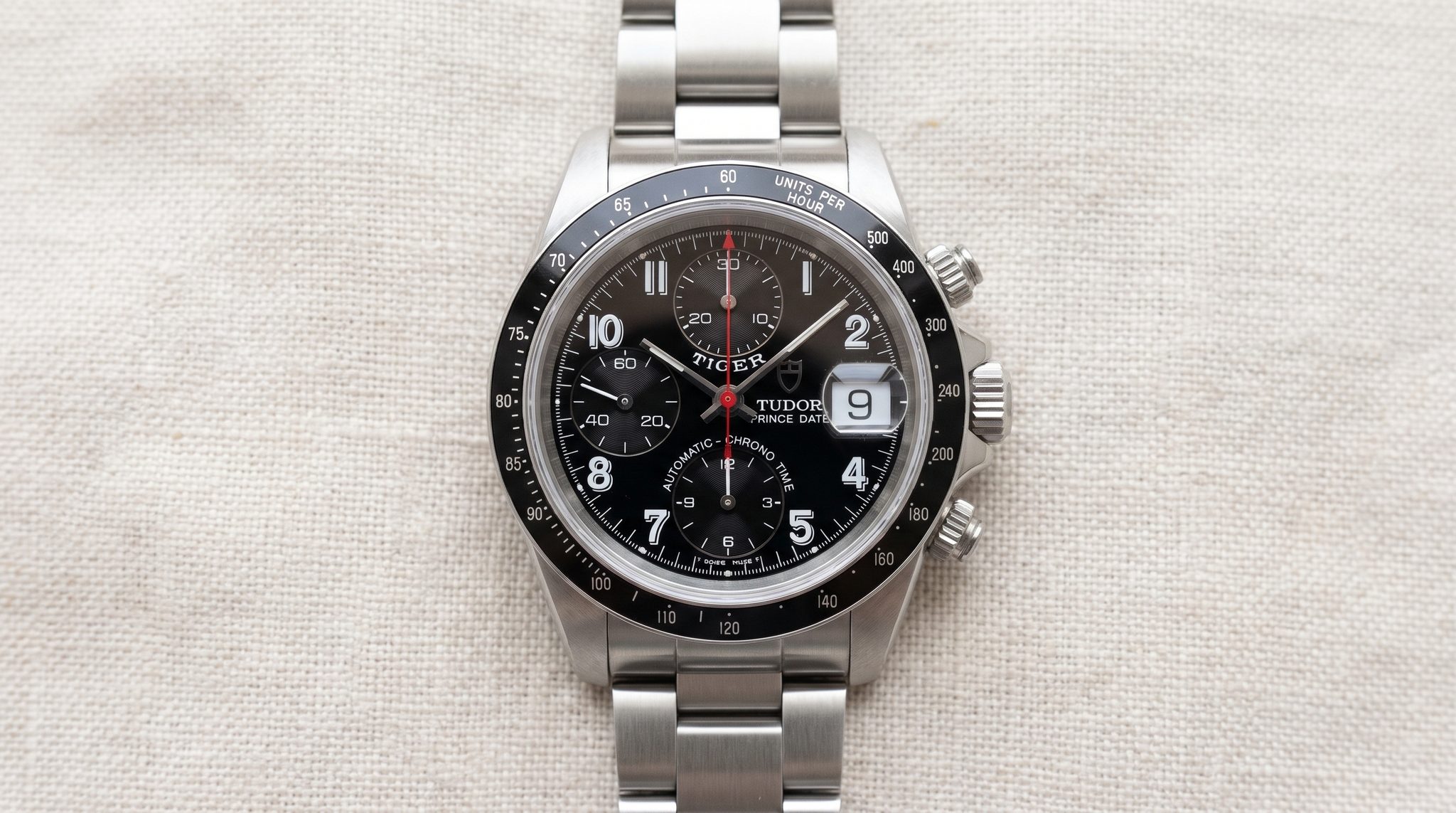
The steel Small Block Tudor chronograph whose reference number never moved while its dial name and colors kept changing.
- Production
- c. 1995–early 2000s
- Case
- Steel, ~40 mm, Small Block
- Lug width
- 20 mm
- Lug-to-lug
- ~48 mm
- Thickness
- ~14 mm
- Bezel
- Black tachymeter, fixed
- Crystal
- Sapphire, cyclops
- Dial
- Black, silver, white, yellow, blue
- Movement
- Modified Valjoux 7750
- Power reserve
- ~42–44h
- Jewels
- 25
- Functions
- Chrono, 12h counter, date
The Tudor Chronograph 79260 was produced from about 1995 to the early 2000s.
- Production years
- c. 1995–early 2000s
- Movement
- Modified Valjoux 7750
The Tudor Chronograph 79260 is a watch whose reference number never changed while nearly everything printed on its dial did. Tudor's own historical material illustrates a 1996 example that still carries the Oysterdate name and a 2000 example that reads only TUDOR and PRINCE DATE: the same reference, the same steel case, four years apart. That is the argument of this watch. The 79260 is the steel, fixed-bezel member of the slimmer Small Block chronographs that began around 1995, and its identity lives in the dial rather than the case. Beneath it sits a Tudor-modified self-winding Valjoux 7750 that stayed constant throughout, so the movement offers no early-versus-late split to hold onto. What changed was the face: black Oysterdate dials, silver dials with cream counters, then Prince Date signatures, white panda layouts, yellow dials that sellers call Tiger, and blue. The black aluminium tachymeter insert on the fixed bezel is the one hardware change Tudor itself singles out, replacing the Plexiglas insert of the earlier Big Block chronographs. At about 40 mm across, 48 mm lug-to-lug and 14 mm thick, it wears compact but tall, a vintage-flavored automatic chronograph that is dated and valued by its dial.
“One reference number, one steel case, and a dial that changed its name and its colors faster than anything else about the watch.”
Tudor Chronograph 79260 production years: c. 1995–early 2000s
The 79260 arrived around 1995 as the steel, fixed-bezel version of the Small Block chronograph, and the one hardware change Tudor itself highlights is the move from a Plexiglas tachymeter insert to black anodised aluminium. Why Tudor made that swap is not documented. The same goes for the 1997 shift from Oysterdate to Prince Date and for the leather strap with a TUDOR-marked folding clasp, which Tudor says became available that year: the changes are recorded, the reasons are not. What the record does show is that the movement never forced a break. Tudor describes the 79260's calibre as a substantially improved self-winding Valjoux 7750, and no collector-recognized movement generation separates early watches from late ones, so the dial carries all the dating information. Even that is loose. Silver dials with cream counters are documented by 1996, but nobody has established the day they replaced the first black dials, and Prince Date dials come in more than one color. Taken together, the sequence shows a design still being worked out in public: within roughly five years the same reference moved from an Oyster-heritage signature to a Tudor-only one, and gained white, yellow and blue faces along the way. The end of the run is equally soft. Tudor illustrates a 2000 example, while dealer papers and listings reach 2002.
- c. 1995Small Block debutBlack aluminium tachymeter insert, sapphire crystal
- 1996Silver dial documentedSilver face, cream-coloured subdials
- 1997Prince Date namePRINCE DATE printed on the dial
- 1997Leather strap optionSteel folding clasp marked TUDOR
- 2000Prince Date exampleNo Oyster wording on dial
- c. 2002Late dealer-dated examplesBlue dial, 40 mm steel case
79260 against its neighbours
The 79260 is easiest to place against the thicker Big Block chronograph it replaced and the two Small Block siblings that share its case and movement but change the bezel.
79270 Sibling (rotating bezel) From c. 1995 | This reference 79260 Tudor · focal c. 1995–early 2000s | |||
|---|---|---|---|---|
| Production | c. 1989–c. 1995 | From c. 1995 | From c. 1995 | c. 1995–early 2000s |
| Case | Steel, thicker Big Block | Steel, Small Block | Steel, Small Block | Steel, ~40 mm, Small Block |
| Bezel | Black tachymeter, fixed | Black rotating 12-hour | Polished steel, fixed tachymeter | Black tachymeter, fixed |
Seven dial and configuration variants across the run
The first 79260s pair a black dial with pale subsidiary registers and sign the face OYSTERDATE rather than Prince Date. The black aluminium insert on the fixed bezel gives the watch a darker, flatter bezel than the earlier Plexiglas chronographs. The window is approximate: the first-year cutoff is not firmly established, and Tudor's own 1996 example already shows the silver variation, so not every early black dial can be pinned to a bounded year.
What to check before buying a 79260
The risk in buying a 79260 is not the case or the movement, which are consistent across the run, but the dial: a genuine case fitted with a refinished or wrong dial can look convincing and is materially less desirable. Because dial color, signature and strap option all sit on separate timelines, a seller's year is a starting point, never proof. The watch rewards the buyer who wants a 40 mm steel automatic chronograph with a real mechanical story and is willing to inspect closely, since sound examples span a wide range and the gap between a tired daily watch and a complete, original set is mostly dial and condition.
Tudor Chronograph 79260 price and value
A Tudor Chronograph 79260 sells for about $3,800 at the median, typically $3,500 to $5,400 across 11 comparable sales.
Tudor Chronograph 79260 for sale
Indicative figures from recent dealer, auction, and Grey Market sales (updated this week). Every watch is verified before it sells here.
Each point is a recent dealer or auction sale, banded to an indicative figure. The range shown is not a valuation.
Grey Market runs watch auctions for vintage and neo-vintage pieces, every lot reviewed before it lists and verified before the seller is paid, and the Watch Exchange, where ID-verified users buy and sell at a fixed price. Selling one? See the ways to sell a Tudor, or check what it’s worth. For more vintage Tudor, see the Tudor reference guide.
Common questions about the 79260
The Tudor Chronograph 79260 was produced from approximately 1995, with examples documented through at least the early 2000s; no final production year is universally established. Tudor's own historical material illustrates examples from 1996 and 2000, while dealer listings sometimes show earlier or later dates, including 1993 and 2002. Serial-number tables and retail dates are not fully consistent, so a watch's listed year does not by itself fix its production date.
- TUDOR Chronograph Watches | Inside TUDOR (1995 to 2000)tudorwatch.com
- Tudor The Hong Kong Watch Auction: XIIIphillips.com
- Tudor The Hong Kong Watch Auction: XIIIphillips.com
Show 7 more
- Fratello's Top 5 Tudor Chronograph References Everfratellowatches.com
- Very Briefly: Tudor Chronographs (Vintage, Pricing)revolutionwatch.com
- Tudor History in 10 References: From 1947 to Black Baythewatchology.com
- Tudor Prince Date 79260 Stainless steel Silver 1998everywatch.com
- Tudor Tiger Prince Date Chronograph Blue Dial Steel 79260swisswatchexpo.com
- PreOwned Tudor Prince Date Chronograph 79260bobswatches.com
- Tudor 79260 - Prince Date watcheschrono24.com