

Cartier Santos 2656
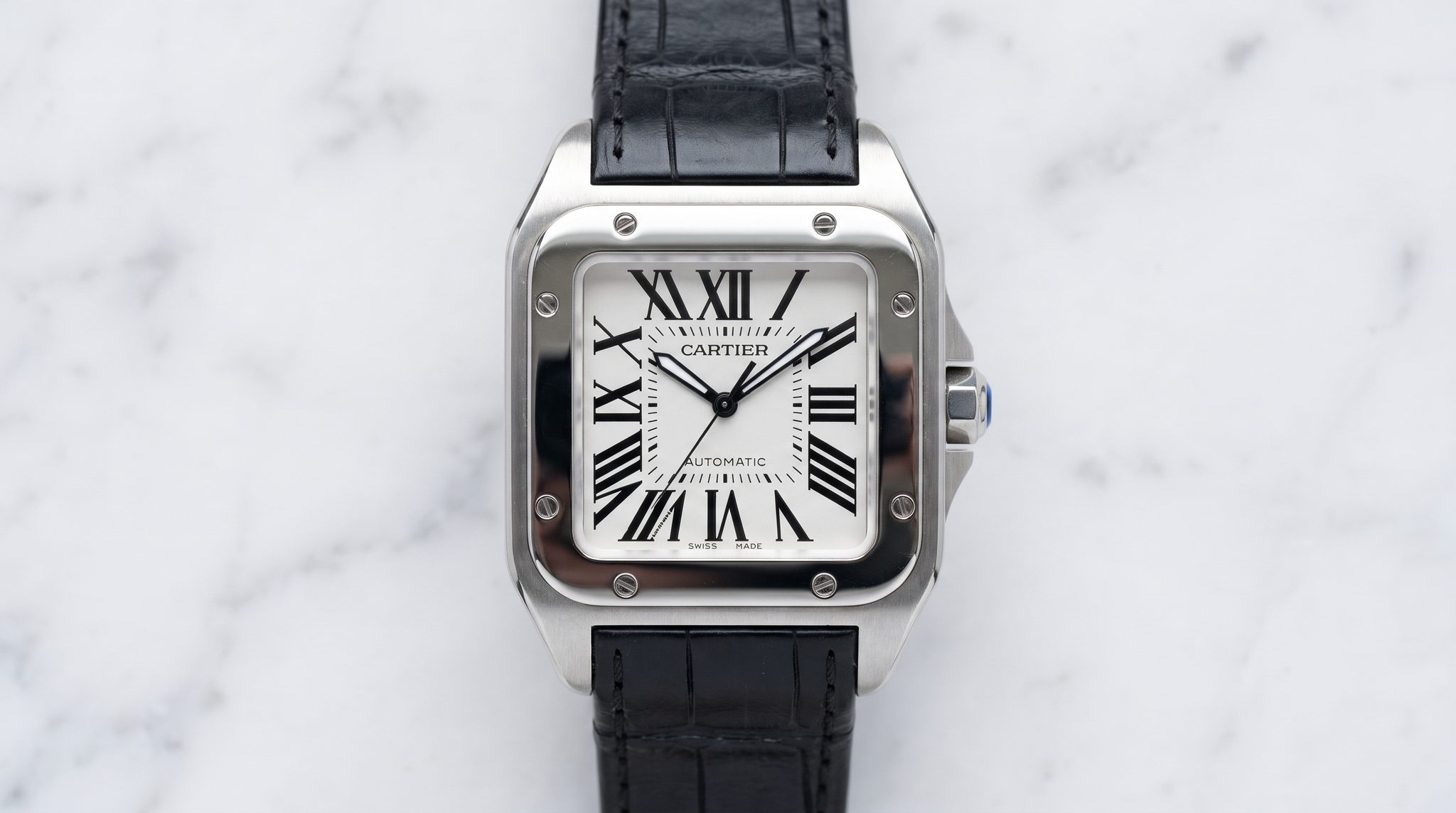
A Santos to judge by originality rather than by year: the c. 38 × 51 mm steel Santos 100 of the c. 2004 centenary.
- Production
- 2004–at least 2010
- Case
- Steel; two-tone variants
- Size
- c. 38 × 51 mm
- Bezel
- Square, eight screws
- Crystal
- Sapphire
- Dial
- Silver, black Roman numerals
- Hands
- Sword, commonly luminous
- Crown
- Cabochon-set
- Movement
- Cartier cal. 049
- Winding
- Automatic
- Jewels
- 21
- Date
- None (standard)
The Cartier Santos 2656 was produced from 2004 to at least 2010.
- Production years
- 2004–at least 2010
- Movement
- Cartier cal. 049
Cartier marked the Santos's hundredth birthday in 2004 by redrawing it at a new scale, and the 2656, the large steel Santos 100, is the result: by Christie's measure a 51 × 38 mm rectangle, its square bezel held by exposed screws. What the reference does not offer is a dating ladder. Christie's places one example at circa 2004 and Collector Square another at circa 2007, and both are described in the same terms, steel case, caliber 049, black Roman numerals, no date. A 2656 is therefore judged by originality rather than by year. Listings also call it the Santos 100 XL, Large or Centenary XL.
The details that identify it are physical. The bezel screws and the eight screws of the case back should show crisp, undamaged slots; the dial carries black Roman numerals with no date window, and under magnification a hidden Cartier signature appears at 7 o'clock. Caliber 049 is self-winding with 21 jewels and central seconds. Most examples are steel, and two-tone and rose-gold-and-black-PVD configurations are also documented. The anniversary edition bears a "1904–2004" designation, but that marking commemorates the centenary and does not date the individual watch.
The end of production is the least settled part of the story. Auction records include rose-gold and black PVD examples dated circa 2010, and marketplace databases list examples as late as 2012. One market database gives c. 2004–2018 for the reference, but those years match the life of the Santos 100 collection, launched in 2004 and replaced by the new Santos de Cartier in 2018, rather than any documented cutoff for the 2656 itself. The inference is that production ended somewhere in that window, and nothing more precise can be supported.
“With no documented revision to separate an early 2656 from a late one, each watch's history is written in its condition and its parts.”
Cartier Santos 2656 production years: 2004–at least 2010
The reason for the 2656 is documented plainly: the Santos turned one hundred in 2004, and Cartier marked it with the Santos 100, an enlarged modern reading of the original watch. Why the enlargement took this particular scale is not documented. The movement was in place from the start, caliber 049, which dealer listings identify as built on the ETA 2892-A2. That attribution rests on dealer descriptions and has not been confirmed from Cartier archival material.
After 2004 the record thins into scattered dated examples: a two-tone yellow-gold and steel watch at circa 2006, a steel watch at circa 2007, a rose-gold and black PVD example at circa 2010. No sequence between these configurations is documented, and two-tone watches appear from the launch period too, so a gold bezel does not make a watch later. The end of the run is equally soft. Listings reach 2012, and in 2018 Cartier replaced the whole Santos 100 collection with the Santos de Cartier, whose case, bracelet and movement architecture were all redesigned, so the 2656 was not simply renumbered.
Step back and the records show a reference whose early and late examples cannot be told apart by any documented trait; the differences that are recorded, steel against gold and silver against black, are matters of configuration. That is a limit of the evidence rather than proof that nothing changed, but it is the limit every buyer works within. The one firm date is the centenary itself.
- c. 2004Centenary launchEight bezel screws, cal. 049
- c. 2004Anniversary editionAnniversary marking, silvered dial, cal. 049
- c. 2006Two-tone exampleYellow-gold bezel and screws on steel
- c. 2010Rose gold PVDBlack PVD case, rose-gold crown and clasp
- 2012Latest listingsDatabase dating, not a Cartier cutoff
- 2018Line replacedNew case, bracelet and movement
2656 against its neighbours
The 2960 and 2961 frame the 2656 from the earlier Carrée generation: smaller watches built around a different case, useful as a measure of how far the Santos 100 departed from them.
This reference 2656 Cartier · focal 2004–at least 2010 | |||
|---|---|---|---|
| Production | c. 1978–c. 1990s | early 1980s–late 1990s | 2004–at least 2010 |
| Case | Steel or 18k gold | Steel, yellow-gold bezel | Steel; two-tone variants |
| Movement | Cal. 077 (ETA 2671 base) | ETA-based, Cartier-signed | Cartier cal. 049 |
| Dial | White Roman; Ghost/slate documented | Usually white Roman | Silver, black Roman numerals |
| Winding | Automatic | Automatic | Automatic |
Five case and dial configurations across the run
The anniversary examples carry the 1904–2004 designation on a silvered dial with black Roman numerals, above caliber 049. Christie's dates one to circa 2004, and Sotheby's records an anniversary watch in both steel and two-tone forms. The marking records an edition identity; it is not evidence of a different movement or lume period, and a standard watch carries the same caliber. Because the marking identifies a centenary edition rather than a production year, any premium rests on documented originality and completeness, such as a full set with the original Cartier box.
What to check before buying a 2656
The risk in buying a 2656 is not rarity or dating but originality. Aftermarket diamond bezels, replaced dials, crowns and clasps are hard to spot in photographs, and a steel Santos with a non-factory gem setting is not a special variant. Original configuration, then case condition, then service history, then box and papers is the safest order of priority.
The watch suits someone who wants the Santos at modern scale: it wears longer than its 38 mm width suggests because of the roughly 51 mm rectangular footprint, though no separately measured lug-to-lug or thickness figure is documented. Approximate 2024–2026 indications put an ordinary steel example around US$2,500–4,000, and good complete examples up to about US$6,500.
One documented circa-2005 example was presented in connection with Dennis Bergkamp's testimonial and survives with its presentation box and a provenance letter. Provenance of that kind adds value only when it is papered, as that one is; for most buyers the 2656 is a modern steel Santos to wear, chosen for intact edges and correct parts.
Cartier Santos 2656 price and value
A Cartier Santos 2656 sells for about $4,300 at the median, typically $3,000 to $6,500 across 18 comparable sales.
Cartier Santos 2656 for sale
Indicative figures from recent dealer, auction, and Grey Market sales (updated this week). Every watch is verified before it sells here.
Each point is a recent dealer or auction sale, banded to an indicative figure. The range shown is not a valuation.
Grey Market runs watch auctions for vintage and neo-vintage pieces, every lot reviewed before it lists and verified before the seller is paid, and the Watch Exchange, where ID-verified users buy and sell at a fixed price. Selling one? See the ways to sell a Cartier, or check what it’s worth. For more vintage Cartier, see the Cartier reference guide.
Common questions about the 2656
The Cartier Santos 2656 was introduced around 2004, when the Santos 100 line was launched. Its end date is not documented: the latest dated examples and listings fall around 2010–2012, and the Santos 100 collection itself was replaced by the Santos de Cartier in 2018.
- CARTIER, SANTOS 100, REF. 2656 (circa 2004)christies.com
- signed cartier, santos 100 anniversary 1904-2004 model, ref. 2656christies.com
- signed cartier, santos 100 model, ref. 2656christies.com
Show 9 more
- Reference 2656 Santos 100 Anniversary Edition 1904-2004sothebys.com
- Santos 100, Ref. 2656 Stainless steel and 18k yellow goldsothebys.com
- Introducing: The 2018 Cartier Santos Collectionhodinkee.com
- Santos: History, References & Collector's Guidearchiva.watch
- Cartier Santos-100 2656 Watches indexcollectorsquare.com
- Cartier Santos-100 watch in stainless steel Ref: 2656 Circa 2007collectorsquare.com
- Cartier Santos 100 2656 Stainless steel White 2005 United Kingdom, Lot 162everywatch.com
- Cartier Santos 100 XL 2656 18k rose gold and PVD-coated stainless steel Black 2010, Lot 116everywatch.com
- Cartier Santos 100 Ref. 2656 Two Tone Steel 18k Gold 38mm1stdibs.com