

Cartier Santos
The Santos is the Cartier that turned an aviator's screwed square case into a steel-and-gold bracelet watch, attainable without looking ordinary.
The Santos shows that a luxury archetype can be rebuilt around a business problem rather than a mechanical one. On 20 October 1978 Cartier presented the modern line at the Musée de l'Air in Paris, beside Alberto Santos-Dumont's aircraft: a steel case and bracelet under a yellow-gold bezel held by conspicuous screws. Alain-Dominique Perrin's problem was commercial. He had to reach a younger, broader buyer who would not buy an all-gold watch, without giving up Cartier's luxury identity, so steel made the watch attainable while the gold and the screws kept it recognisably Cartier.
The design was older than the problem. Louis Cartier made the first Santos in 1904 for his friend Santos-Dumont, who wanted to read the time in flight without letting go of the controls, something a pocket watch could not allow. The square case and exposed screws that began as a practical answer became the watch's identity, and the 1978 relaunch borrowed that story along with the shape.
Since then the bracelet Santos has moved through four case generations, each with a documented reason. The flat Carrée of 1978 was drastically revised, renamed and relaunched in 1987 as the Galbée, softer and curved to follow the wrist. In 2004 the Santos 100 marked the watch's centenary with a deliberately larger, bolder case, and the 2018 Santos de Cartier redesign updated proportions, bracelet system and movement while keeping the screws. Beside that line runs a separate dress branch, the leather-strap Santos-Dumont, revived from 2004 and prominently from 2019, which descends from the 1904 watch rather than from the bracelet Santos.
The vintage Cartier Santos references 2960 and 2961 are flat Carrée watches, the 2961 being the two-tone configuration most collectors picture, and the 1567 is a compact Galbée. Through all of them the square, the Roman numerals and the screws survive every redesign while metals, sizes and movements change around them, which is why a 1978 watch and a 1990s watch still read as the same object.
What each Santos reference trades for
4 references across 3 eras
Santos Carrée
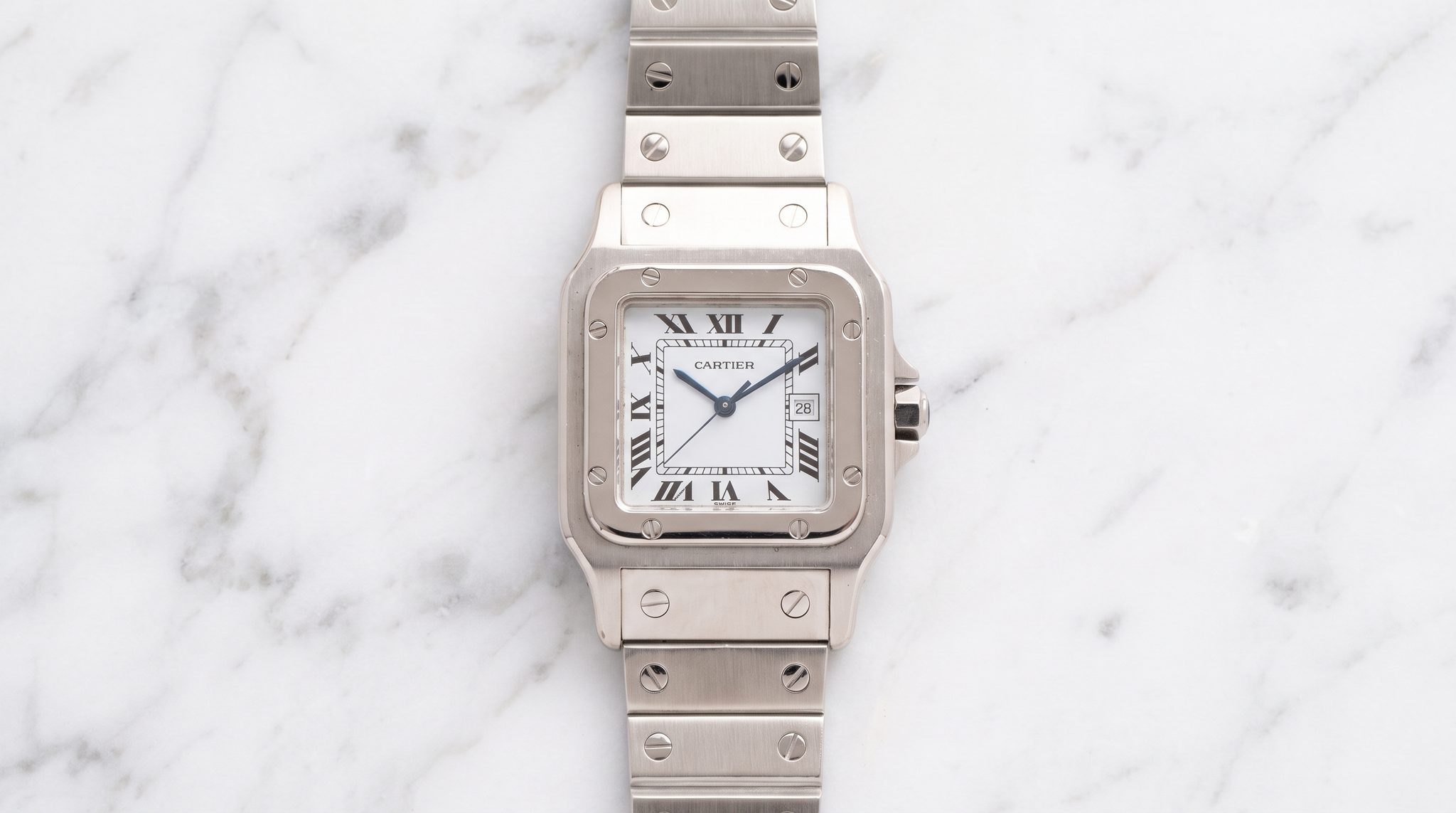
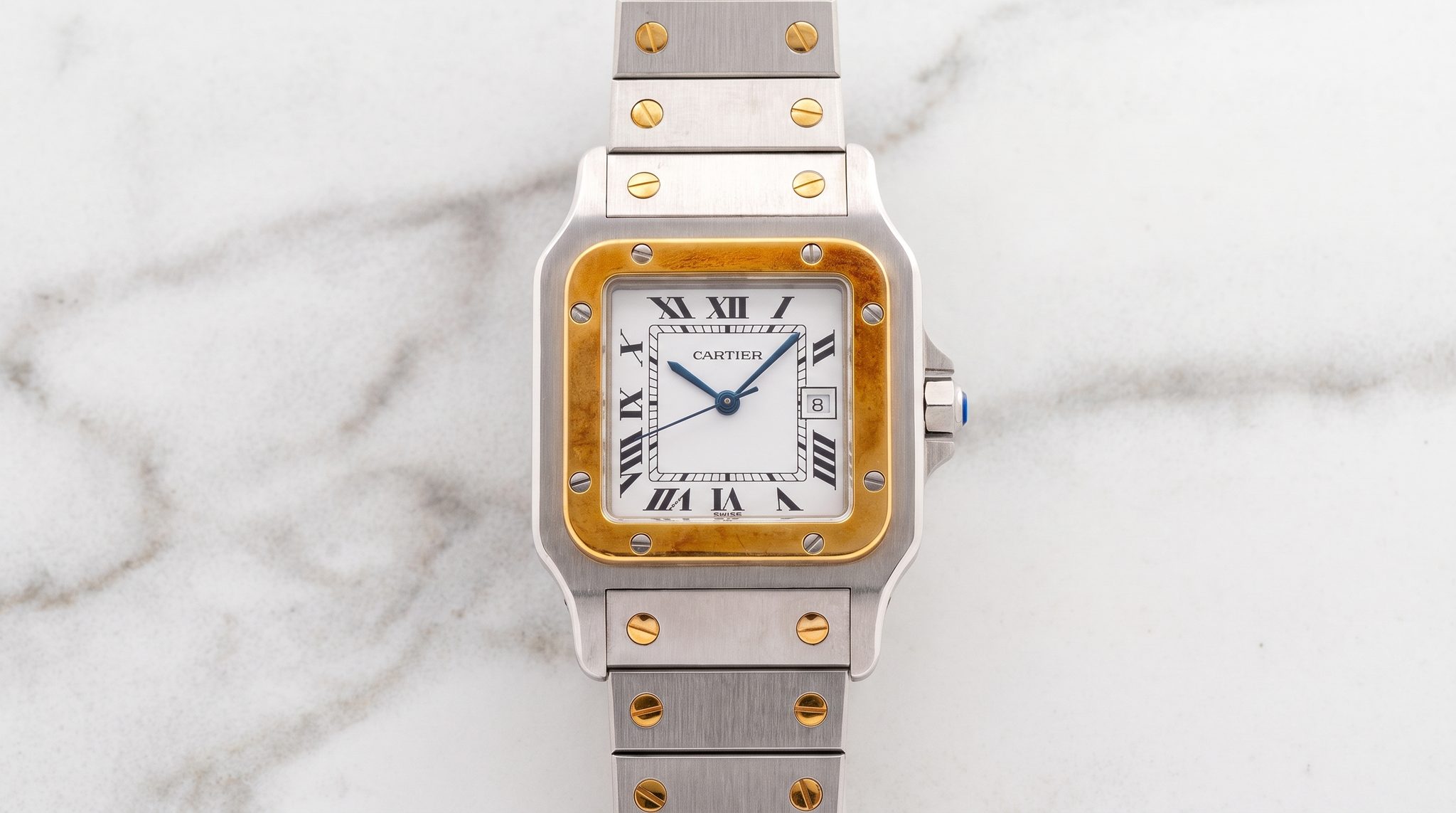
The Carrée is the Santos as relaunched in 1978: a flat, square case with crisp planes, a bezel held by eight visible screws, and an integrated bracelet whose links repeat the screw heads. It existed to give Cartier a steel or part-steel watch for a younger buyer and for more casual, active use, and the 2960 and 2961 are its automatic references, the 2960 generally identified as the steel watch and the 2961 as the two-tone. The 1987 Galbée was meant as its successor, but no cutoff is documented: 2961 examples are recorded through the 1990s, including one sold new in Paris in 1999, whether made that year or sold from stock. Archiva also records the number 2961 on a curved Galbée, so a late-dated 2961 says nothing about the flat case until its shape is checked.
Santos Galbée
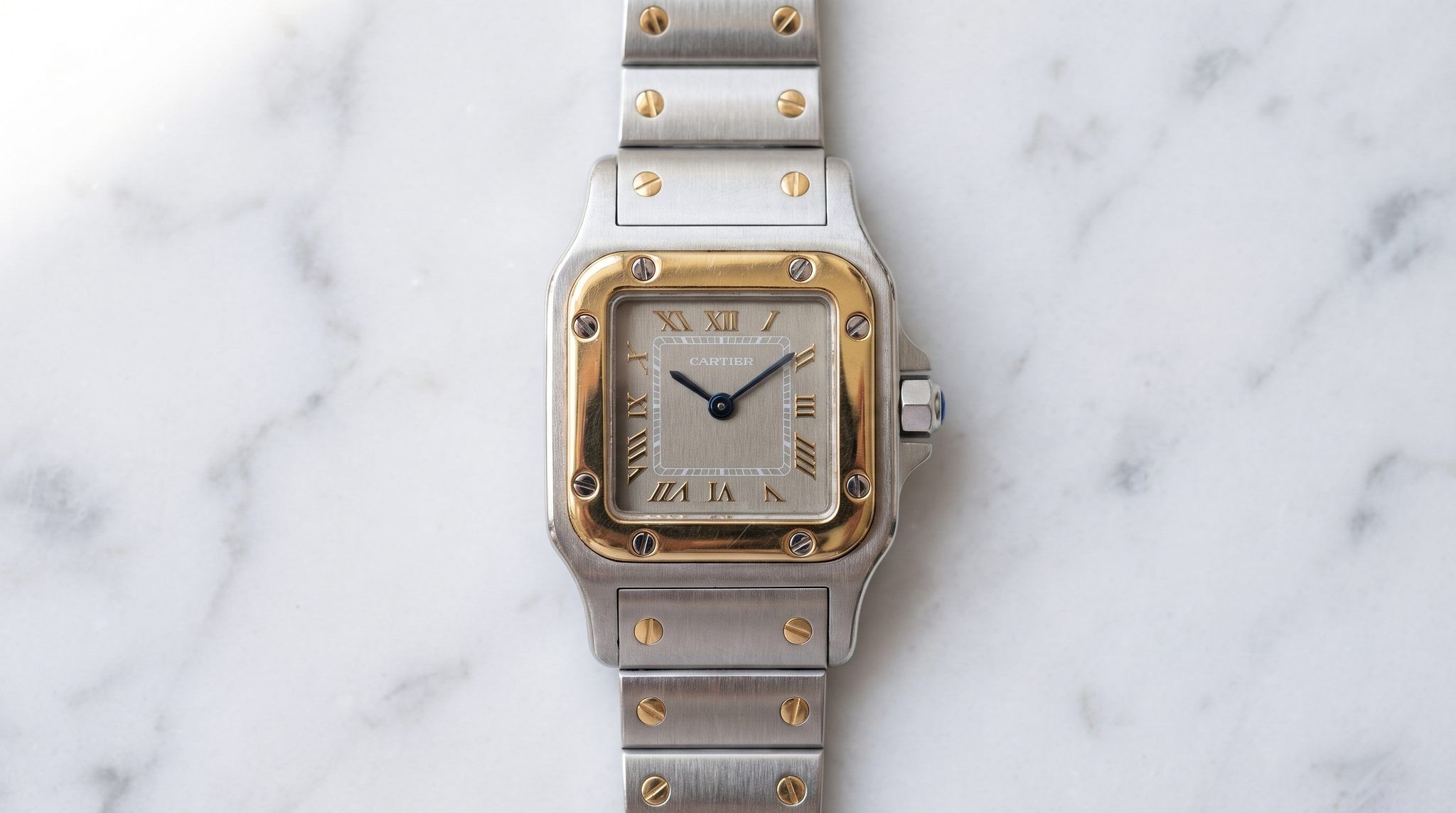
In 1987 Cartier drastically revised, renamed and relaunched the Santos, and the documented aim was a softer, more curved and more wearable successor to the angular Carrée. Galbée means curved in French: the case sides, bezel edges and bracelet were reshaped to follow the wrist while keeping the screws and Roman numerals, and on dated models the date generally moved to 6 o'clock. The generation ran in quartz and automatic form and in sizes from the compact 1567 to an XL that Cartier enlarged as tastes shifted toward bigger watches in the 2000s. In 2004 the Santos 100 took that direction further, introduced for the centenary with a deliberately larger, bolder case. Cartier's reason for retiring the Galbée is not documented, and 1567 watches are recorded until at least 2008, so the two generations overlapped.
Santos 100
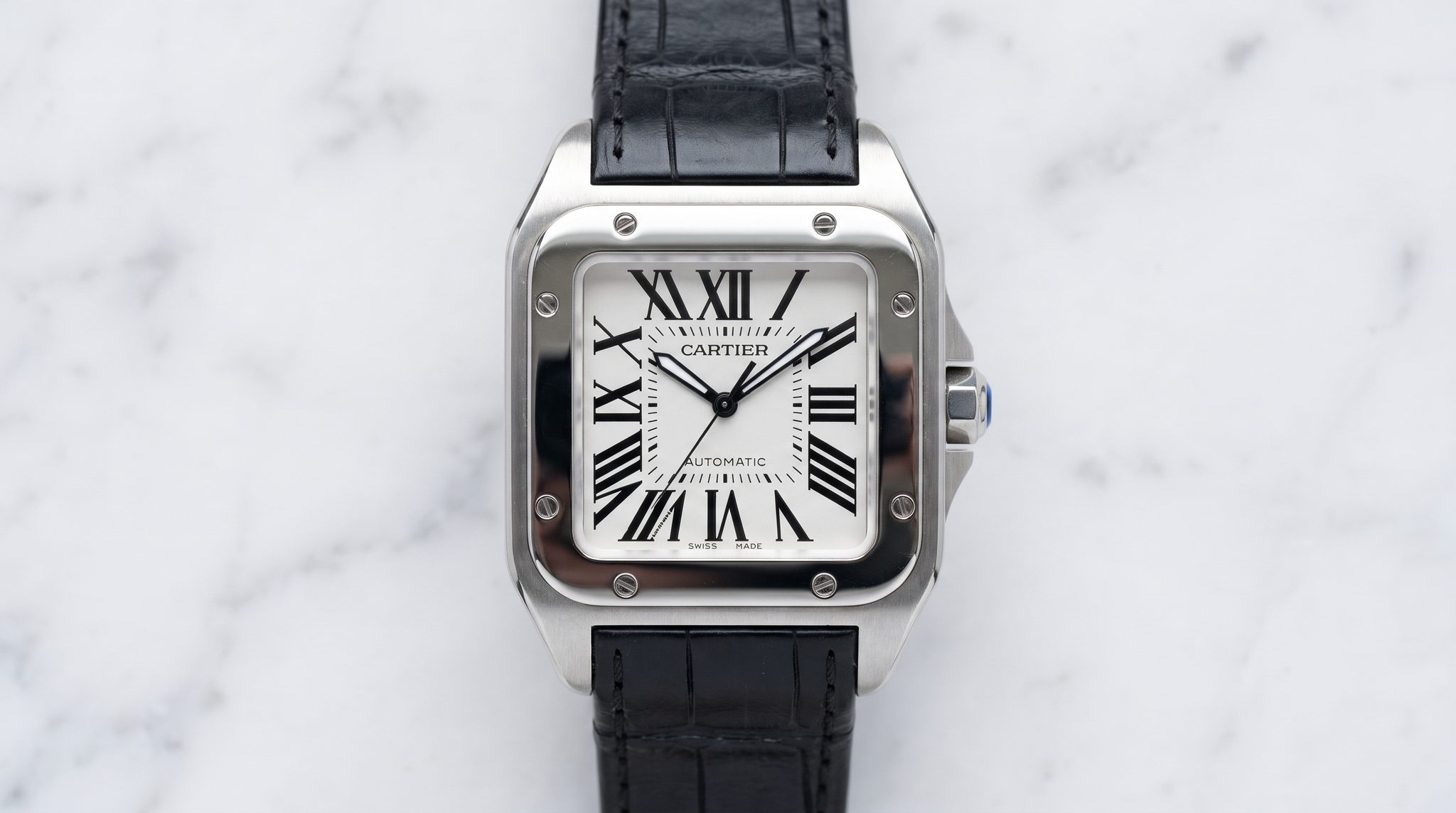
Cartier marked the Santos centenary in 2004 with the Santos 100, a deliberately larger, thicker and bolder case than the Carrée or the Galbée had been. The square bezel and its screws stayed, but the case was redrawn around them, in steel, two-tone and precious metal, with time-only and chronograph versions and many references rather than one. The large steel 2656 is its automatic form. In 2018 Cartier introduced the current Santos de Cartier in slimmer medium and large cases, and the Santos 100 is usually described as ending then, though at least one contemporary report says the new large model did not simply replace it.
Which Santos to buy
For daily wear, the 2961 is the most complete answer: automatic, with a date at 3, a sapphire crystal and a slim case of about 8 mm, plus the gold bezel that Perrin's 1978 design was built around.
For a first vintage piece, the 2960 gives the same flat Carrée architecture without the premium attached to the two-tone configuration, provided the buyer checks the watch itself rather than the listing's description of its movement and date.
The reference collector's target is an early 2961 Carrée with sharp, unpolished case edges, an original bracelet and clasp, intact screws and a dial whose aging matches the rest of the watch, because it is the fullest expression of the 1978 formula.
The 1567 rewards patience. It is the compact, quartz way into the curved Galbée, and the example worth waiting for keeps its bracelet and papers. A buyer who wants a larger Santos is looking past the vintage run, toward the 2004 Santos 100 or the 2018 Santos de Cartier.
What to check on any Santos
Buying across the Santos means buying parts that Cartier itself replaced at service, so a watch can be genuine in every component and still be wrong. The family is a target both for complete counterfeits and for frankenwatches built from genuine parts of different generations and sizes. Perrin's 1978 customer bought a steel-and-gold watch for more casual, active use than a gold dress watch, and the collector's version of that watch is one whose case, bracelet and dial have aged together.
Common questions about the Santos
The Carrée of 1978 has a flat, square, sharp-edged case. The Galbée of 1987 has curved case sides and a bracelet reshaped to follow the wrist. Both keep the exposed bezel screws and Roman-numeral dial, and the point where one replaced the other is not securely documented.
- A Week On The Wrist: The Cartier Santoshodinkee.com
- SIHH 2018: The Return of the Cartier Santosrevolutionwatch.com
- A Brief History: The Cartier Santostherake.com
Show 9 more
- Santos: History, References & Collector's Guidearchiva.watch
- Our Stylecartier.com
- Reference 2961 Santos Carréesothebys.com
- Collector's guide to Cartier Paris, London and New Yorksothebys.com
- Santos Galbée Ref. 2961: Specifications & Historyarchiva.watch
- Cartier Santos: Searching for the Perfect Steel Sports Watchchrono24.ca
- Cartier Just Reissued a Classic Pilot's Watch from the Early 1900sgearpatrol.com
- The Evolution: Santos de Cartierbucherer.com
- Cartier Santosen.wikipedia.org