

Tudor Black Bay 79730
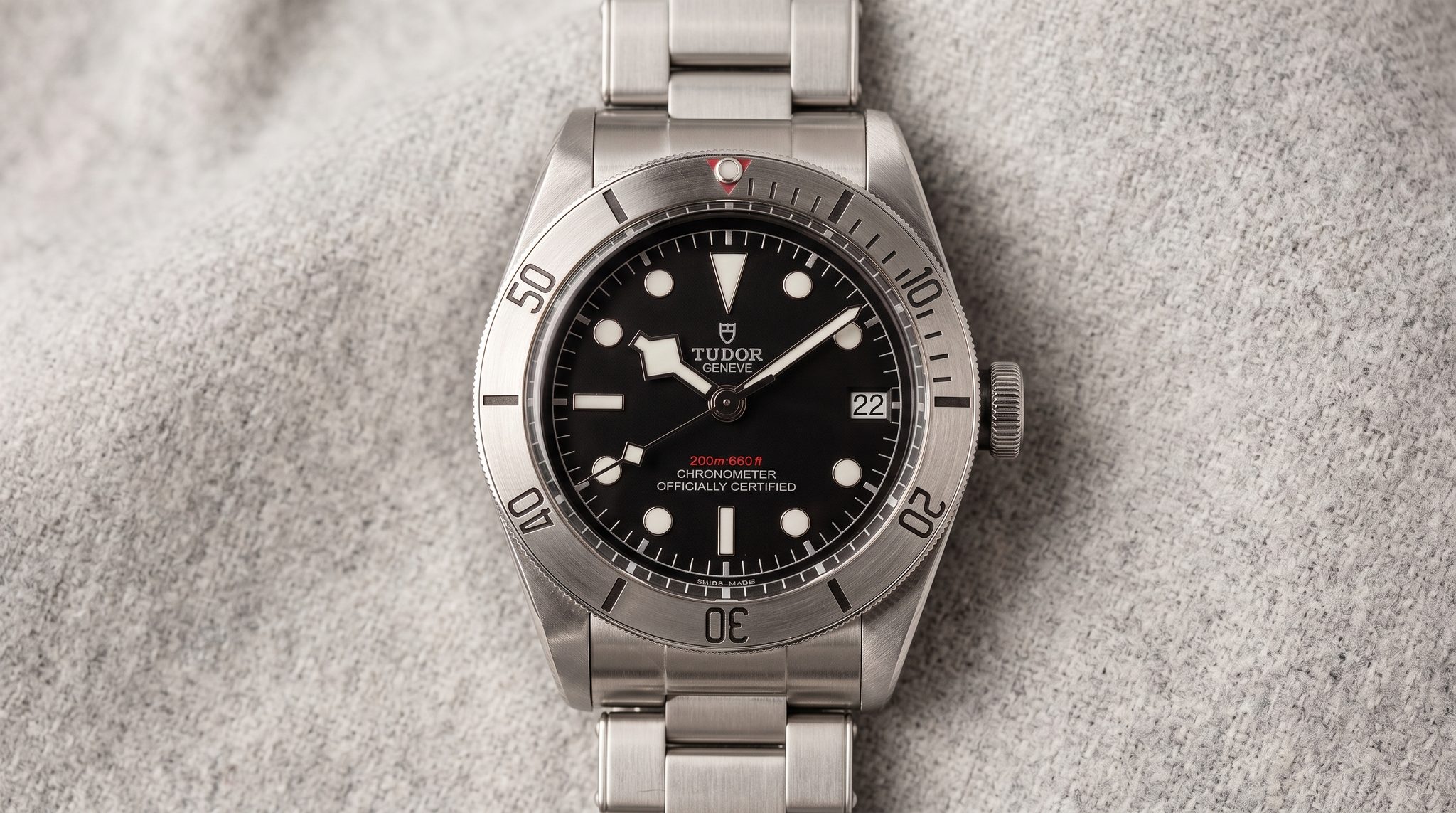
The Black Bay 79730 is where Tudor’s manufacture-movement transition arrived in its most useful form: a 41 mm steel-bezel watch with a date and roughly 70 hours of reserve.
- Production
- c. 2017–2023
- Case
- Stainless steel, 41 mm
- Bezel
- Unidirectional steel
- Crystal
- Domed sapphire
- Dial
- Matte black, gilt accents
- Date
- At 3 o’clock
- Water resistance
- 200 m / 660 ft
- Movement
- Tudor MT5612
- Power reserve
- ~70h
- Chronometer
- COSC-certified
- Lume
- Luminous markers and pip
The Tudor Black Bay 79730 was produced from about 2017 to 2023.
- Production years
- c. 2017–2023
- Replaced
- 79220
- Movement
- Tudor MT5612
The Tudor Black Bay 79730 is the watch that made Tudor’s move from ETA-based Black Bays to manufacture calibres tangible on the wrist. Its MT5612 provides approximately 70 hours of power reserve, nearly twice the roughly 38 hours associated with the preceding ETA 2824-2 generation, while the watch itself keeps the familiar 41 mm case and adds a date, a steel bezel, and a black dial with a small but memorable flash of red at the depth rating. That combination gives the reference its place in the Black Bay story: it is not simply another colourway, but the dated steel branch of the manufacture-movement transition.
Introduced at Baselworld in 2017, the Black Bay 79730 was the first steel Black Bay 41 with a date. In the hand, its identity is unusually concrete. The bezel is stainless steel rather than a coloured insert, with engraved graduations filled black and a red triangle at 12 o’clock. The matte black dial carries applied circular and baton markers, Arabic numerals at 3, 6, and 9, Tudor’s snowflake hour hand, and red “200 m: 660 ft” text. The date window interrupts the otherwise balanced layout at 3 o’clock, making the MT5612, rather than the closely related no-date MT5602, the mechanically coherent calibre designation.
That distinction also explains much of the reference’s collecting interest. The earlier 79220 watches used ETA-based movements, while the 79230 family introduced Tudor’s manufacture MT5602 in 2016. The 79730 followed as the date-equipped steel-bezel counterpart, using the date-equipped MT5612 from the same movement family. Tudor offered it with a steel bracelet, leather strap, or fabric strap, but these are wearing configurations rather than securely documented factory marks. No authoritative production sequence establishes separate 79730 dial generations, lume compounds, or bezel-pip eras. The stable identifiers are therefore the steel bezel, date display, black dial, red depth rating, and manufacture calibre.
The reference is commonly treated as a 2017–2023 model, although public sales records document examples through the early 2020s without establishing a single factory cutoff. Its importance lies in that tension between a settled identity and an imperfect paper trail: the watch is easy to recognise, but not every date attached to an individual example proves when Tudor manufactured it.
“The 79730 is the Black Bay’s manufacture-movement transition made visible: steel bezel, date at 3, and about 70 hours where the preceding ETA generation offered about 38.”
Tudor 79730 production years: c. 2017–2023
The 79730’s chronology is more decisive at the beginning than at the end. Tudor introduced it at Baselworld 2017, with contemporary coverage stating that retailers would receive it in June. The reason for the 2016 date sometimes attached to the reference is the wider Black Bay movement transition: Tudor introduced the no-date 79230 family with the manufacture MT5602 in 2016. The dated 79730 followed as a separate steel-bezel branch, and its date requires the related MT5612 rather than the no-date calibre.
The dial and bezel arrived as a coherent visual package. The black matte surface, gilt accents, applied markers, snowflake hand, and red depth rating make the watch identifiable without relying on a serial or seller-assigned year. The steel bezel is equally important: engraved graduations, black-filled markings, and the red triangle at 12 distinguish it from the coloured bezel inserts used by the contemporary 79230 models. The brief does not document a production reason for the dial execution or a later factory revision, so those traits should not be turned into a mark system.
Strap and bracelet choices changed what the owner received, not the underlying reference. Tudor offered steel-bracelet, leather, and fabric configurations, and the same case, dial, bezel, and movement could therefore appear in different wearing forms. The available record does not establish a separately timed bracelet transition. Likewise, it documents luminous markers and a luminous bezel pip but does not establish a dated change in compound, colour, or construction.
The closing date is less exact. Sales databases record 79730 examples from 2017 through 2021, while specialist material treats the model as effectively superseded by the redesigned 41 mm generation in 2023. Those records establish an observed market window, not a definitive factory cutoff. In a few years, Tudor moved from an ETA-powered 41 mm Black Bay to a dated manufacture version and then to a slimmer later architecture. The 79730 is the middle step where that technical change became a stable, recognisable design rather than an abstract catalogue transition.
- 2017IntroductionDate at 3; red depth-rating text
- 2017Movement handoffAutomatic date movement; COSC designation
- 2017Dial executionSnowflake hand; gilt accents; Arabic 3, 6, 9
- 2017Wear optionsSteel bracelet, leather, or fabric strap
- c. 2020 – 2021Recorded examplesListings record examples through 2021
- 2023Effective supersessionSlimmer case and later-generation architecture
79730 against its neighbours
These three references frame the 79730’s exact role in the Black Bay family. The 79220 series shows what changed when Tudor moved on from the ETA generation, the 79230 shows the closely related no-date manufacture architecture, and the 79733N demonstrates that the dated steel-bezel design was a distinct branch rather than a generic dial option.
79220 Direct predecessor 2012–2015/16 | 79230 Closest no-date sibling 2016 onward | 79733N Two-tone sibling Introduced 2017 | This reference 79730 Tudor · focal c. 2017–2023 | |
|---|---|---|---|---|
| Production | 2012–2015/16 | 2016 onward | Introduced 2017 | c. 2017–2023 |
| Case | Stainless steel, 41 mm | Stainless steel, 41 mm | Steel and yellow gold | Stainless steel, 41 mm |
| Bezel | Coloured insert | Coloured insert | Black bezel | Unidirectional steel |
| Movement | ETA 2824-2 | Tudor MT5602 | Tudor MT5612 | Tudor MT5612 |
| Date | No date | No date | At 3 o’clock | At 3 o’clock |
One dial generations across the run
The 79730 is principally one collectible configuration, not a family of securely dated marks. On the wrist, the matte black dial appears quiet until the gilt accents catch the light, while the red depth rating echoes the triangle on the engraved steel bezel. The date at 3 o’clock and snowflake hand complete the stable visual signature.
Tudor supplied the reference on a steel bracelet, leather strap, or fabric strap. Those choices alter the watch’s presence and package, but they do not establish separate dial or movement variants. The available record also does not verify a chronological split in lume material, lume colour, or bezel-pip construction. A seller’s “Mark” terminology therefore needs physical and documentary support rather than acceptance as a factory taxonomy.
What to check before buying a 79730
Buying a Black Bay 79730 is less about hunting a secret dial mark than about verifying that the watch is the correct reference in the correct configuration. The central risks are a substituted bezel, dial, hands, or movement, along with softened case geometry, incomplete bracelet hardware, and water resistance that has not been tested. Because the production cutoff is not precisely documented, paperwork and physical agreement matter more than a marketplace year field.
The best examples preserve the 79730’s original steel-bezel, date-dial identity and show the manufacture movement that gives the reference its place in Tudor’s history. A clean, honest watch with its original bracelet and service evidence is more compelling than an allegedly rare example whose unusual detail cannot be tied to a documented factory configuration.
79730 price and value
Tudor Black Bay 79730 for sale
Indicative market value from recent dealer, auction, and Grey Market sales: median ≈ $2,300, with a typical $2,200–$2,600 range across 11 comparable sales (updated this week).
Each point is a recent dealer or auction sale, banded to an indicative figure. The range shown is not a valuation.
Common questions about the 79730
The Tudor Black Bay 79730 was produced from c. 2017 to 2023. Its introduction is documented at Baselworld 2017, while the effective 2023 supersession reflects the arrival of the redesigned 41 mm generation rather than a universally documented factory cutoff. Some databases show broader approximate windows, but they do not establish a 2016 factory start.
- Introducing: Tudor Heritage Black Bay Steelhodinkee.com
- The Entire Tudor Black Bay Lineage, from 2012 to 2024monochrome-watches.com
- Tudor Heritage Black Bay Steel Watch Reviewablogtowatch.com
Show 7 more
- Tudor Black Bay 79730 reference pagechrono24.com
- Tudor Black Bay 79730 model overviewdialicious.com
- Tudor Black Bay watcheswatchbase.com
- Tudor Black Bay 79730 buying guidewristler.eu
- Tudor Black Bay price guidewatchcharts.com
- Tudor Black Bay reference timelinemillenarywatches.com
- Pre-owned Tudor Black Bay buying guidanceweknowwatches.com