

Rolex Datejust 126300
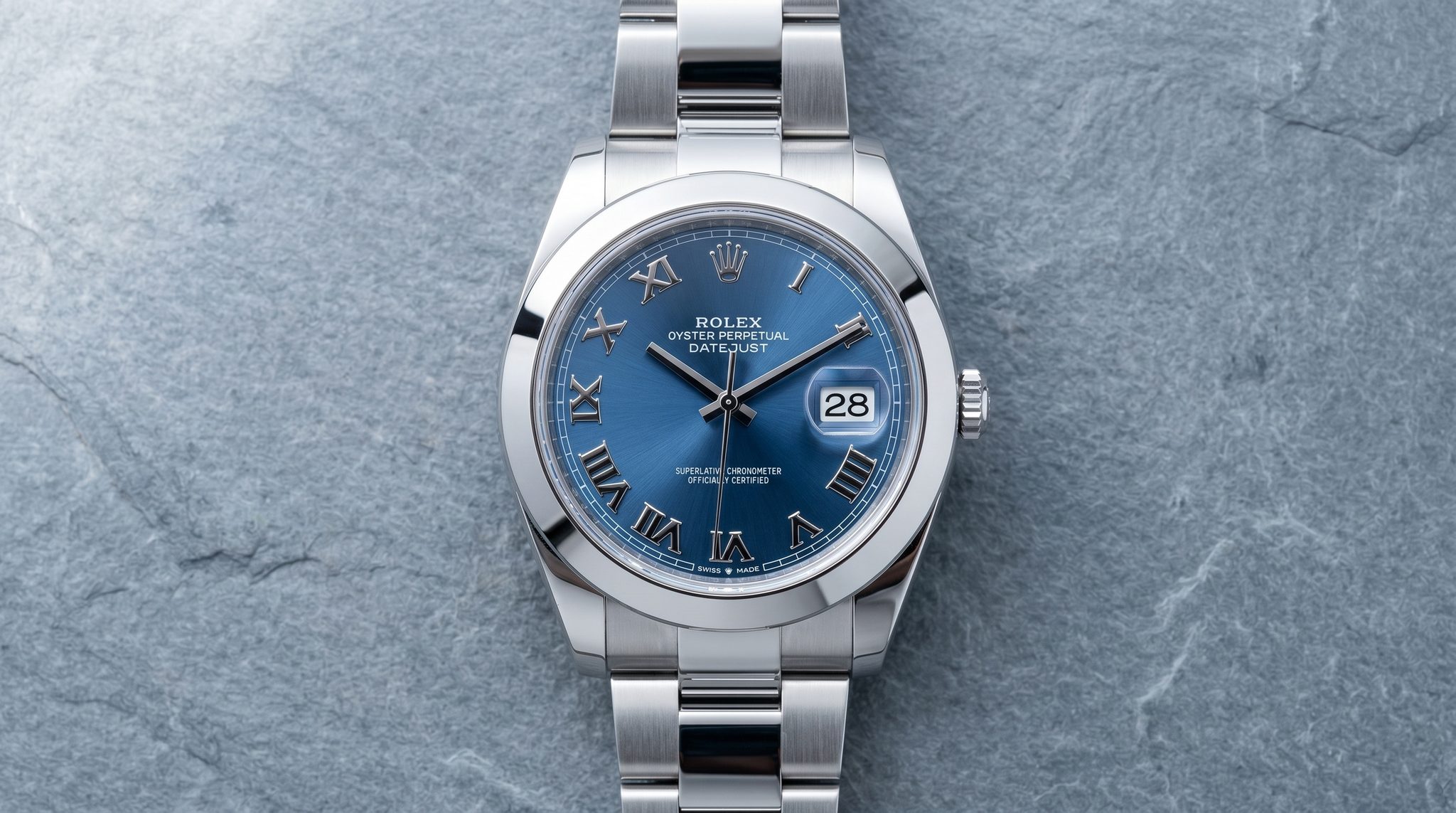
The Rolex Datejust 126300 is the stable, current-production Datejust 41 in all Oystersteel with a smooth bezel and the Cal. 3235, a reference defined less by “marks” than by straightforward configuration choices.
- Production
- 2017–present
- Case
- Oystersteel
- Diameter
- 41 mm
- Thickness
- ~11.8 mm
- Lug width
- 21 mm
- Lug-to-lug
- ~47.5 mm
- Bezel
- Smooth, polished steel
- Crystal
- Sapphire, Cyclops
- Water resist
- 100 m
- Crown
- Twinlock
- Movement
- Cal. 3235
- Power
- 70h
The Rolex Datejust 126300 is the Datejust 41 that refuses to become a puzzle: introduced in 2017 and still current, it has stayed anchored to a single, modern core, the Oystersteel smooth-bezel case and the 70-hour Cal. 3235, with no newer successor reference to “replace” it so far. That continuity is the point of the reference. In a model family where collectors often talk in generations and tiny production tells, the 126300 is best understood as a modern platform whose most meaningful differences are the ones you can see immediately: the dial execution and the bracelet chosen at purchase.
Physically, the 126300’s identity is easy to read in the hand. The bezel is polished and unfluted, a clean steel ring that frames the dial without the ridged profile associated with fluted Datejust bezels. The case is Rolex’s 41 mm Oyster architecture with a screw-down Twinlock crown and a sapphire crystal with Cyclops over the date, rated to 100 meters. On the wrist, third-party caliper measurements put it at about 11.8 mm thick and roughly 47.5 mm from lug tip to lug tip (about 51.3 mm across if the solid end links are included), with a 21 mm lug width.
Inside, the Cal. 3235 sets the tone: an in-house automatic movement with a 70-hour power reserve and a 4 Hz beat rate, featuring an instantaneous date, quickset date, and hacking seconds. Reviewers also highlight Rolex’s Chronergy escapement as a defining 32xx-era upgrade. Put together, the watch’s story is less about decoding era-specific tells and more about choosing the configuration that suits the owner, then keeping the same reference as Rolex continues to refine the Datejust 41 line around it.
“Introduced in 2017 and still current with the Cal. 3235, the Datejust 126300 is defined by continuity: a smooth-bezel steel Datejust 41 whose story is configuration, not “marks.””
126300 across 2017–present
The Datejust 126300 arrives at the moment the Datejust 41 concept settles into its long-term shape. The Datejust 41 family is introduced in 2016, and within about a year the all-Oystersteel, smooth-bezel variant becomes a defined, current-production reference: 126300, launched in 2017 and still offered today. Unlike many older Rolex references, its history is not a sequence of visible mid-run hardware changes; the brief record for this exact reference is one of continuity, with the same core construction and the same movement family throughout.
That steadiness is easiest to explain by looking at what Rolex changed just before it. The immediate steel smooth-bezel predecessor in the 41 mm slot is the Datejust II ref. 116300, a watch widely described as thicker and more “chunky” in its proportions. The Datejust 41 generation that follows is repeatedly framed as a return to a more traditional Datejust profile, and the 126300 is the purest expression of that update in steel.
Mechanically, the 126300’s defining event is the adoption of the Cal. 3235 as the standard engine for this generation. It is Rolex’s new-generation automatic date movement, cited with a 70-hour power reserve and a 4 Hz beat rate, and its Chronergy escapement is regularly singled out in technical coverage. Compared with the prior Datejust II era’s 31xx-based approach (the Datejust II is cited with Cal. 3136), the 3235 represents a clear movement-generation step, even if Rolex does not frame the change as a series of “marks” for this specific reference.
One zoomed-out fact clarifies why collectors talk about the 126300 differently than vintage Datejust references. In the older collecting world, originality is often read through small, time-bound tells, lume signatures, printing layouts, and case details. The modern 126300, by contrast, is documented as a single continuous reference whose meaningful variety is catalog variety. The questions that matter in practice are not “which dial generation is it,” but “which dial and which bracelet,” and whether the watch remains in correct factory configuration for its reference.
- 2016Line launches41 mm Datejust lineup appears
- 2017Ref. debutsSmooth steel bezel, 41 mm
- 2017Cal. 323570-hour reserve spec cited
- 2017 – presentTwo bracelets3-link vs 5-link bracelet
- 2017 – presentStill currentRef. remains active
126300 against its neighbours
The Datejust 126300 is easiest to place by bracketing it with the watch it replaced in the same niche, and with its closest in-family counterpart that keeps the same 41 mm architecture but changes the bezel metal and profile. Ref. 116300 shows what Rolex refined when it moved from the Datejust II to the Datejust 41 era, while ref. 126334 demonstrates how much of the modern 41 mm Datejust experience is shared across references once the bezel choice shifts from smooth steel to fluted white gold.
116300 Predecessor 2009–2016 | This reference 126300 Rolex · focal 2017–present | ||
|---|---|---|---|
| Production | 2009–2016 | 2017–present | 2017–present |
| Case | Oystersteel | White Rolesor | Oystersteel |
| Diameter | 41 mm | 41 mm | 41 mm |
| Thickness | ~12 mm | 11.7 mm | ~11.8 mm |
| Bezel | Smooth steel | Fluted, 18k WG | Smooth, polished steel |
| Crystal | Sapphire, Cyclops | Sapphire, Cyclops | Sapphire, Cyclops |
| Water resist | 100 m | 100 m | 100 m |
| Crown | Twinlock | Twinlock | Twinlock |
| Movement | Cal. 3136 | Cal. 3235 | Cal. 3235 |
| Power | ~48h | 70h | 70h |
| Lug width | 20 mm | 21 mm | 21 mm |
| Lug-to-lug | ~44 mm | 47.6 mm | ~47.5 mm |
What to check before buying a 126300
Buying a Rolex Datejust 126300 is less about hunting an elusive early configuration and more about confirming that a very specific, very modern recipe has stayed intact. The reference is defined by its smooth polished steel bezel and Oystersteel case, and it should be powered by the Cal. 3235. Most of the price and preference differences in the market cluster around visible configuration choices, especially dial execution and whether the watch is on an Oyster or Jubilee bracelet.
The practical risks are the modern ones. Condition is often the deciding factor: over-polishing can soften the case lines and round the bezel, while mismatched bracelet parts or swapped dials undermine the integrity of what is otherwise a straightforward reference. Completeness also matters. Many listings place a premium on examples offered with box and papers, and the strongest prices tend to follow the most popular dial choices cited in market guides.
In daily ownership, the 126300 behaves like a contemporary Datejust should. The sapphire-and-Cyclops crystal, the 100 m rating, and the screw-down Twinlock crown make it a robust watch for regular wear, and the Cal. 3235’s 70-hour reserve can reduce how often the watch needs to be reset if it sits off the wrist for a couple of days. The result is a Datejust that rewards careful selection up front, then largely gets out of the way.
Rolex Datejust 126300 for sale
Indicative market value from recent dealer, auction, and Grey Market sales: median ≈ $10,000, with a typical $9,000–$10,750 range across 867 comparable sales (updated this week).
Each point is a recent dealer or auction sale, banded to an indicative figure. The range shown is not a valuation.
Common questions about the 126300
Rolex Datejust ref. 126300 is documented as introduced in 2017 and remains in production at present.
- Rolex Datejust 41 Steel ref. 126300 & ref. 126334 | REVIEWmonochrome-watches.com
- Watch Comparisons: Rolex 126300 vs. 116300 vs. 126334bobswatches.com
- Rolex Datejust 41mm Black Dial 126300 - Hands-On Reviewyoutube.com
Show 7 more
- Pre-Owned Rolex Datejust 126300 for Salebqwatches.com
- Rolex 126300 Watches - Prices, Models, Details - Covetedcoveted.com
- Rolex Datejust 126300 - Luxury Watches USAluxurywatchesusa.com
- Rolex Datejust 126300 - Pre-Owned & Unworn: $9K-$13K+watchguys.com
- Rolex 126300 - Datejust 41 watcheschrono24.com
- Rolex Datejust 41 watch: Oystersteel - m126300-0002 (US)rolex.com
- Rolex Datejust 126300 Ultimate Buying Guide | Bob's Watchesyoutube.com