

Cartier Tank 2303
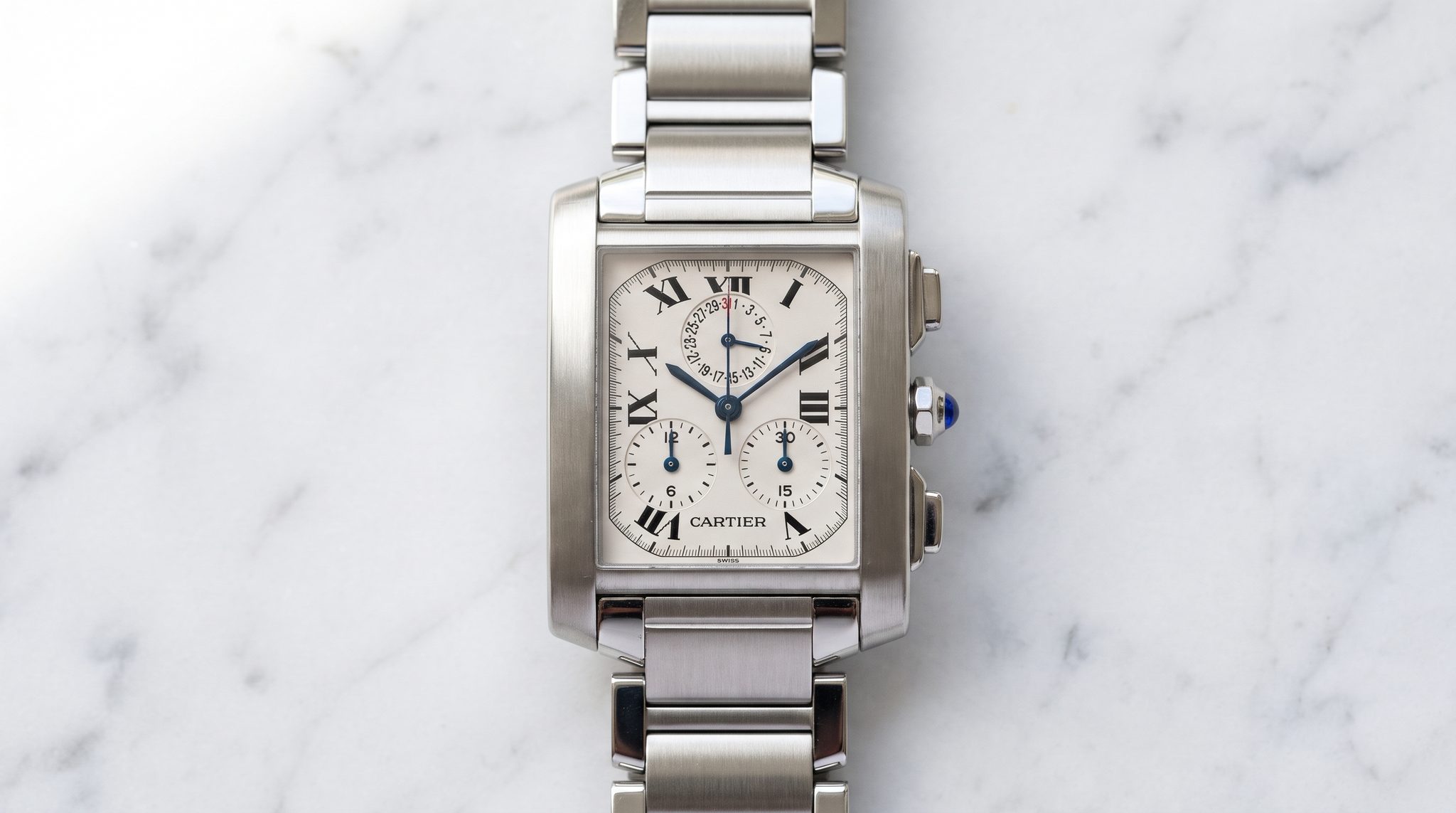
The large Tank Française Chronoflex is a quartz chronograph with no documented launch year, ancestor or heir, which leaves condition to do the work that paperwork does on other Tanks.
- Production
- c. 1996–early 2000s
- Case size
- 28 × 36 mm
- Thickness
- 6.7 mm
- Case metal
- Steel or steel/18k gold
- Crystal
- Sapphire
- Crown
- Sapphire cabochon
- Caseback
- Four screws
- Dial
- Silvered or white, Roman
- Hands
- Blued steel
- Movement
- Quartz Cal. 212P
- Functions
- Chronograph, date
- Water resistance
- 3 ATM
- Bracelet
- Integrated, concealed clasp
The Cartier Tank 2303 was produced from about 1996 to the early 2000s.
- Production years
- c. 1996–early 2000s
- Movement
- Quartz Cal. 212P
The Cartier Tank 2303 is a chronograph that arrived without a paper trail. One specialist index lists examples of this same reference as both "circa 1990" and "circa 2003", and no available source establishes a launch year, a numbered predecessor or a successor. That vacuum is the defining fact of the watch: where a vintage Tank is valued for its documented lineage, the 2303 is judged almost entirely on the example in front of you.
The watch itself is clear enough. It is the large Tank Française Chronoflex (some catalogues write Chronoreflex), a 28 × 36 mm rectangle in steel or in steel with 18k yellow gold, driven by the quartz Cartier calibre 212P. Dated examples run from 1996 through 2000 and 2002 to circa 2003, with later listings reaching 2004, and one specialist index places the family from about 1997. The dial gives it away at a glance: black Roman numerals on a silvered or white ground, blued-steel hands, a date at the top and two small registers for 30 minutes and 12 hours below. Cartier's secret signature sits hidden in the numerals, reported at the X or, in some descriptions, at the 10. Because it is a quartz watch, it never had a beat rate or a power reserve to argue about, and what is left to examine is the case, the dial, the bracelet and whether the chronograph still works.
“A quartz Tank with no documented birth, parentage or heir: for the 2303, the watch in hand is the only evidence.”
Cartier Tank 2303 production years: c. 1996–early 2000s
The record for the 2303 is a set of auction and dealer estimates, not a factory ledger, and it should be read that way. The earliest catalogued examples are steel watches with silvered dials, dated circa 1995 by auction houses and 1996 by dealers. A specialist index prefers about 1997, and a third listing offers circa 1990, which conflicts with the others and is not a reliable launch date. The watch is a quartz chronograph because quartz regulation made a slim rectangular case with a date and two registers practical, but Cartier's reasoning for adding it to the Tank Française line is not documented here.
Steel and 18k yellow gold appears in records from about 2000, and a circa-2003 two-tone is catalogued with calibre 212P T. Why the gold version appeared is not documented, and nothing shows the dial or movement changing alongside it. Catalogues write 212P and 212P T interchangeably, so whether the suffix marks a production era or only careless cataloguing is unsettled. Examples dated 1999 to 2004 still carry the reference 2303, which is why collectors read the later watches as continued production, not a successor. Taken together, this is a reference defined by what did not change: one calibre, one case and one layout across roughly eight years of dated listings, so almost nothing in the watch's design dates an individual example.
- c. 1995 – 1996Earliest examplesFour-screw back, sapphire cabochon crown
- c. 1997Index start dateApproximate; not a confirmed launch
- c. 2000Two-tone documentedGold crown, steel-and-gold bracelet
- c. 2003Late 212P T examplesSame date and two-register layout
- 2004Latest dated listingsLayout unchanged from early watches
2303 against its neighbours
No numbered predecessor or successor to the 2303 is documented, and later chronographs of this kind continue to appear under the same reference, so the useful comparison is between its own configurations: steel versus steel and yellow gold, and silvered versus white dial.
This reference 2303 Cartier · focal c. 1996–early 2000s | |
|---|---|
| Case size | 28 × 36 mm |
| Case metal | Steel or steel/18k gold |
| Dial | Silvered or white, Roman |
| Movement | Quartz Cal. 212P |
Three case and dial variants across the run
This is the configuration of the earliest catalogued examples, and the one most often described in auction text. The silvered dial has a pale, slightly reflective surface against which the black Roman numerals and the outer fifth-second divisions stand out sharply, and the blued-steel hands pick up a darker tone in certain light. The signature is concealed in the numerals, reported at the X or, in some descriptions, at the 10. Steel case and bracelet, a four-screw back and a sapphire cabochon crown complete the picture, with quartz calibre 212P inside, described in auction catalogues as 25 jewels. That jewel count comes from a single specialist listing and is not corroborated elsewhere.
What to check before buying a 2303
The risk in a 2303 is not a missing pedigree but a lot of quiet wear, since the watch is a quartz chronograph with an integrated bracelet and no documented production figures to anchor a premium. Rarity is a collector's perception here, not a published number. A Cartier service record, a complete bracelet and an unpolished case therefore count for more than any claim about early production. It suits someone who wants a Cartier chronograph in a compact rectangle (28 × 36 mm, 6.7 mm thick, 3 ATM) that never needs winding. Listings in 2025 and 2026 cluster in the low-to-mid four figures in euros.
Cartier Tank 2303 price and value
A Cartier Tank 2303 sells for about $2,000 at the median, typically $1,400 to $2,400 across 12 comparable sales.
Cartier Tank 2303 for sale
Indicative figures from recent dealer, auction, and Grey Market sales (updated this week). Every watch is verified before it sells here.
Each point is a recent dealer or auction sale, banded to an indicative figure. The range shown is not a valuation.
Grey Market runs watch auctions for vintage and neo-vintage pieces, every lot reviewed before it lists and verified before the seller is paid, and the Watch Exchange, where ID-verified users buy and sell at a fixed price. Selling one? See the ways to sell a Cartier, or check what it’s worth. For more vintage Cartier, see the Cartier reference guide.
Common questions about the 2303
The Cartier Tank Française 2303 was produced from c. 1996 to the early 2000s. Published examples are dated 1996, 2000, 2002 and circa 2003, with later listings reaching 2004, and one specialist index places the family from about 1997. No source establishes a launch year or an end year, and no distinct predecessor or successor reference is documented.
- Cartier | Reference 2303 Tank Française Chronoflexsothebys.com
- Cartier Tank Française Chronograph Wristwatch, Ref. 2303onlineonly.christies.com
- Cartier Tank Française Chrono Watches indexcollectorsquare.com
Show 7 more
- Tank Française Chronoflex 2303theindex.watch
- Cartier Tank Française 2303 Yellow gold and Stainless steel 2000, Lot 261everywatch.com
- Cartier Tank Française 2303 Stainless steel and Diamond White, Lot 296everywatch.com
- Cartier Tank Française Chronoflex 2303 Stainless steel Silver 2000, Lot 347everywatch.com
- Tank Française Chrono, Ref. Cartier 2303collectorsquare.com
- Cartier Tank Française (2303)wristler.eu
- Cartier 2303chrono24.com