

Breitling Top Time 1450
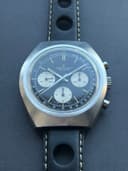
The Breitling 1450 is the large, hand-wound Top Time whose identity is clearest in its architecture: a broad steel cushion case, three registers, and Valjoux 7736 power.
- Production
- c. 1973–c. 1975
- Case
- Stainless steel
- Diameter
- ~42–44 mm
- Lug-to-lug
- ~45.5–46 mm
- Thickness
- ~14.5–15 mm
- Crystal
- Plexiglass
- Dial
- Black matte, silver registers
- Scale
- Tachymeter
- Movement
- Valjoux 7736
- Winding
- Manual
- Chronograph
- Three-register
- Beat rate
- 18,000 vph
The Breitling Top Time 1450 was produced from about 1973 to about 1975.
- Production years
- c. 1973–c. 1975
- Movement
- Valjoux 7736
The Breitling 1450 is a chronograph defined less by a long production story than by a remarkably coherent physical idea: a large steel cushion case wrapped around a hand-wound, three-register instrument. The surviving dating evidence narrows to approximately 1973 and 1975, but it does not establish a firm factory start or end date. That tension is the central fact of the reference. It is a watch that can be identified confidently by its architecture, while its place in Breitling’s production sequence remains deliberately less certain.
Grouped by Breitling with the Top Time references 820 and 821 under the 1972 “Cushion Long Playing” heading, the 1450 belongs to the large chronograph style of the early 1970s rather than the smaller, more restrained Top Time cases that preceded it. In hand, its scale is the first impression. Published examples measure approximately 42 to 44 mm across, around 45.5 to 46 mm from lug to lug, and about 14.5 to 15 mm thick. The hooded lugs and tonneau outline make that width read as deliberate, not merely oversized. A black matte dial with three silvered subsidiary registers, a tachymeter scale, and a plexiglass crystal gives the watch the visual language of a working chronograph, while the Valjoux 7736 supplies the mechanical continuity behind it.
The movement is not just an associated detail. The documented 7736 is manually wound, runs at 18,000 beats per hour, and records running seconds, elapsed minutes, and elapsed hours. No second movement generation is established for the reference, and no reliable sequence of factory dial marks or lume eras has been demonstrated. That absence matters: the 1450 is best understood as one documented configuration whose surviving differences must be tested individually, not as a neat chain of numbered variants.
The result is a particularly honest vintage Breitling. Its broad case, three-register dial, and 7736 movement make the watch legible as a product of its period, while the uncertain production boundaries make condition and originality more important than an invented rarity taxonomy. Collectors are not buying a perfectly mapped sequence. They are buying a large, mechanically straightforward chronograph whose strongest evidence remains visible on the watch itself.
“The Breitling 1450 is a watch with a firm physical identity and an unfinished paper trail: its case, dial, and Valjoux 7736 speak clearly, while its exact production boundaries do not.”
Breitling 1450 production years: c. 1973–c. 1975
The 1972 archive grouping gives the 1450 its clearest historical anchor, but it does not prove that production began in that calendar year. Breitling placed the reference beside 820 and 821 as a Cushion Long Playing chronograph, which explains why the case is so broad and why the three-register 7736 is central to its identity. The record does not document a predecessor replacing an earlier model, or a later reference taking its place.
The approximately 1973 and 1975 dates belong to individual surviving examples, not to a confirmed factory ledger. Collectors can reasonably read them as evidence that the reference was active in the early-to-mid 1970s, because both examples share the same large cushion-case and three-register concept. They cannot turn those two dates into a precise production run. The reason the reference’s start and end dates remain unclear is not documented.
The movement evidence is more stable than the calendar evidence. The documented 1450 uses the manually wound Valjoux 7736, with an 18,000-beat-per-hour rate and three chronograph indications. No second calibre generation is recorded, so there is no basis for dividing the reference into early and late movement eras. The same discipline applies to the dial. A black matte dial with silvered registers is well documented, while a silver-colored dial appears in other dealer material without enough evidence to establish a factory transition or even a confirmed factory variant.
The dimensions tell a similar story. One inspected example measures about 42 mm wide and 15 mm thick; another listing gives approximately 44 by 46 mm and 14.5 mm. Different measurement conventions, case tolerances, or listing error could explain the gap, but the available evidence does not identify a separate case generation. In a reference associated with only a few early-1970s dates, that restraint is useful. The 1450 changed less clearly than many collectors would like, and that is precisely why every claim about a “Mark” deserves proof rather than a label.
- 1972Model grouping“Cushion Long Playing” archive heading
- c. 1973Early exampleLarge steel case, three registers
- 1970sCore configurationManual-wind three-register movement
- c. 1975Later exampleBlack dial, silver subsidiary registers
1450 against its neighbours
References 820 and 821 frame the 1450 as a member of Breitling’s Cushion Long Playing group rather than as a clean predecessor or successor. The comparison is useful precisely because the archive confirms the shared family and movement while leaving the component-level differences less certain.
820 Contemporary sibling 1972 grouping | 821 Contemporary sibling 1972 grouping | This reference 1450 Breitling · focal c. 1973–c. 1975 | |
|---|---|---|---|
| Production | 1972 grouping | 1972 grouping | c. 1973–c. 1975 |
| Case | Not specified | Not specified | Stainless steel |
| Movement | Valjoux 7736 | Valjoux 7736 | Valjoux 7736 |
| Dial | Not specified | Not specified | Black matte, silver registers |
| Chronograph | Three-register | Three-register | Three-register |
What to check before buying a 1450
Buying a Breitling 1450 is primarily an exercise in separating a coherent vintage chronograph from an assembled one. The reference has a documented core configuration, but no reliable factory variant ladder that can excuse an incorrect movement, refinished dial, or altered case as a rare Mark.
Condition is unusually visible on this watch because its broad case depends on sharp geometry and contrasting finishes. The final decision belongs to the surviving object, not to a seller’s date estimate: a well-preserved 1450 should feel like one watch in its case, dial, hands, and Valjoux 7736. For someone drawn to large 1970s chronographs and willing to have the watch opened by a specialist, it offers a direct, wearable connection to Breitling’s Cushion Long Playing period. It is less suitable for a buyer who needs a fully documented production sequence or factory-verified variant story.
1450 price and value
Breitling Top Time 1450 for sale
A 1450 is scheduled to open on Grey Market. Every watch is verified before bidding starts.
Common questions about the 1450
The Breitling Top Time 1450 was produced from approximately 1973 to approximately 1975. Those dates come from surviving examples, while Breitling’s 1972 archive grouping establishes the model’s period context rather than a definitive start and end date.
- Breitling Archivesbreitling.com
- Breitling 1450 Chronographcentralwatch.com
- Breitling Chronograph Ref. 1450uhren-miquel.de
Show 7 more
- Steel Breitling Ref. 1450 vintage wristwatch, circa 1975blackbough.co.uk
- Breitling 1450 Chronographanalogshift.com
- Reference Numbersbreitlingsource.com
- EXCLUSIVE TIMEPIECES & JEWELSmonacolegendauctions.com
- Montre Breitling Long Playing Chronograph 1450paradiswatches.com
- Breitling Serial Number Lookup: Date & Verify Your Watchwatchscanning.com
- How to Interpret Breitling Reference Numberschrono24.com