

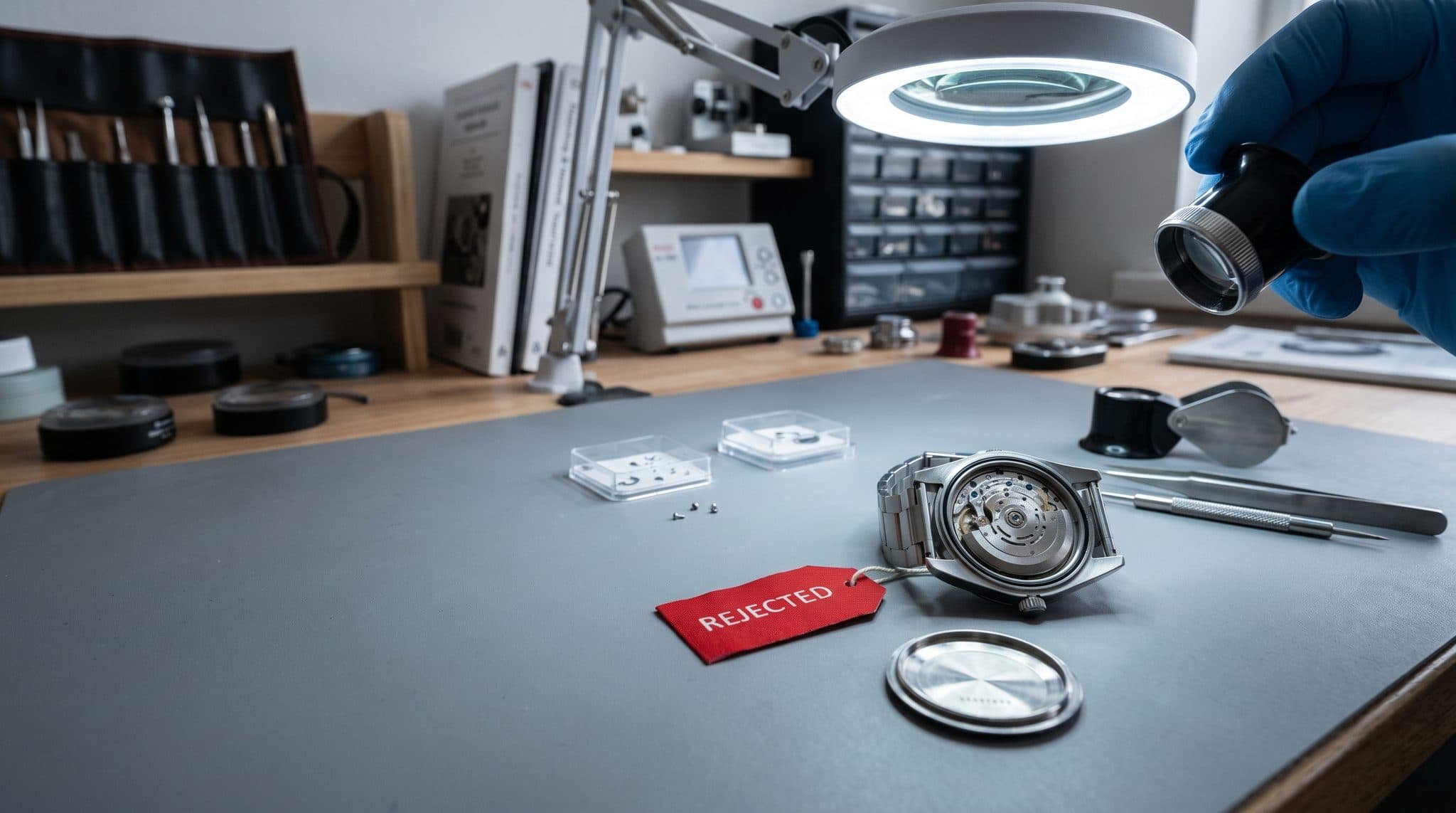
Short answer: since August, about one watch in ten submitted for a Grey Market auction has been approved. Most of the watches we turn down are genuine. The biggest reason by far is fit: the watch is real, but it is not one our bidders are looking for at the price the seller hopes to get. Counterfeits are a real but smaller share. Here is what the numbers show.
The Number
We started taking auction submissions in April 2026. Across everything we have decided since then, about one in seven submissions has been approved. Since August, as submissions have grown, it has been about one in ten.
An earlier version of this story said we turned down roughly 30 percent of submissions. That figure was wrong for us, and this story replaces it with the numbers we actually see.
A rejection here is a decision about a specific auction, not a verdict on a watch or its owner. Many of the watches we pass on are perfectly good watches that would sell well somewhere else, or with us at a different price.
Why Watches Are Turned Down
Not every rejection is logged with a reason, so we can only describe the ones that are: about a third of the total. Among those, the split looks like this.
| Reason recorded | Share of recorded rejections |
|---|---|
| Not right for our auctions: genuine, but not what our bidders want at the seller's price | About 70% |
| Not authentic | About 18% |
| Price expectation well above the market | About 5% |
| Below our value floor, duplicate submissions and other | About 6% |
Figures are rounded. The point that surprises most sellers is the first row: seven in ten of the rejections we can explain have nothing to do with authenticity.
"Not Right for Our Auctions"
Every auction we run is curated. Bidders come because the lots are worth their attention, and a week of bidding only works when there are several people who want the watch. So we ask the same question of every submission: will this draw real bids from the collectors who follow our auctions?
A watch can be completely genuine and still fall short of that. Common reasons:
- A reference with a thin collector market. Plenty of good watches are worn and loved but rarely sought out, and they struggle to build momentum in a timed auction.
- Condition that limits the audience. Heavy polishing, a replaced dial or mismatched parts don't make a watch fake, but they narrow the pool of bidders. Our guides to polished and unpolished cases and frankenwatches explain why.
- Photos or details that don't let us judge it. If we can't see the case, the dial and the caseback clearly, we can't put it in front of bidders. This is the easiest one to fix.
We would rather run fewer lots that sell well than fill a calendar with watches that end without a winning bid. That is good for the sellers whose watches we do accept, and it keeps every auction worth a bidder's attention.
The Fakes
Almost one in five of the rejections we logged a reason for was a watch that was not what it claimed to be. That includes outright counterfeits and watches built from a mix of genuine and aftermarket parts and sold as original. They tend to arrive with confident descriptions and good photographs, which is exactly why a careful first look matters.
Submission review is the first gate, not the last. Every watch we accept for auction is then verified in hand by an independent verifier before it ships to the buyer, and the seller is paid only after the buyer has had the watch and accepted it. Our guide to telling if a Rolex is real covers the checks any buyer can run without tools.
Priced Above the Market
A smaller group of watches are right for us but arrive with a reserve or expectation well above what the reference actually sells for. We look at completed sales of the same reference in similar condition, and if the gap is large we would rather say so up front than run an auction that cannot meet its reserve. Our reference guides, such as the Rolex reference guide, show recent sale ranges for each model.
How to Give Your Watch the Best Chance
- Send clear, complete photos. Dial, case sides, lugs, caseback, clasp and any papers. Our guide to photographing a watch for sale shows what we need.
- Disclose what has been replaced. A service dial or replaced bezel lowers the price but doesn't rule a watch out. An undisclosed one is a much bigger problem.
- Price from completed sales, not asking prices. A realistic expectation is the single most fixable reason a good watch gets turned down.
- Check the serial and papers. Our serial number tutorial and Rolex serial lookup help you confirm the production year, and papers add value only when their serial matches the watch.
If your watch isn't picked for auction, it can still be the right watch for someone. Our guide to consignment, direct sale and auction walks through the other ways to sell, and our selling page covers both of the ways to sell on Grey Market.
What It Means for Buyers
Selectivity is the reason an auction lot on Grey Market is worth your time. Only about one in ten submissions makes it to the block, every one of those is verified in hand before it reaches you, and your payment is held by Grey Market until you have had 24 hours with the watch. For the wider picture of buying pre-owned, see our guide to buying a pre-owned luxury watch online and the authentication guide.
Questions People Ask
Does a rejection mean my watch is fake? Usually not. Most of the rejections we can explain are genuine watches that weren't the right fit for an auction, or were priced well above recent sales.
What share of submissions are counterfeit? Among rejections with a recorded reason, a little under one in five. Counterfeits are a real problem, but they are not most of what we turn down.
Is every auction watch checked again after it is approved? Yes. Approval only gets a watch onto the block. Before it ships to the winning bidder, it is verified in hand by an independent verifier.