

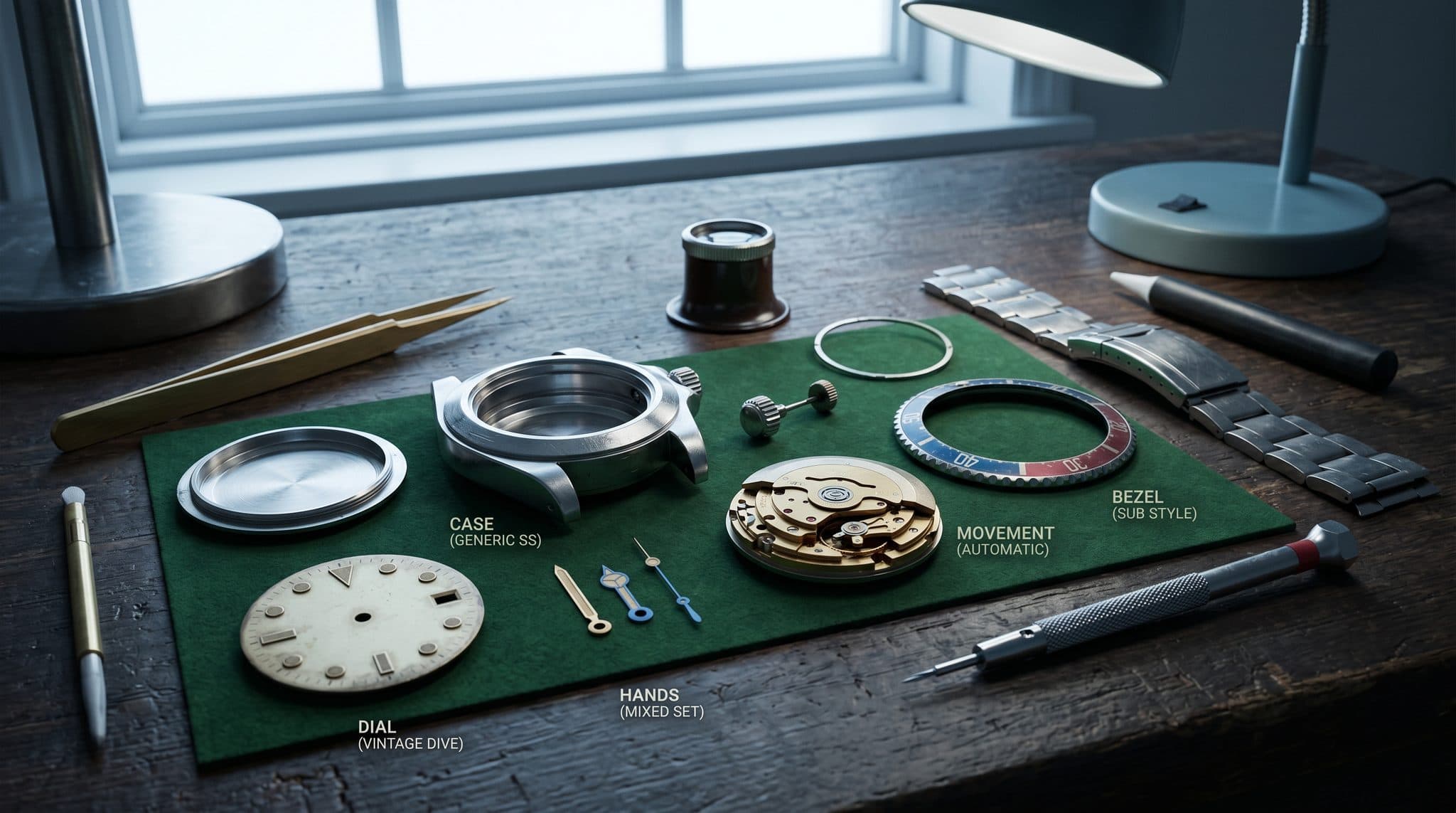
A frankenwatch is a watch assembled from parts that never left the factory together, often every one of them genuine, and sold as if it were original. It is the most common authenticity problem in luxury watches: not counterfeits, but real parts in the wrong combinations.
What Is a Frankenwatch?
A frankenwatch — sometimes spelled "franken-watch" or simply "franken" — is a luxury timepiece assembled from a mixture of authentic and replacement components. The parts may all be genuine. The combination is not. Named after Mary Shelley's stitched-together creature, a frankenwatch is a watch that exists as a single physical object but does not exist as a coherent factory configuration.
The classic example: a 1968 Rolex Submariner case fitted with a 1972 dial, modern aftermarket hands, and a service-replacement bezel insert. Every individual piece is a real Rolex part. The assembled watch has never existed in any Rolex production record. Its market value sits somewhere between the value of the case alone and the value of an all-original example — and a buyer who pays the original-example price has been quietly cheated.
Frankenwatches are the most common authentication problem in the vintage and pre-owned market today, and they are far harder to detect than outright counterfeits. This is the core of why multi-pillar authentication exists.
How Frankenwatches Get Made
Most frankenwatches are not built by criminals. They are built by watchmakers, dealers, and even well-meaning owners over decades of legitimate service work. Understanding the assembly path is the first step to spotting one.
Service Replacements
Through the 1990s, brand service centers — including Rolex, Omega, and Patek Philippe — routinely replaced dials, hands, and bezel inserts with current-production parts during routine service. A watch sent in for an overhaul in 1995 might come back with a 1995-era dial swapped onto a 1965 case. Owners considered this an upgrade. Today's collectors consider it a value-destroying franken event. Brands have largely stopped this practice for vintage pieces, but the historical damage is permanent.
Parts Harvesting
When an irreparable case or movement is parted out, the salvageable components — dials, hands, crowns, bezels — enter the parts market. Watchmakers buy them to complete repairs. Most of this is legitimate. The problem arises when a beat-up but original watch is "restored" using harvested parts from another era, producing a piece that looks better than its true condition warrants.
Intentional Upgrading
This is the predatory tier. A common-spec watch is upgraded with rarer or more desirable components — a standard dial replaced with a "tropical" patina dial, or a refinished bezel swapped for an unfaded original — to inflate its market value. The seller may not disclose the changes, or may describe the watch in language that sidesteps the issue ("dial in stunning original-style condition").
Honest Mistakes
Some frankenwatches are unintentional. A previous owner may have purchased what they believed was an all-original watch, never knowing it had been modified before they acquired it. They list it in good faith with the documentation they have. Authentication frameworks need to treat these cases with the same rigor as deliberate fraud, even when no one in the chain acted maliciously.
The Spectrum of Franken Severity
Not all frankens are equal. The market generally recognizes a spectrum:
| Severity | Example | Value Impact |
|---|---|---|
| Cosmetic | Service-replacement crystal or crown | Negligible — generally accepted |
| Minor | Replacement bezel insert from same era | 5–10% reduction |
| Significant | Service dial or hands replacing originals | 20–40% reduction |
| Severe | Cross-era component mixing on a vintage piece | 50%+ reduction; authenticity in dispute |
| Fraudulent | Common dial replaced with rare-spec dial to inflate value | Watch becomes effectively unsellable to informed buyers |
The same component change can sit at different severities depending on context. A service dial on a 2015 Submariner is mostly a non-issue. A service dial on a 1965 Submariner can cut the value in half because vintage collectors specifically pay a premium for original gilt printing and matte transitions that service dials do not replicate.
How to Spot a Frankenwatch
Detection is harder than counterfeit detection because every individual element may pass inspection. Authentication has to focus on the relationships between components.
Era Consistency
Confirm that the dial, hands, bezel, and movement all come from the same production window. Reference catalogs and brand archives document when specific components were used. A dial design introduced in 1969 cannot legitimately appear on a watch with a 1965 case. Lume color is a useful proxy here: tritium lume from the 1960s ages to a creamy yellow-brown, while later super-luminova ages to a flat green-white.
Lume Color and Aging
Lume on the dial markers, hands, and bezel pip should age together, because they were exposed to the same environment for decades. A dial showing rich tropical patina paired with crisp white hands is suspicious — the hands have likely been replaced. Authentic vintage watches show internally consistent aging across all luminous surfaces.
Hand Proportions and Style
Hand replacement is one of the most common franken changes because hands are easy to swap and dramatically affect the watch's character. Compare hand width, length, and counterbalance shape against verified reference photographs for the production year. A 0.5mm difference in hand length is enough to identify a swap.
Dial Printing and Texture
Service dials produced after the 1980s often use different printing methods (typically pad printing) than original dials (gilt printing, applied indices, or specific lithographic techniques). Under macro magnification, a service-era dial looks subtly different from an original — flatter, less three-dimensional, slightly different font weight.
Bezel and Case Mismatch
Bezel inserts and bezels themselves are routinely replaced. A faded "ghost" bezel paired with a sharply finished case suggests the case may have been polished or the bezel may not be original to the watch. Look for evidence that the bezel age matches the case age.
Movement Verification
If you can see the movement (or request photographs of it), confirm the caliber matches the reference and production year. Movement serial numbers, finishing patterns, and rotor signatures can all be cross-checked against documented examples.
Why Frankenwatches Persist
There are three structural reasons frankens remain a problem despite decades of buyer awareness:
- Information asymmetry. Most casual sellers do not know whether their watch has been modified during prior ownership. They list in good faith.
- Service ambiguity. Brands have historically been inconsistent about what was replaced during service. Records are incomplete.
- Value compression. Frankens often carry no documentation of their modifications, but they look "good enough" to be priced near all-original examples in casual venues.
This is precisely the gap that platform-level authentication is designed to close. When every listing is run through a structured visual and procedural verification, franken indicators surface in the report rather than living unspoken in the listing.
Buying With Confidence
You do not need to avoid frankenwatches entirely. Many of them are perfectly enjoyable timepieces, and some are honestly disclosed at appropriate prices. The key is informed purchasing:
- Demand era-consistency disclosure from the seller. If they cannot confirm originality of dial, hands, and bezel, treat the watch as franken-suspect and price accordingly.
- Compare to verified reference examples in the same production year. Auction archives at major houses (Phillips, Christie's, Sotheby's) are gold-standard references.
- Run the watch through platform authentication before settlement. Read what we turn down at submission for the patterns we see most.
- Accept franken-status discounts when buying — and never claim originality you cannot prove when selling. The market punishes both information sellers and information hoarders eventually.
For the broader framework, return to the complete authentication guide. For the related issue of overpolishing — which is technically a form of franken alteration — see Polished vs. Unpolished Watches.
Reference guides
Deep dives on the references discussed in this story:
- Rolex Submariner 5512 (c. 1959–1978)
- Rolex Submariner 1680 (c. 1967–1979)
- Rolex Submariner 14060 (c. 1990–1999)