

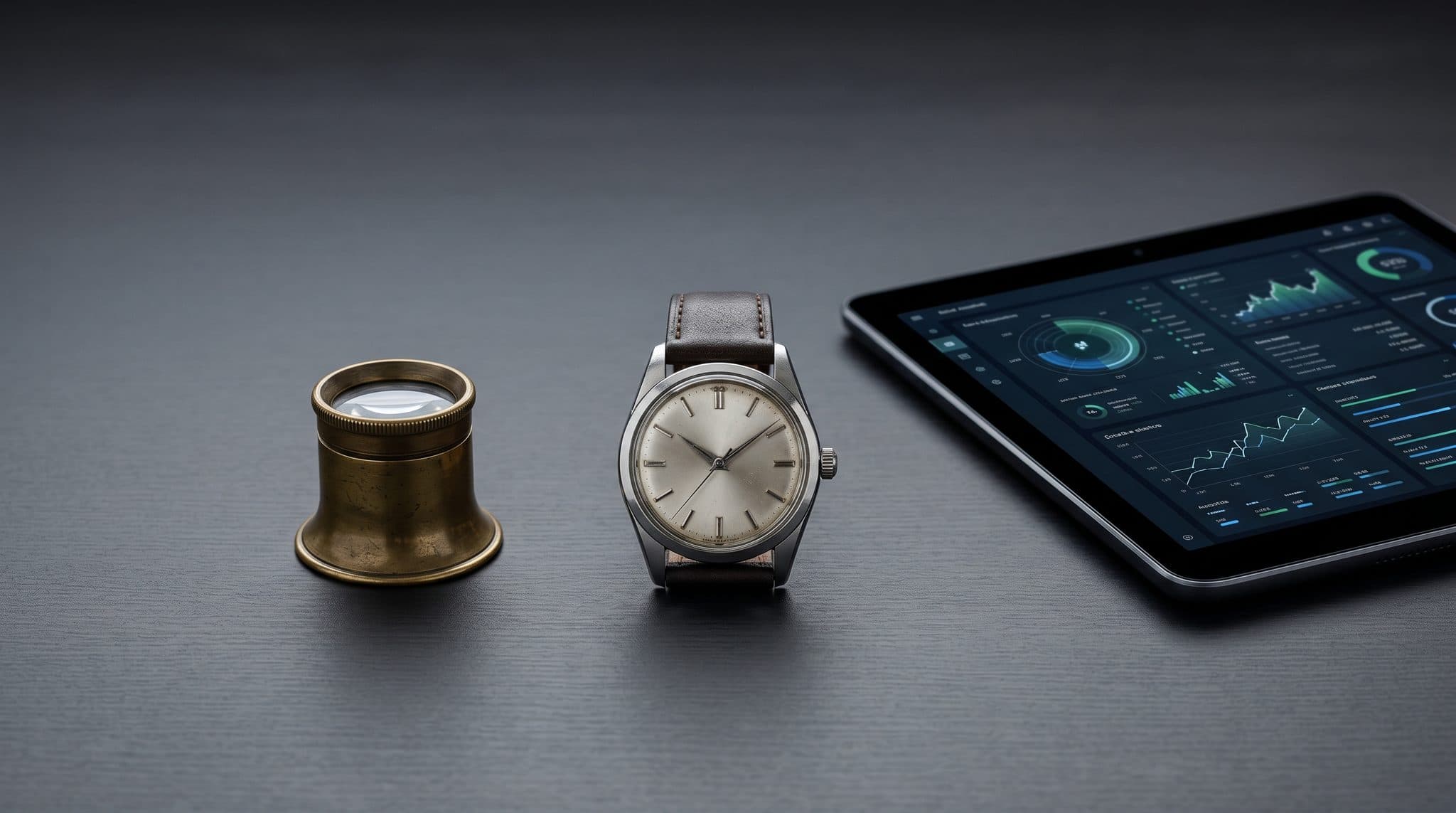
The future of watch valuation is not AI or human. It is both.
Why Valuation Is the Hardest Problem in Watch Selling
Ask three dealers what your watch is worth and you will get three different numbers. The pre-owned watch market has historically operated on subjective expertise, personal relationships, and opaque pricing—which means sellers routinely leave money on the table or overprice and sit on unsold inventory for months.
The emergence of AI-powered watch authentication and valuation is changing this dynamic. But how does it actually work? And can a machine really assess a timepiece as well as a seasoned dealer with decades of experience?
How Traditional (Human) Valuation Works
A traditional appraisal relies on a human expert—typically a watchmaker, dealer, or auction specialist—examining the watch in person or through detailed photographs. They assess several factors:
- Authenticity. Is the dial original? Are the hands correct for the reference and production year? Is the movement genuine and matching?
- Condition. Has the case been polished? Is the bezel insert original? Are there replacement parts?
- Completeness. Does it come with box and papers? Are the papers matching? Is the warranty card stamped?
- Market context. What have comparable examples sold for recently? Is the model trending up or cooling down?
Strengths of Human Valuation
Experienced appraisers bring intuition built over thousands of watches. They can detect subtle inconsistencies that do not fit neatly into a database—an unusual lume application, a dial variant that appeared only in a specific production batch, or wear patterns that suggest a frankenwatch. They also understand the emotional and narrative value of provenance in ways that algorithms currently cannot.
Weaknesses of Human Valuation
Human expertise is inconsistent, expensive, and does not scale. Two equally qualified experts can disagree by 15 to 20 percent on the same watch. Appraisals require physical access or extremely detailed photography, and turnaround times range from days to weeks. For a private seller trying to price a listing today, this is often too slow and too uncertain.
How AI-Powered Valuation Works
AI watch authentication systems—like the multi-agent pipeline used by Grey Market—analyze photographs of a watch through several specialized models, each trained on a different aspect of verification:
- Identity. The system identifies the brand, model, and reference number from dial and case characteristics.
- Research. It generates a specification sheet for the identified reference and cross-references known production details.
- Retrieval. It searches a database of verified reference images using visual embeddings to find the closest matches.
- Witness. Multiple parallel checks compare the submitted photos against known authentic examples, flagging inconsistencies in dial printing, hand proportions, marker alignment, and case finishing.
- Verdict. A synthesis model aggregates all findings into a confidence score and a structured report.
Strengths of AI Valuation
Speed and consistency are the clear advantages. An AI system can process a submission in minutes rather than days, and it will produce the same result every time for the same inputs. It can cross-reference thousands of data points simultaneously—far more than any human can hold in working memory. And it scales: whether the platform processes ten watches a day or ten thousand, the quality is identical.
Weaknesses of AI Valuation
AI systems are only as good as their training data. Rare references, unusual dial variants, and edge cases can fall outside the model's experience. AI also struggles with context that lives outside the photographs—provenance stories, service history, or the significance of a specific serial number range. And adversarial attacks (sophisticated counterfeits specifically designed to fool machine vision) are a growing concern in the industry.
Why the Best Systems Use Both
The debate is not AI versus human—it is about which combination produces the most reliable outcome. At Grey Market, the AI pipeline handles the heavy lifting: identity verification, spec-sheet generation, visual comparison against authenticated references, and structured confidence scoring. Human experts then review edge cases, assess submissions that fall below confidence thresholds, and bring contextual knowledge that the models lack.
This hybrid approach achieves two things that neither can accomplish alone: the consistency and speed of automated verification combined with the judgment and contextual awareness of experienced specialists.
What This Means for Sellers
If you are selling a watch, AI-powered authentication benefits you in several ways. It removes the pricing guesswork by anchoring your valuation in data from actual completed transactions rather than dealer estimates. It builds buyer trust because a third-party verification report gives bidders the confidence to pay full market value. And it speeds up the process—when the time is right to sell, you do not want to wait two weeks for an appraisal.
The key is choosing a platform that uses AI as a tool within a broader verification framework, not as a standalone black box. Ask whether human review is involved, whether the system provides confidence scores, and whether the verification methodology is transparent.
Ready to See It in Action?
Grey Market's AI verification pipeline is available to every seller on the platform. Submit a watch to see how it works, or read our Ultimate Guide to Selling Your Luxury Watch Online for the full seller's playbook.