

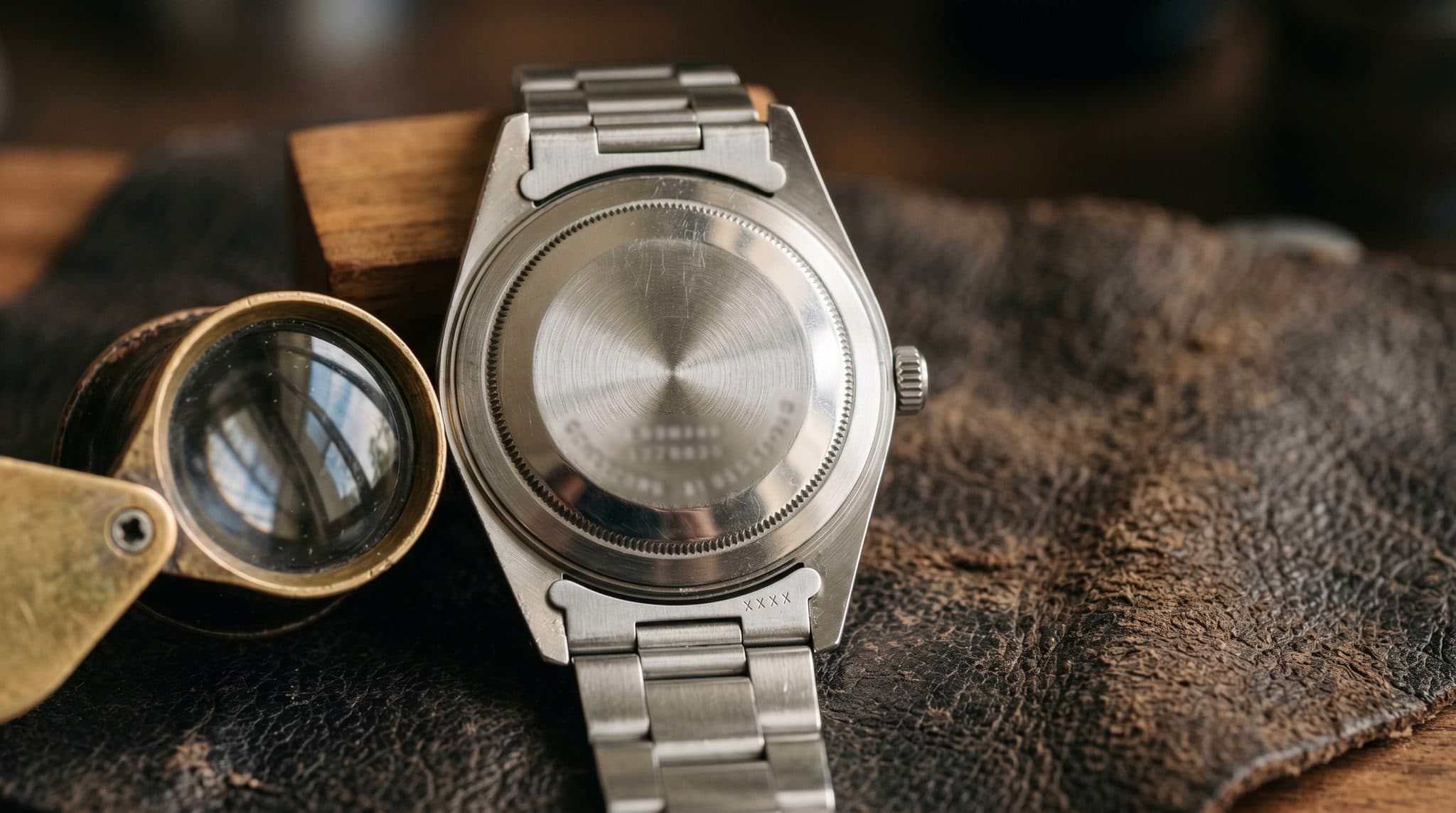
Eight digits and a letter can tell you whether the watch is what the seller says it is.
Why the Serial Number Matters
The serial number is the watch industry's primary unique identifier — the equivalent of a vehicle VIN. It encodes when the watch was made, often where, and sometimes for whom. Cross-referenced against the seller's claims and the watch's other characteristics, it is the single fastest authenticity check available to any buyer.
A serial that does not match the production year claimed in the listing is a hard stop. A serial that matches the year but reveals a configuration mismatch (a 2008 case with a 2015 dial, for instance) is a strong franken signal. A serial that is engraved unusually shallow or uneven can suggest the caseback has been replaced or the case has been overpolished to the point of erasing original finishing.
This tutorial walks through where to find the serial on each major brand, how to read it, and what to verify. Use it alongside the broader authentication framework.
Rolex: The Most Important Number on the Watch
Where to Find It
On Rolex watches produced through the mid-2000s, the serial is engraved on the case between the lugs at the 6 o'clock position. The bracelet must be removed to read it. From 2005 Rolex began engraving serials on the rehaut (the inner ring between the dial and crystal), where they are visible without removing the bracelet, alongside repeating "ROLEX ROLEX ROLEX" text; by 2008 the rehaut engraving had replaced the between-the-lugs serial across the range. Where the number sits and how it is cut is the first check in our guide to telling whether a Rolex is real.
How to Read It
Rolex serials follow a sequence of formats that have changed over the decades:
- Pre-1954: Numerical only, sequential.
- 1954–1987: Numerical, with year-correlated ranges. A 1968 watch might have a serial in the 1.7–2.1M range.
- 1987–2010: Letter prefix followed by six digits. R, L, E, X, N, S, W, T, U, A, P, K, Y, F, D, Z, M, V, G, J — each letter corresponds to a production year window.
- 2010–present: Random scrambled alphanumerics, no longer year-decodable from the serial alone.
Our Rolex serial number lookup turns a serial into a production year, and our guide to dating a Rolex beyond the serial covers the caseback codes, dial markings and calibres that should agree with it.
What to Verify
- The serial format matches the claimed production year. A letter-prefix serial cannot appear on a watch claimed to be from 1985.
- The serial range falls in the year window cited by trusted reference databases.
- The engraving is sharp and legible, with consistent depth. Shallow or smoothed engravings suggest case polishing has reduced engraving depth — common, and it materially affects value.
- For modern watches, the rehaut serial matches the warranty card serial exactly.
Omega: Movement-Based Serials and Case Markers
Where to Find It
Omega's primary serial is engraved on the movement, not the case. To verify, the caseback must be opened — which is why pre-purchase movement photographs are critical for any vintage Omega purchase. The case typically carries a separate reference number and case-specific identifiers.
How to Read It
Omega movement serials are sequential and well-documented from the early 1900s onward. A serial of approximately 24 million corresponds to roughly 1968 — the era of the Speedmaster Professional 145.022. The Omega Vintage Information Centre and Omega Database provide the year-by-year correlation tables.
What to Verify
- The movement serial corresponds to the year claimed by the seller.
- The caliber matches the reference. A Speedmaster Professional should have a caliber 321, 861, or 1861 depending on era — never a different caliber, even if the case looks correct.
- The case reference number is consistent with the dial and movement. Omega reference numbers like "ST 145.022" appear inside the caseback.
- Service stamps inside the caseback can corroborate or contradict the watch's history.
Patek Philippe: Two Serials That Must Match
Where to Find It
Patek Philippe engraves two distinct serials: the case serial (on the inside of the caseback) and the movement serial (on the movement itself). Both should be present, and on an authentic watch they correspond to each other in the Patek Philippe Extract from the Archives — a paid service Patek offers that confirms the watch's specifications at the time of original delivery.
How to Read It
Patek serials are six-digit numbers, sequentially issued. A movement serial of approximately 3,200,000 corresponds to roughly 1995. Reference works such as the Patek Philippe Encyclopedia document the year-by-year ranges.
What to Verify
- Both case and movement serials are present and not modified.
- The two serials are consistent with each other and with the claimed production year.
- An Extract from the Archives is available, ideally already obtained by the seller. Without one, the watch is harder to authenticate definitively, especially for vintage references.
- The reference number, dial signature, and case configuration match what the Extract documents (or what would be documented for that production year).
Audemars Piguet: The Royal Oak Reference Stack
Where to Find It
Audemars Piguet engraves the case serial between the lugs (similar to early Rolex practice) and a movement serial inside the case. Modern Royal Oak references additionally feature engraved reference numbers on the inside of the caseback.
How to Read It
AP serials are alphanumeric and tied to specific production batches. The Audemars Piguet Heritage Department maintains records, and AP boutiques can verify serials against their internal database for buyers and sellers — a service that is increasingly important as Royal Oak counterfeits have become more sophisticated.
What to Verify
- The case serial is sharp and unaltered.
- The movement serial is present and consistent with the case serial era.
- The reference number engraving inside the caseback matches the model. Royal Oak 15400 and 15500 are distinct references with different production years and feature sets.
- For high-value or rare references, request an AP Heritage Department verification.
Tudor: The Often-Forgotten Cross-Check
Where to Find It
Vintage Tudor watches use Rolex cases (Tudor was Rolex's "sister" brand using outsourced movements), so the case serial is engraved between the lugs in Rolex style. The movement, however, is a Tudor-supplied caliber (typically ETA-based for vintage references, in-house for modern Black Bay and Pelagos models).
How to Read It
Vintage Tudor serials follow Rolex conventions for the era. Modern Tudor watches have their own serial format on the case and rehaut.
What to Verify
- For vintage Tudor, the case serial corresponds to the claimed year using Rolex year tables.
- The movement is a Tudor-correct caliber — not a Rolex movement (which would suggest the watch was modified or is a franken).
- Modern Tudors with manufacture movements (MT5400, MT5612, etc.) have movement decorations and signatures that should be confirmed visually.
Red Flags Across Every Brand
Independent of brand-specific format, certain serial-level signals warrant skepticism on any watch:
- Shallow or uneven engravings. Case polishing reduces engraving depth. Engravings that have lost crispness signal a polished or reworked case.
- Missing or partial serials. Rare on authentic watches. Highly suspicious when present.
- Serial mismatch with paperwork. Warranty cards and watches that do not share serials are not paired correctly. The card may have been issued for a different watch.
- Serial range conflict with dial design. A serial range from 1972 paired with a dial design only used after 1976 indicates a franken or counterfeit.
- Engraving font or spacing oddities. Each brand has consistent serial-engraving conventions. Variation suggests after-market alteration.
Tools and References
The fastest way to validate a serial across brands is to combine several reference layers:
- Brand archives (Patek Philippe Extract, AP Heritage, Omega Vintage Information Centre).
- Reference databases such as the Omega Database, Rolex Forums serial threads, and the Patek Philippe Encyclopedia.
- Auction archives — Phillips, Christie's, Sotheby's, and Antiquorum publish detailed lot descriptions for sold watches that include serial information for cross-comparison.
- Platform authentication tools like Grey Market's verification system, which incorporates serial cross-referencing as part of its multi-stage AI pipeline.
The Bottom Line
The serial number is not a magic authentication wand — a correct serial does not, by itself, guarantee an authentic watch — but a problematic serial is almost always a guarantee of a problematic watch. Run the serial check first on any high-value purchase. If the serial passes, continue to dial, hands, movement, and paper checks. If the serial fails, walk away.
For the full authentication framework that contextualizes serial checks, return to the complete authentication guide. To understand what happens when serial checks reveal problems at scale, read Why Only One Watch in Ten Makes It to Auction.
Reference guides
Deep dives on the references discussed in this story:
- Omega Speedmaster CK2915 (1957–1959)
- Rolex Datejust 1625 (c. 1959–1977)