

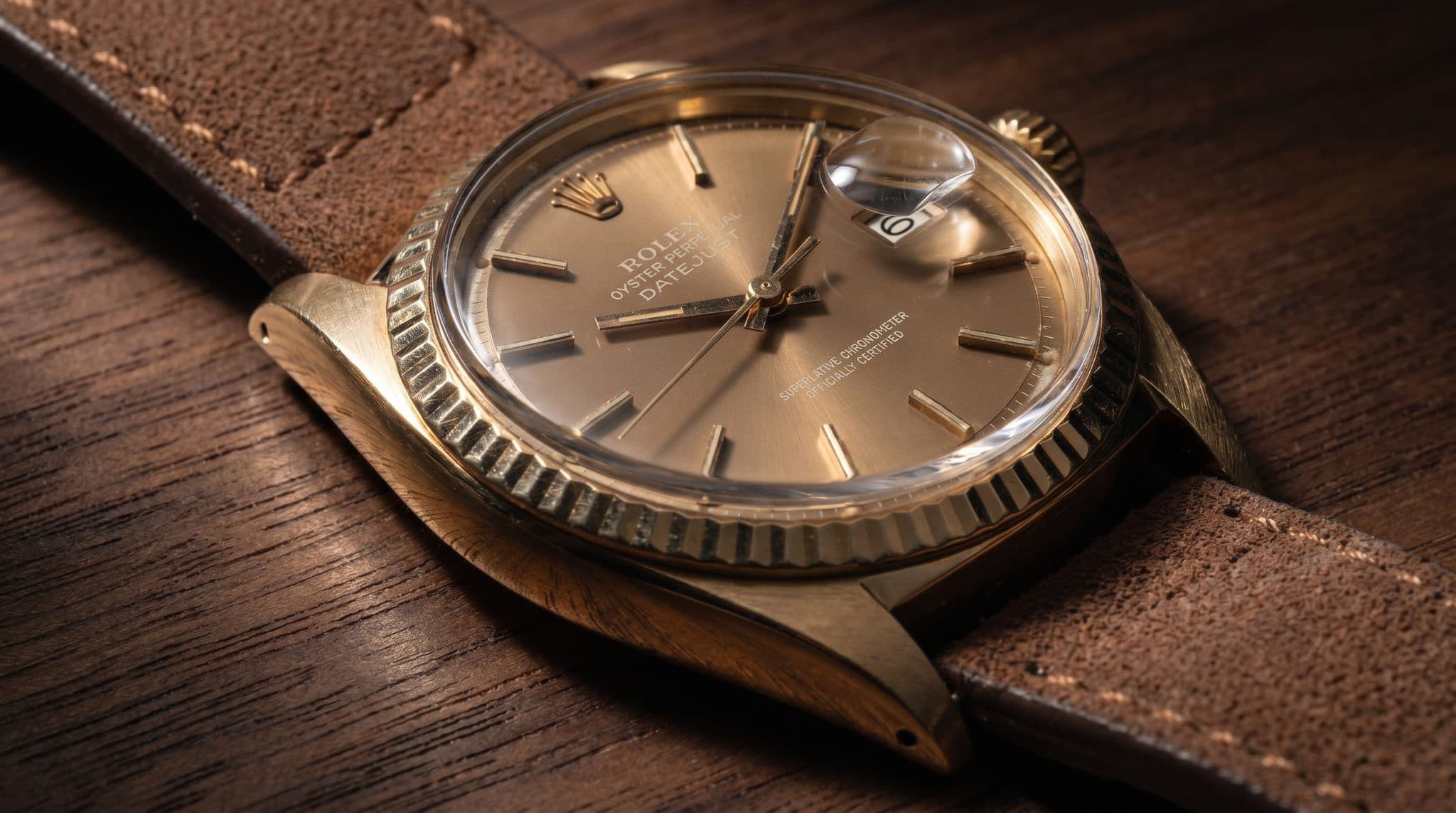
The single most debated topic in watch collecting — settled with facts.
The Polishing Debate, Explained
Few topics generate more heated discussion among watch collectors than polishing. On one side: collectors who believe a watch should look its best at all times, and that a professional polish restores a watch to its intended glory. On the other: collectors who argue that factory finishing is sacred, and that removing even a fraction of a millimeter of steel destroys originality, character, and value.
Both sides have valid points. But the market data is unambiguous about one thing: for vintage and discontinued luxury watches, unpolished condition commands a significant and measurable premium. Understanding why — and knowing how to tell the difference — is essential knowledge for any buyer or seller in the pre-owned market.
What Polishing Actually Does
Watch case polishing removes a thin layer of metal from the surface to eliminate scratches and restore a smooth, reflective finish. When done correctly by a skilled professional, the result is a watch that looks nearly new.
The problem is what gets removed along with the scratches:
- Factory edge geometry. Luxury watches are finished with precise transitions between polished and brushed surfaces. The sharp, purposeful angles on lugs, bezel edges, and case sides are part of the design. Each polishing pass softens these edges slightly, and repeated polishing rounds them into a shape the designer never intended.
- Surface depth. Metal removal thins the case. On the lugs, where the case is thinnest, this can push the lug holes outward toward the edge — a telltale sign of overpolishing that experienced buyers check first.
- Brushed finishing. Many watches feature alternating brushed and polished surfaces. A careless polish can erase the brushed texture entirely, replacing it with a uniform mirror finish that looks wrong to anyone who knows the reference.
How Much Value Does Polishing Cost?
The value impact depends entirely on the watch. Here is the general framework:
Vintage and Discontinued References
For collectible references from the 1950s through early 2000s, the difference between polished and unpolished can be dramatic. Industry estimates and auction data suggest a 20 to 30 percent reduction in collector value for polished examples compared to unpolished equivalents in similar overall condition.
At the extreme end, the difference is even more striking. In auction records, unpolished examples of rare references have sold for multiples of what polished examples achieved — sometimes five to ten times more for the most desirable vintage pieces where originality is paramount.
Modern Production References
For current-production watches that you wear daily, the value impact of professional polishing is minimal — typically 5 percent or less. The market for modern pieces is driven more by overall condition and completeness (box, papers, warranty card) than by whether the case has been polished once or twice.
The In-Between
Recently discontinued models — watches made in the last 10 to 20 years — fall in between. As these references age and supply decreases, the premium for unpolished condition grows. A watch that loses 5 percent of its value from polishing today might lose 15 percent in ten years as it transitions from "used watch" to "collectible."
How to Tell If a Watch Has Been Polished
This is the practical skill every buyer needs. Here are the signs to look for:
Lug Geometry
The lugs are the first place to check. On an unpolished watch, the lug edges will be sharp and defined, with crisp transitions between surfaces. The lug holes (where the spring bars sit) should be centered in the lug, perfectly round, and sitting high. On a polished watch, the edges soften, the lugs appear thinner, and the lug holes migrate toward the outer edge as metal is removed from the surface.
Brushing Quality
Factory brushing is applied with industrial precision — the lines are uniform in depth, spacing, and direction. After-market re-brushing (which sometimes accompanies polishing) typically looks different: less uniform, sometimes slightly diagonal, or with visible start-and-stop marks at the edges of surfaces.
Edge Transitions
Where polished surfaces meet brushed surfaces, there should be a clean, sharp line. Polishing blurs this boundary. On a case side that transitions from brushed top to polished bevel, a polished watch will show a soft, rounded transition instead of a crisp angle.
Crown Guards
On watches with crown guards (like the Rolex Submariner), check the sharpness of the guard edges and the symmetry between the two sides. Polishing tends to affect crown guards unevenly because of their complex geometry. On a vintage Rolex, the case is the one part that cannot be replaced, which is why our vintage Rolex buying guide starts there.
Engravings and Hallmarks
Caseback engravings, serial numbers, and hallmarks are recessed into the metal. Polishing reduces the depth of these engravings. If serial numbers appear shallow or slightly smoothed compared to reference examples, the caseback has likely been polished.
When Polishing Is Perfectly Fine
The anti-polishing stance is not universal, and it should not be. There are legitimate situations where polishing makes sense:
- Modern daily wearers. If you bought a current-production Omega Seamaster to wear every day and it picks up desk-diving scratches, a professional polish after a few years of wear is reasonable and will have minimal impact on resale value.
- Brand servicing. Rolex, Omega, and other manufacturers routinely polish cases during official service. For watches still under warranty or intended for personal enjoyment rather than collecting, this is standard practice and nothing to worry about.
- Non-collector pieces. Not every watch is a collectible. For fashion watches, entry-level pieces, or watches you intend to keep forever, polishing to maintain appearance is a perfectly valid choice.
The rule of thumb: if you are buying or selling a watch where collector value matters, polishing status matters. If the watch is a personal daily wearer that you do not plan to sell at a premium, polish with a clear conscience.
What to Ask When Buying
If you are evaluating a pre-owned watch — especially a vintage or discontinued reference — ask the seller these questions directly:
- Has the case been polished? If so, how many times and by whom?
- Can you provide close-up photos of the lugs showing the lug holes and edge geometry?
- Is the brushed finishing original or has it been re-applied?
- Are the caseback engravings at their original depth?
A seller who cannot or will not answer these questions is a red flag. Reputable sellers and platforms provide this information upfront in their condition reports because they understand what informed buyers need to know.
The Bottom Line
Polishing is not inherently bad. Overpolishing is. And for watches with collector value, any polishing introduces risk. As a buyer, learning to read the signs of case work protects you from overpaying for a watch whose value has been reduced by well-intentioned but destructive refinishing. As a seller, understanding polishing status helps you price accurately and photograph the right details to build buyer confidence.
For the complete buyer's framework — from authentication and pricing to bidding strategy and scam avoidance — read our Ultimate Guide to Buying a Pre-Owned Luxury Watch Online. And if you are ready to sell, start with our seller's guide.
Reference guides
Deep dives on the references discussed in this story:
- Rolex Cosmograph Daytona 16528 (1988–2000)
- Rolex Submariner 16610 (1989–2010)
- Rolex Submariner 16610LV (2003–2010)