

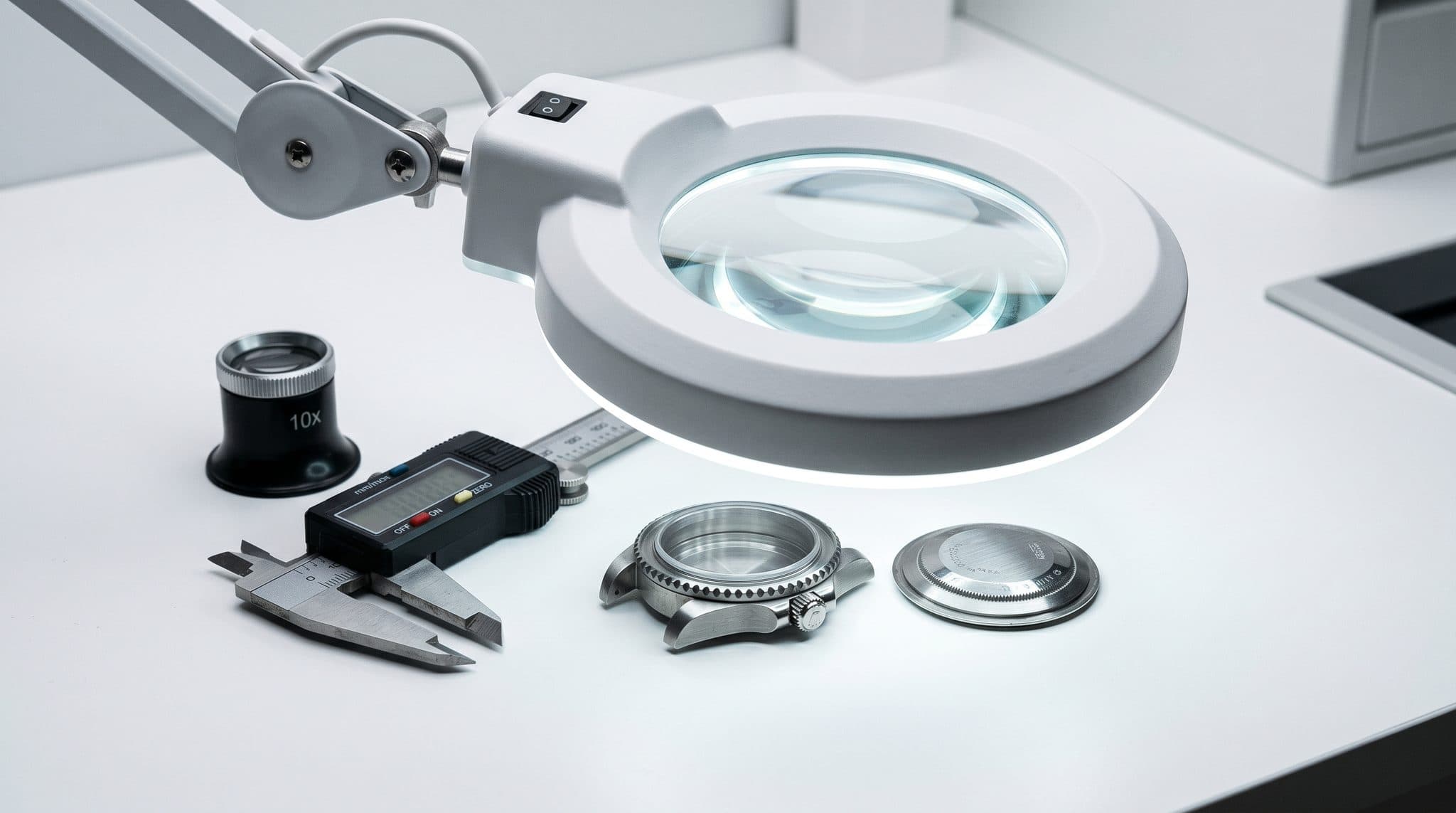
The era of "look closer to spot the fake" is over. The new question is structural: who absorbs the loss when a sophisticated counterfeit slips through?
What Super Fakes Are — And Why They Are Different
"Super fake" is the industry's working term for a category of counterfeit luxury watch that emerged in the late 2010s and has matured into a serious authentication challenge in the 2020s. Unlike the obvious replicas of previous decades, super fakes are engineered specifically to defeat visual inspection. They feature:
- Cases milled from the correct grade of stainless steel or gold, finished with brand-correct brushed and polished surfaces
- Sapphire crystals with anti-reflective coating
- Movements that are either heavily modified Asian clones or, in the most sophisticated examples, parted-out genuine movements from cannibalized watches
- Dials produced with the correct printing techniques — gilt, applied indices, era-correct lume formulations
- Serial numbers harvested from real watches, allowing the counterfeit to "pass" basic serial verification
- Boxes, papers, and warranty cards reproduced or, in some cases, paired with watches the papers do not actually belong to
Production quality has reached the point where seasoned dealers, wearing the watch on their wrist for several days, can fail to detect the counterfeit without opening the case. This is the structural shift that the authentication industry has spent the past three years adapting to.
How We Got Here
The super fake phenomenon is not the result of a single innovation. It is the convergence of three trends:
1. Manufacturing Capability
CNC machining, precision casting, and quality control techniques have become accessible to any operation with capital. Counterfeit operations now produce cases and components with tolerances measured in microns, on equipment comparable to legitimate manufacturers. The barrier to physical replication has fallen dramatically.
2. Movement Sophistication
Asian clone movements (DG, Asian 7750, ETA-style) have evolved from obvious counterfeits to passable replicas. The most advanced operations now harvest genuine movements from damaged authentic watches and recase them, producing counterfeits that contain genuine internals — making movement-based authentication itself unreliable in some cases.
3. Information Availability
Authenticated reference photographs, factory specifications, internal Rolex/Patek/AP technical drawings, and even portions of brand archive databases have leaked into the dark corners of the internet. Counterfeit operations now know precisely what details to replicate, because the reference material is openly accessible.
What Super Fakes Still Get Wrong
Despite their sophistication, super fakes are not perfect. Authentication frameworks built for this generation focus on the things even high-end counterfeits cannot fully reproduce (for the Rolex-specific version a buyer can run by hand, see how to tell if a Rolex is real):
Movement Finishing at the Microscopic Level
Genuine luxury movements show finishing details — Côtes de Genève striping, perlage, anglage on chamfered edges, blued screws, gilt engravings — that require finishing techniques counterfeiters cannot economically replicate. Under macro photography of the movement, super fakes typically reveal themselves.
Procedural Trail
Even when a counterfeit has a real serial number, that serial corresponds to a specific watch with a documented history. If the seller cannot trace the watch's chain of ownership — purchase receipts, service records, prior listings — the procedural trail breaks down. Marketplace platforms increasingly require this trail as part of authentication, not as an alternative to it.
Lume Aging Continuity
Counterfeit lume can replicate the appearance of aged tritium, but it cannot replicate decades of internally consistent aging across all the watch's luminous surfaces. A super fake with "tropical" patina applied to the dial still has bright, modern-looking lume on the bezel pip and hands. Authentic vintage watches age uniformly.
Dial Printing Three-Dimensionality
Genuine vintage Rolex gilt dials and Patek Philippe applied indices have a depth and three-dimensionality that high-resolution printing cannot match. Macro photography under angled light reveals the difference: real dials show subtle shadow play around printed elements; super fake dials look slightly flat by comparison.
Wear Pattern Authenticity
Watches that have lived in the world for 30 to 60 years carry wear patterns that match their stated history. The crown shows wear consistent with regular winding. The case sides show contact patterns. The bracelet pins show stretch in expected places. Super fakes are often artificially aged, but the aging is rarely internally consistent across all the watch's surfaces.
The Authentication Industry's Response
Three structural changes have emerged in response to super fakes, and they are reshaping how the pre-owned market works.
Multi-Pillar Verification Becomes Standard
Single-point authentication (a dealer's eye, a one-look review) is no longer sufficient. Credible platforms now layer visual verification, mechanical verification, paper trail review, and platform procedural controls together. Read the authentication trust guide for the four-pillar framework that has become standard.
AI Pattern Recognition at Scale
Machine vision systems trained on tens of thousands of authenticated reference images can identify subtle inconsistencies that human reviewers miss. The pipeline used at Grey Market — and increasingly across the industry — runs every submission through structured AI verification, producing confidence scores and flagging anomalies for human escalation. The mechanics are detailed in Watch Valuation: AI vs. Human.
Insurance and Procedural Backstops
The most material change is structural. Platforms increasingly carry authentication insurance — financial guarantees that cover buyers if a watch sold through the platform later turns out to be inauthentic. This shifts the loss from buyer to platform, creating a strong economic incentive for the platform to invest in verification infrastructure. It also gives buyers something they could never have in private-party sales: institutional accountability.
Why Buyers Should Care About Procedural Trust
The takeaway from the super fake era is not "learn to spot fakes." Even experts increasingly cannot. The takeaway is structural: who absorbs the loss when a sophisticated counterfeit slips through?
- In a forum or classified sale, the buyer absorbs the loss entirely. Recovery against a private seller is rarely successful.
- In a dealer transaction, the dealer's reputation and policies determine recourse. Outcomes vary widely.
- In a marketplace transaction with platform-level authentication, the platform absorbs the loss — and that economic exposure is exactly why the platform invests in verification infrastructure that no individual buyer could afford.
This is why the buying-side advice in our Ultimate Guide to Buying a Pre-Owned Luxury Watch Online emphasizes platform selection over watch selection. The watch is identical across venues. The trust infrastructure is not.
What Sellers Need to Know
Super fakes affect sellers as well as buyers. Sellers offering authentic watches are now competing for buyer attention against listings that may be sophisticated counterfeits indistinguishable from the real thing. The response, paradoxically, has been to over-document. Sellers who proactively submit watches to authentication, who provide complete service histories, and who offer detailed provenance documentation now differentiate themselves and command price premiums for that transparency.
The era of "the watch speaks for itself" is over. The watch and the documentation now speak together. For the seller-side framework, see our Ultimate Guide to Selling Your Luxury Watch Online.
The Long View
Super fakes will continue to evolve. The counterfeit industry has every economic incentive to keep up with authentication advances, and authentication has every economic incentive to stay ahead. The sustainable answer is not "perfect detection" — that arms race is endless — but a financially structured trust model where the cost of authentication failures is borne by the parties best positioned to invest in detection.
That is the actual product of the modern marketplace, and the reason platform-level trust is now more valuable than any single authentication technique. For the related topics, see What Is a Frankenwatch?, 10 Watch Scams Every Buyer Should Know, and Why Only One Watch in Ten Makes It to Auction.