

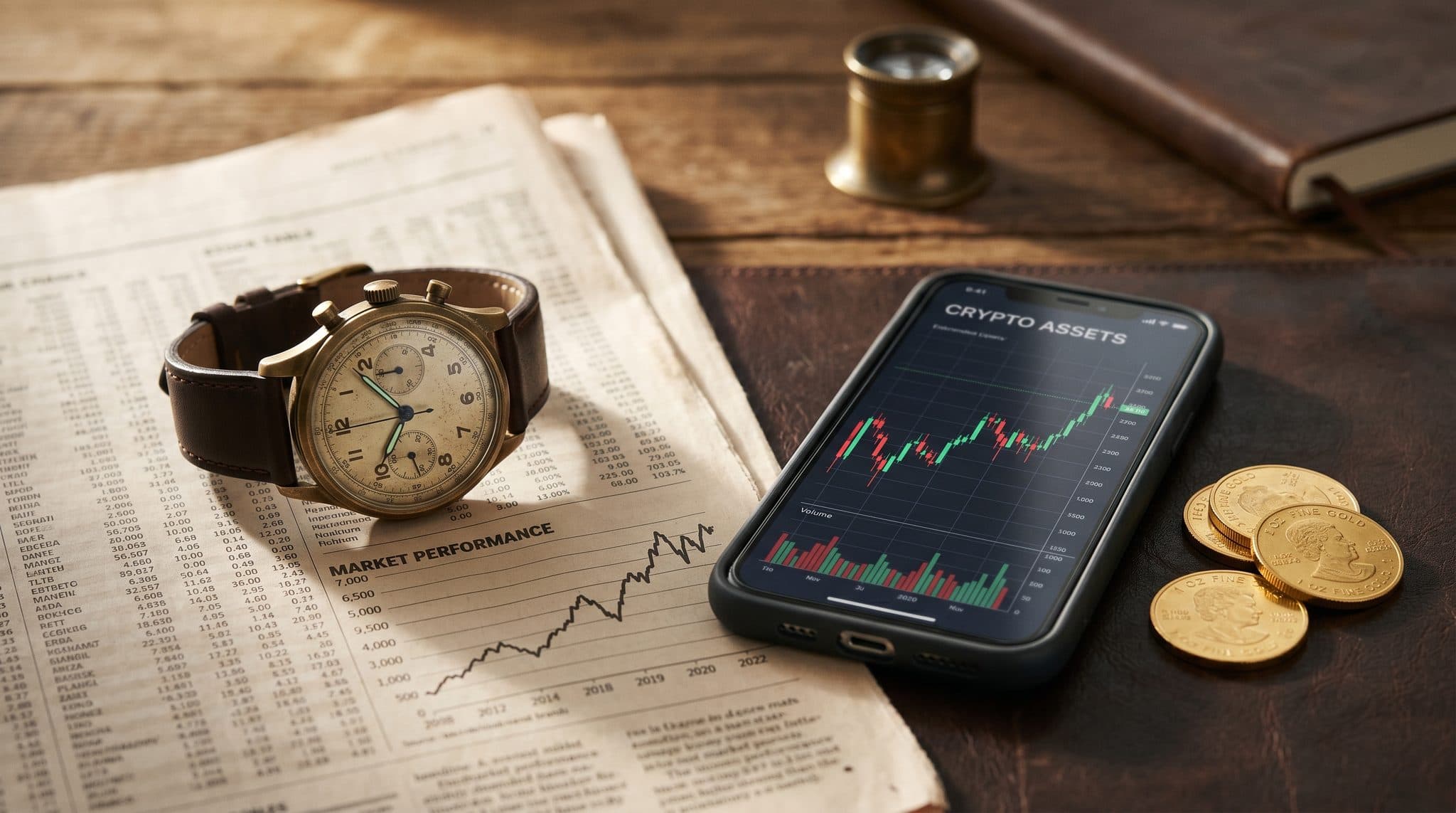
Three asset classes, three completely different value propositions. The right answer is rarely all-in on any of them.
Why Compare At All?
If you are reading this, you have probably heard variations of all three pitches. Stocks: the long-term compounding machine, boring but unbeatable over decades. Crypto: the asymmetric upside bet, the asset class for the digital age. Watches: the tangible passion asset that holds value, lets you enjoy it daily, and outperforms inflation. Each pitch is partially true. None is the whole story.
This article compares the three across the dimensions that actually matter for personal allocation decisions — returns, volatility, liquidity, custody costs, tax treatment, and the non-financial dimensions that financial assets simply cannot deliver. The goal is not to crown a winner. It is to give collectors who treat watches as part of an overall asset position the framework to size that position correctly.
For the dedicated watch-investing framework, this article complements our collector's investing guide.
1. Long-Term Returns
Stocks
The S&P 500 has delivered approximately 7 to 10 percent annual real returns (after inflation) over multi-decade periods, with the long-term arithmetic average around 8 percent. This is the most studied asset class in human history, and the return distribution is well understood. A diversified equity portfolio held for 30+ years has produced positive real returns in essentially every rolling window.
Crypto
Returns are dominated by Bitcoin, which has produced compound annual returns above 100 percent over its full history but with extreme variance. Holding from 2014 through 2024 produced approximately 60 to 70 percent annualized returns; holding from peak 2017 through 2020 produced negative returns; holding from peak 2021 through 2023 produced approximately 50 percent drawdowns. The asset class is too young for stable long-term return assumptions.
Watches
Investment-grade watches have produced approximately 5 to 10 percent annualized returns over the past two decades for blue-chip references in good condition, with select rare references producing dramatically higher returns. The return distribution is highly reference-dependent: a vintage Paul Newman Daytona has appreciated at over 15 percent annualized; an average Rolex Submariner has appreciated at roughly 4 to 6 percent; a non-blue-chip luxury watch has typically tracked inflation or modestly underperformed it.
The Comparison
For pure returns over multi-decade periods, diversified equities have the strongest historical track record by a wide margin. Bitcoin has delivered higher returns over its history but with a much shorter sample. Watches sit between — strong returns for the right references, mediocre returns for the wrong ones, with selection skill mattering enormously.
2. Volatility and Drawdowns
| Asset Class | Typical Annual Volatility | Largest Historical Drawdown |
|---|---|---|
| S&P 500 | 15–20% | ~50% (2008–2009) |
| Bitcoin | 60–80% | ~85% (2017–2018, 2021–2022) |
| Investment-grade watches (blue-chip) | 10–25% | ~30–40% (2022–2024 correction) |
| Investment-grade watches (vintage rare) | 15–35% | ~30% (varies by reference) |
The watch market correction of 2022 to 2024 was the asset class's most significant drawdown in modern memory — but it was meaningfully smaller than crypto drawdowns and not dramatically worse than equity bear markets. Watches are less volatile than crypto and modestly less liquid than equities, which can make the volatility feel different psychologically: when you cannot easily sell, the volatility shows up as a question of "what is this worth right now" rather than as daily marked-to-market pain.
3. Liquidity
Liquidity is where the three asset classes diverge most dramatically.
Stocks
Near-perfect liquidity for major equity indices. A million dollars of S&P 500 ETF can be sold in seconds at the prevailing market price during trading hours, with bid-ask spreads measured in basis points. Even individual large-cap stocks can be liquidated in hours without meaningful price impact.
Crypto
High liquidity for major coins (Bitcoin, Ethereum). Liquidation happens in minutes on major exchanges, with spreads slightly wider than equities. Smaller coins have meaningfully worse liquidity, and large positions can be hard to exit without moving the market.
Watches
Materially worse liquidity than the financial assets. Selling a $50,000 watch quickly often requires accepting 10 to 20 percent below market — to a dealer who can flip it. Selling at full market value typically takes 2 to 8 weeks through marketplace listings or auction. Selling a million-dollar watch in an unfavorable market environment can take several months and may require auction-house consignment with attendant fees.
Liquidity matters most when you need it most — exactly the moments when you are most likely to be forced to sell. This is the strongest argument against treating watches as a liquid asset position.
4. Custody and Carrying Costs
Annual carrying costs vary dramatically across the three.
Stocks
Effectively zero. A brokerage account costs nothing in most jurisdictions. ETF expense ratios on broad indices are 0.03 to 0.20 percent annually. There are no storage, insurance, or maintenance requirements.
Crypto
Near zero in financial terms but meaningful in operational complexity. Hardware wallets cost $50 to $200 once. Self-custody requires careful security practices that many holders do not maintain well. Custodial solutions (exchange-held coins) trade convenience for counterparty risk — exchanges have failed and taken customer assets with them. There is no cash-flow drag from holding crypto, but the operational tail risk is real.
Watches
Material annual costs. Watch insurance runs 1 to 2 percent of insured value annually — see our practical guide to insuring a watch collection for the mechanics. Service costs run $500 to $2,500 every 5 to 10 years per watch, depending on brand. Storage (a quality safe) is a one-time investment of $1,000 to $10,000+ depending on collection size. The total carrying cost on a $100,000 collection is approximately 1.5 to 3 percent annually — meaningful, but smaller than the typical hedge-fund management fee.
5. Tax Treatment
Tax treatment varies materially by jurisdiction. In the United States, the broad framework:
- Stocks: Long-term capital gains taxed at 0%, 15%, or 20% depending on income bracket. Qualified dividends taxed at the same rates. Short-term gains taxed as ordinary income.
- Crypto: Capital gains taxation similar to stocks at the federal level, with additional complexity around staking, swapping, and DeFi activity. Wash-sale rules currently do not apply to crypto, which creates tax-loss harvesting opportunities.
- Watches: Treated as collectibles. Long-term capital gains on collectibles are taxed at a maximum 28% federal rate — meaningfully higher than the 20% maximum for stocks and crypto. State taxes apply on top.
The collectibles tax treatment is a meaningful drag on long-term watch returns relative to financial assets. A 30 percent gross return on a watch becomes roughly 22 percent after federal tax for high earners, while a 30 percent return on equities becomes roughly 24 percent. Over decades, the compound difference is substantial.
6. The Things Financial Assets Cannot Deliver
This is the dimension most return-focused comparisons miss, and it is the strongest argument for watches in any portfolio.
Use Value
You cannot wear a stock. Crypto does not tell time. A watch you own and wear delivers continuous, daily utility for the entire holding period, in a way financial assets simply cannot. The return calculation is incomplete without accounting for this.
Aesthetic and Emotional Engagement
The relationship a collector builds with a single watch over years of ownership is not reproducible with any financial asset. A watch passed from a parent to a child carries meaning that a brokerage statement does not. This dimension does not show up in the return numbers but accounts for much of the durable demand that drives the asset class.
Privacy and Portability
Watches are physically portable, internationally tradable, and not subject to the same surveillance as financial accounts. For collectors with reasons to value asset privacy or international portability, watches offer something equities and crypto do not.
Resistance to Counterparty Risk
Stocks held in a brokerage carry counterparty risk on the broker. Crypto in custody carries exchange risk; in self-custody, it carries operational risk. A watch in your safe carries neither. The risk profile is different in kind, not just degree.
7. The Allocation Question
Most collectors who do well with watches treat them as 5 to 20 percent of their overall asset position — large enough to matter, small enough that liquidity constraints do not become catastrophic. The remaining capital sits in liquid financial assets, where capital efficiency, dividend reinvestment, and rebalancing flexibility actually deliver compound returns.
Within that 5 to 20 percent, concentration in investment-grade references — see our analysis of currently-undervalued watches — produces stronger long-term outcomes than diversification across mediocre pieces. The contrarian extreme is the one-watch collection, which trades all the optionality of a portfolio for the depth of a single durable relationship with a single piece.
8. The Honest Bottom Line
If your only goal is maximum risk-adjusted financial return over a multi-decade window, the academic answer is a diversified equity portfolio with a small bond allocation. Crypto is a higher-variance allocation that may or may not pay off. Watches are a hybrid consumer/financial asset that delivers real but tax-disadvantaged returns alongside non-financial benefits financial assets do not provide.
The collectors who do best treat all three as complementary rather than competing. They hold the bulk of their wealth in financial assets where capital efficiency matters most. They treat crypto allocation as the discretionary high-variance bet it is. And they treat watches as the asset position that lives at the intersection of capital and consumption — the part of the portfolio that exists not to maximize returns but to make the asset position tangible and personally meaningful.
For the broader investing framework, see the collector's investing guide. For the current state of the watch market specifically, read our 2026 watch market report.