

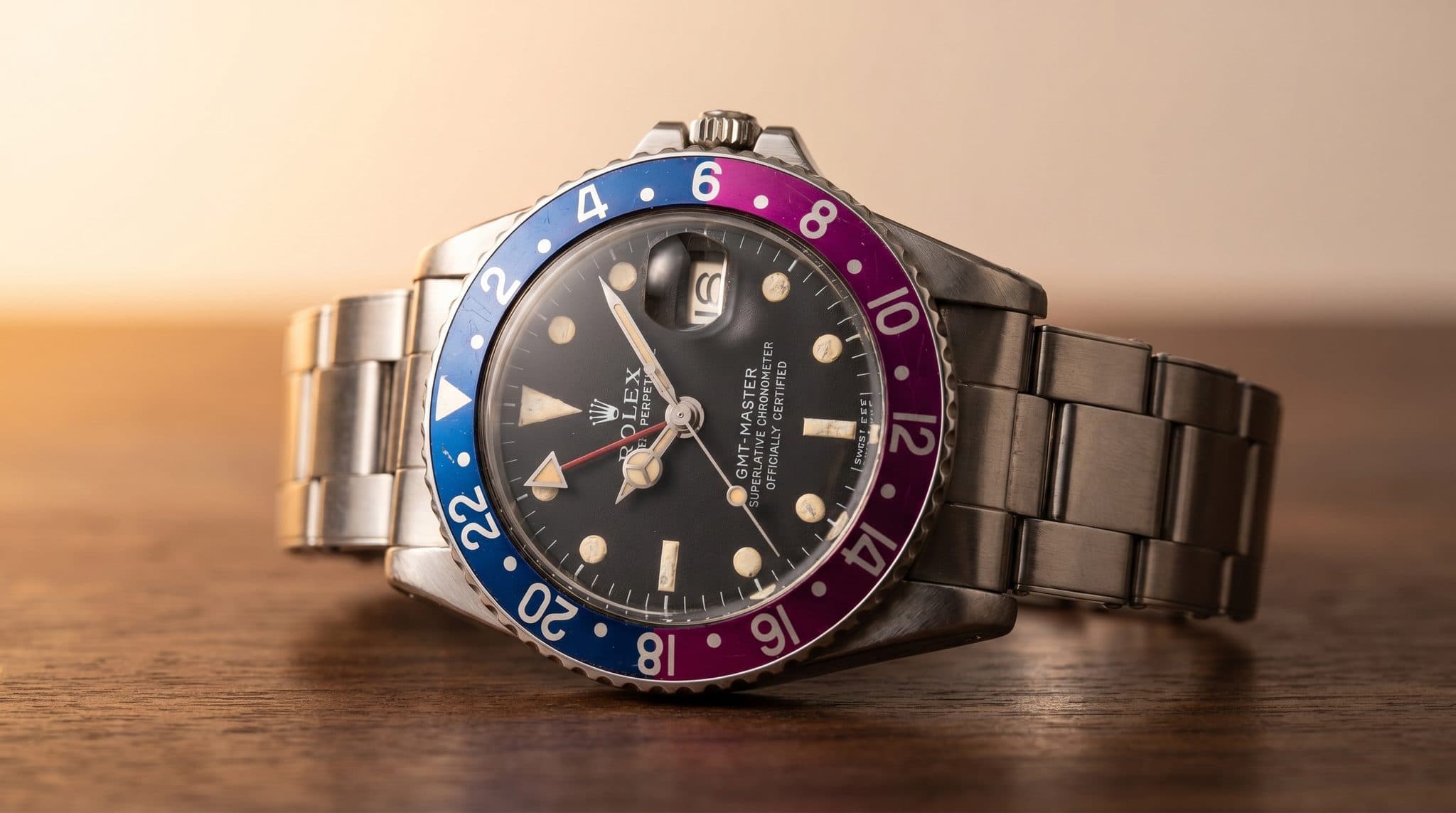
Most collectors will tell you to diversify. The collectors who actually love watches keep finding their way back to one.
The Conventional Wisdom
If you ask the typical watch enthusiast — or read any standard collecting guide — the prescribed approach is portfolio thinking. Build a diverse collection. Cover different complications: a chronograph, a dive watch, a dress piece, maybe a perpetual calendar. Spread across brands. Mix vintage and modern. Keep some pieces for daily wear, others for occasions.
The logic is reasonable. A portfolio reduces idiosyncratic risk if you are thinking of watches as assets. It provides variety for different occasions and outfits. It demonstrates collecting sophistication. And, frankly, it gives you more excuses to keep buying.
This article is the counterargument. Not because portfolio thinking is wrong — it has its place — but because the case for a one-watch collection has become unusually compelling in 2026, and almost no one is making it out loud.
Why Concentration Beats Diversification (For Many Collectors)
The Wear-Time Math
Start with the simple arithmetic. A collector who owns 10 watches and wears one each weekday wears each watch roughly 36 days per year. The rest of the time, the watch sits in a drawer or safe. A collector who owns one watch and wears it every day wears that watch 365 days per year — or about 10x the wear time per piece. Watches are made to be worn. The relationship between collector and timepiece deepens through wear, scratches, service history, and shared experience. A watch that lives in a winder is barely a watch. A watch that lives on your wrist for 10 years becomes part of your identity.
The Quality Curve
Within any budget — whether $5,000 or $500,000 — concentration almost always allows a meaningfully better watch than diversification. A collector spending $50,000 across five watches gets five $10,000 watches. A collector spending the same $50,000 on a single watch gets one $50,000 watch. The latter is not 5x better — but it can be substantially better, particularly if the higher budget enables a tier shift (from steel to gold, from current to vintage, from production model to rare reference). The single-watch collector ends up with a piece they could not otherwise own.
Reduced Decision Fatigue
This is underrated and matters more than collectors typically admit. With one watch, you do not think about which watch to wear today. The decision is made permanently. The cognitive overhead of "rotating the collection" — choosing pairings, planning around occasions, wondering if you are giving each watch enough wrist time — disappears entirely. The watch becomes a fixed point, like a wedding ring. You stop thinking about it and start thinking through it.
Capital Concentration
If watches are partially an investment for you (and the framework in our collector's investing guide argues they should be), concentration in a single high-quality reference may produce stronger long-term returns than spreading across mid-tier pieces. The blue-chip references appreciate disproportionately to their entry-level brand siblings. Owning one Patek Nautilus is generally a stronger asset position than owning four mid-tier watches at the same total cost.
The Counterarguments (And Why They Are Weaker Than They Sound)
"But I want variety."
Collectors who say this often mean: "I want the dopamine hit of acquiring a new watch every few months." That is a different desire from wanting variety in daily wear. The actual variety question is whether you wear different watches for different occasions, and the honest answer for most collectors is: not really. The dive watch becomes the daily watch. The chronograph functions get used twice a year. The dress watch comes out for weddings. A single excellent watch — well-chosen — can cover most lived occasions for most collectors.
"What if it gets damaged or stolen?"
This is a real consideration but is solved by insurance, not redundancy. Read our practical guide to how to insure a watch collection — the principles apply equally to single-watch holdings. A scheduled personal articles policy covers loss, theft, and damage at full appraised value. The insurance cost on a single high-value watch is materially lower than on five watches with the same total value, because administrative overhead is not multiplied.
"What if I get bored?"
This is the strongest argument and worth taking seriously. A watch you wear daily for 20 years has to be a watch you genuinely love, not just one you talked yourself into. Boredom risk is the reason this approach is not for everyone. But the collectors who do choose well — typically after years of cycling through different watches — usually report that the watch becomes more interesting over time, not less. The relationship deepens.
"But I will miss [other watch I want]."
You will. That is the actual cost. The one-watch approach requires accepting that there are many beautiful watches you will never own, in exchange for a deeper relationship with the one you chose. This is the hardest part of the philosophy to accept, and the part that separates the collectors who can do it from the collectors who cannot.
How to Choose Your One Watch
If this argument resonates, the next question is which watch. The one-watch decision is high-stakes precisely because it is the only watch decision you will make for a long time. Five criteria help.
1. Wearable Daily, Genuinely
Not "wearable in the abstract" — wearable to your actual gym, your actual office, your actual weekends. Water resistance, scratch resistance, comfortable bracelet, screw-down crown. The classic answer for most collectors is a steel sport watch (Submariner, Royal Oak, Nautilus, Black Bay), but the right answer depends on your life. A formal Patek Calatrava is the wrong one-watch for someone who actually swims and lifts. A dive watch is the wrong one-watch for someone whose life is exclusively boardroom and black-tie.
2. Mechanically Trustworthy
The watch will be serviced multiple times in your lifetime. Pick a brand with strong service infrastructure, available parts, and a movement that can be maintained for decades. This rules out certain independent brands whose long-term servicing is uncertain. It points toward Rolex, Patek, AP, Omega, JLC, Lange, and a handful of others.
3. Visually Timeless to You
The relevant judgment here is whether the design will still feel right in 30 years. Trendy watches are wonderful for two-year ownership. They become uncomfortable to wear daily after five. Choose a design language you have loved for at least five years already, not one you discovered last quarter.
4. Within Budget for the Right Specification
If your budget cannot reach the right specification of a particular reference — original dial, full set, unpolished, ideal era — choose a different watch. Compromised condition is fine for a portfolio piece. It is corrosive for a one-watch collection, where you will look at the imperfections every day.
5. Authenticated Beyond Doubt
The watch you wear every day cannot have any authenticity question hanging over it. Spend the budget for full authentication. Read our authentication trust guide. The peace of mind that comes from owning a watch you are completely certain about is worth more than another watch.
The Cultural Argument
There is a quieter, harder-to-quantify reason the one-watch collection is having a moment. We live in a period of nearly infinite consumer choice and nearly infinite acquisition friction-removal. Buying another watch has never been easier. The question is not "can you afford it" but "do you want to own another thing."
Against that backdrop, choosing one watch and committing to it is a small act of resistance — a choice to own something rather than collect things. It is the same impulse that has produced renewed interest in capsule wardrobes, single-instrument musicianship, and other forms of curated minimalism. Watches happen to be one of the categories where this approach pays off most dramatically, because watches are uniquely suited to long-form ownership.
What If You Already Have a Collection?
If this article has resonated and you currently own multiple watches, the path forward is not to dump everything tomorrow. It is to apply the one-in/one-out discipline that experienced collectors describe. Identify the watches you actually wear, the watches you never wear, and the watches you keep "just because." Sell the unworn pieces. Use the proceeds to upgrade your most-worn watch to the version of it you really want. Repeat the process annually.
Over a few years, most collectors end up with three to five watches they genuinely love and wear, instead of fifteen they accumulated. Some end up with one. The collection becomes meaningful rather than abundant. This is the real version of the one-watch argument: not "you must have one watch," but "you should know which watch is the one, and structure everything else around that knowledge."
For practical considerations on the financial side, see 5 Signs It's Time to Sell Your Watch. For the broader investing context, see the collector's investing guide.
Reference guides
Deep dives on the references discussed in this story:
- Patek Philippe Calatrava 96 (1932–c. 1973)