

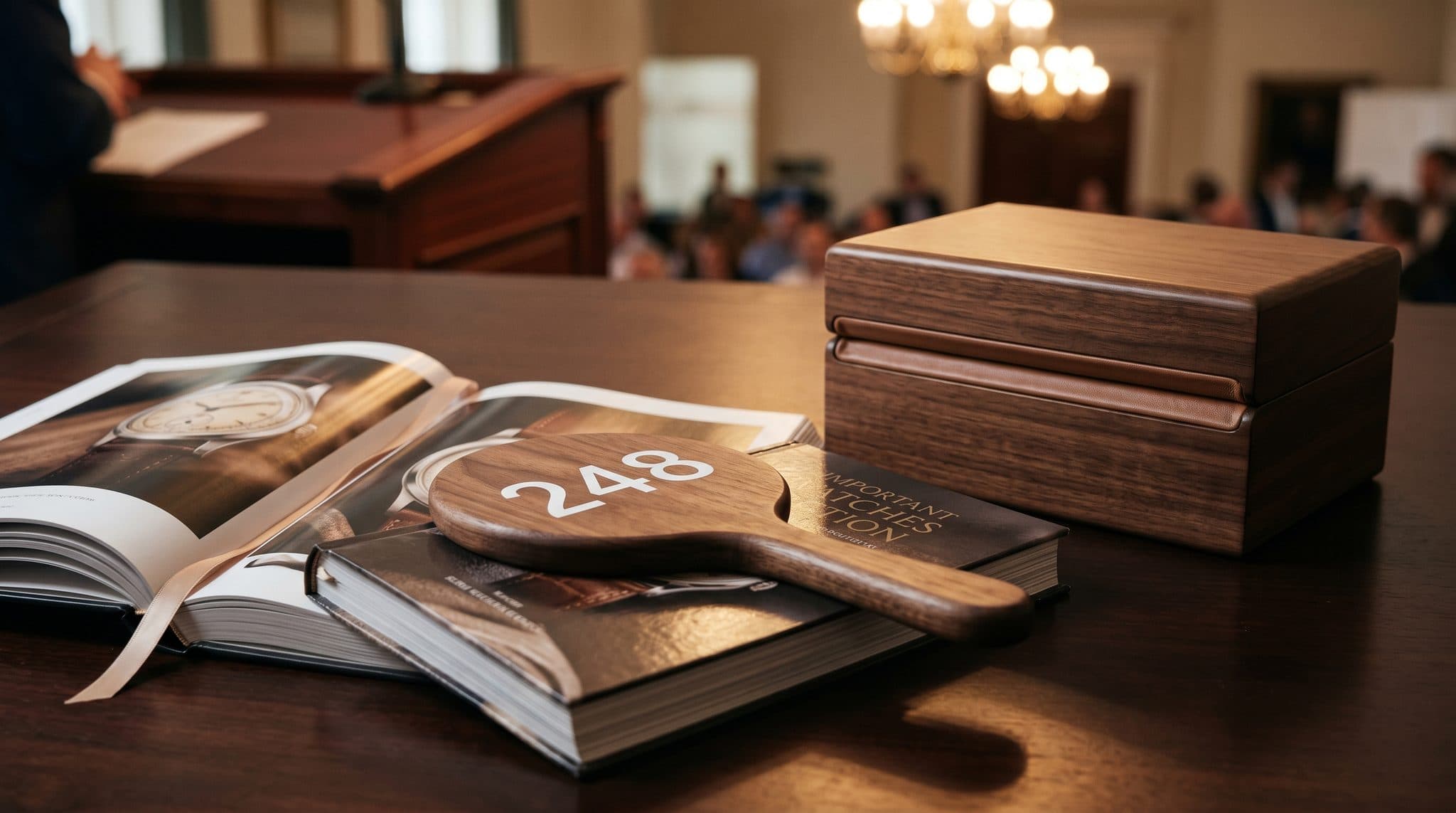
Auction psychology is real. Here is how to beat it.
Why Auctions Are the Smartest Way to Buy
Auctions — both online and in person — are where informed buyers find the best deals on pre-owned luxury watches. Unlike fixed-price listings where the seller sets the terms, auctions let the market determine value in real time. The result is that buyers often pay 10 to 25 percent less than dealer asking prices for the same reference in comparable condition.
But auctions also carry risk. Bidding wars, buyer premiums, and the adrenaline of a ticking clock can push unprepared buyers well past market value. The difference between a great deal and an expensive mistake comes down to preparation.
Whether you are bidding on your first watch or your fiftieth, this guide gives you the framework to win confidently and within budget. For the complete buyer's playbook, start with our Ultimate Guide to Buying a Pre-Owned Luxury Watch Online.
Step 1: Research the Watch Before the Auction Opens
The most important work happens before you place a single bid. For every lot you are considering:
- Study recent sold prices. Check completed auction results — not asking prices — for the same reference. Chrono24 sold listings, auction house archives, and WatchCharts provide real transaction data. Compile at least five to ten comparable sales to establish a price range.
- Identify the exact reference. A Rolex Submariner 116610LN is not the same as a 126610LN. Small reference differences can mean thousands in value. Confirm the reference number, production year, and any dial or bezel variants.
- Assess condition from the listing. Read every word of the condition report. Study every photograph. Is the case polished or unpolished? Are the hands and dial original? Is the bracelet complete with all original links? Condition drives value — a polished example of a reference might be worth 20 to 30 percent less than an unpolished one.
- Check completeness. Does the lot include box and papers? Original warranty card? Hang tags? A complete set commands a measurable premium over a watch-only example.
Step 2: Set Your Maximum Bid — and Write It Down
This is the single most important discipline in auction buying. Before the auction opens, determine the absolute maximum you are willing to pay — including the buyer premium and any applicable taxes or shipping — and write it down. Not a mental note. Write it on paper or type it into your phone where you will see it during the auction.
Why write it down? Because auction environments are specifically designed to create urgency and emotional engagement. When you are three minutes from the close and someone outbids you by fifty dollars, your brain shifts from rational analysis to loss aversion. The written number is your anchor to reality.
How to Calculate Your Maximum
- Start with the median recent sold price for the reference in comparable condition
- Adjust for condition, completeness, and any unique characteristics (rare dial variant, desirable serial range)
- Subtract the buyer premium percentage (typically 5 to 15 percent depending on the platform)
- That adjusted number is your hammer-price ceiling — the most you can bid before the premium pushes you over budget
Step 3: Understand Buyer Premiums and Total Cost
Every auction platform charges a buyer premium — a percentage added on top of the hammer price (your winning bid). This is how the platform makes money, and it is non-negotiable.
Typical buyer premium ranges (published rates, September 2026):
- Major auction houses (Phillips, Christie's, Sotheby's, Bonhams): 28 to 30 percent on a typical watch, on a sliding scale where the first tier is highest
- Online watch auctions (Grey Market 7 percent, Loupe This 10 percent, Grailzee 5 percent with a $250 minimum)
- Marketplaces (eBay, Chrono24, Bezel): usually no buyer premium, with the fee charged to the seller instead
A watch with a hammer price of $10,000 at a major house costs $12,800 after premium. The same watch winning at $10,000 on Grey Market costs $10,700. This difference alone can save you thousands, which is one reason peer-to-peer auction platforms are gaining market share.
Step 4: Choose Your Bidding Strategy
There are two dominant approaches, and both have merit depending on the situation:
Early Bid (Anchoring)
Place your maximum bid early and let the platform's proxy bidding system defend your position. The advantage: you set an anchor that may discourage casual bidders from competing. You also avoid the stress of last-minute timing. The disadvantage: your bid activity signals demand and can encourage others to bid higher than they otherwise would have.
Late Bid (Sniping)
Wait until the final minutes — or seconds — to place your bid. The advantage: you avoid driving up the price through extended back-and-forth bidding. Other bidders may not have time to react. The disadvantage: many platforms extend the auction by several minutes if a bid is placed in the final moments, which can neutralize the sniping advantage. You also risk technical failures (slow internet, page not loading) that cause you to miss the window entirely.
Which Strategy Wins?
For most buyers on most platforms, a hybrid approach works best: monitor the auction without bidding, then place your maximum bid with five to ten minutes remaining. This limits price escalation while giving you enough buffer to handle platform extensions or technical issues.
Step 5: Read the Terms Before You Bid
Every auction platform has terms that govern what happens after you win. Before you bid, confirm:
- Payment deadlines. Most platforms require payment within 48 to 72 hours of winning. Missing this deadline can result in forfeiture and account penalties.
- Return policy. Some platforms offer a brief inspection period (24 to 72 hours after delivery) during which you can return the watch if it materially differs from the listing description. Others sell as-is. Know which you are dealing with.
- Shipping and insurance. Understand who pays for shipping and insurance, and what coverage is provided during transit.
- Authentication guarantees. Does the platform authenticate before listing? Is there a post-sale dispute process? Platforms with pre-sale authentication (like Grey Market) reduce your risk significantly.
Step 6: Watch the Auction — But Stay Disciplined
On auction day, log in early and confirm your account is in good standing. If you are using proxy bidding, your maximum should already be set. If you are bidding live, have your written maximum visible.
Common traps to avoid:
- Revenge bidding. Someone outbids you and you bid again out of spite, not strategy. If your maximum is $8,000 and the price is at $8,200, let it go. Another example of the same reference will appear.
- Round-number anchoring. Bidders cluster around round numbers ($5,000, $7,500, $10,000). Bidding $5,100 or $7,600 often wins against competitors who stopped at the round number.
- The "just one more bid" spiral. Each incremental bid feels small — just another $50 or $100. But after ten of those, you are $500 to $1,000 over your researched maximum. This is the most common way buyers overpay.
Step 7: After You Win
Congratulations — you have won the lot. Now execute cleanly:
- Pay promptly. Complete payment within the platform's deadline. Delayed payment damages your reputation and can result in the sale being canceled.
- Confirm shipping details. Provide accurate delivery information and confirm insurance coverage. For high-value watches, signature-required delivery is non-negotiable.
- Inspect immediately upon receipt. Compare the watch to every listing photo. Check the serial number, case condition, dial, hands, bracelet, and included accessories against the condition report. If anything does not match, document it with photos and contact the platform within the return window.
- Insure the watch. Standard homeowners insurance typically undercovers luxury watches. Specialized coverage from providers like Hodinkee Insurance ensures full replacement value.
The Bottom Line
Watch auctions reward preparation and punish emotion. The buyers who consistently find the best deals are not the ones with the deepest pockets — they are the ones who research the reference, set a firm maximum, understand the total cost including premiums, and walk away when the price exceeds their number.
Ready to start? Browse current auctions on Grey Market, or read our full buyer's guide for everything from authentication to condition assessment to scam prevention.
Reference guides
Deep dives on the references discussed in this story:
- Rolex Submariner 116610LN (2010–2020)
- Rolex Submariner 126610LN (2020–present)